Reactivity & aggression
Resource Guarding in Dogs: Why Dogs Guard Food, Toys & People
Why dogs guard their food bowls, toys and favorite people, what the warning signs look like, and how to reverse guarding safely with trades, not confrontation.
Key takeaways
- Resource guarding is a normal canine behavior that protects valuable things, but it can escalate to bites if it is handled with confrontation.
- Early signs include stiffening, eating faster, freezing, whale eye and a lowered head over the item, often before any growl.
- Taking food or toys away to 'show who is boss' teaches dogs that people really are a threat to their things, which makes guarding worse.
- Trading up and adding good things as you approach change your dog's feelings, so your approach starts to predict a bonus rather than a loss.
- Guarding that involves bites, children, or other dogs in the household calls for strict management and help from a qualified professional.
Jump to a section
- What is resource guarding?
- Why dogs guard resources
- Signs of resource guarding: the warning ladder
- Dog guarding food
- Dog guarding toys and chews
- Dog guarding owner or places
- How to treat resource guarding: a step-by-step plan
- Management and safety, especially with children
- When guarding calls for professional help
- What to do next
Resource guarding in dogs is when a dog uses body language, growling, snapping or biting to keep people or other animals away from something he values, such as food, chews, toys, resting spots or even a favorite person. It is a normal canine behavior, but it can become dangerous, and how you respond decides whether it improves or escalates.
The instinct to confront a guarding dog is understandable, yet it is exactly what tends to make guarding worse. Below you will learn the subtle early signs, why dogs guard, how to handle food, toy and person guarding, and a step-by-step plan for changing how your dog feels when you come close. Guarding is one of the more serious dog behavior problems, so safety comes first throughout.
What is resource guarding?
Resource guarding, sometimes called possessive aggression, is a dog's attempt to keep control of something valuable when he believes it might be taken. What counts as valuable is up to the dog. It might be a bowl of kibble, a stolen sock, a bully stick, a bed, a doorway or a specific human.
In the wild, holding on to food and resources is a survival skill. In our homes, the same behavior can lead to bites, especially to children who do not recognize the warning signs.
Why dogs guard resources
Several factors make a dog more likely to guard:
- Genetics and temperament. Some dogs are simply more inclined to protect things.
- Scarcity history. Dogs who competed for food in a litter, a shelter or on the street may have learned that resources can run out.
- Learning. If people often take things away, especially by force or by chasing, the dog learns that human approach predicts loss.
- Value. High-value items, such as raw bones, stolen food or new toys, trigger more guarding than ordinary ones.
- Pain or illness. A dog who is sore or unwell has less tolerance, and some medical conditions increase hunger.
Vet check: If guarding appears suddenly in an adult dog, or comes with changes in appetite, weight, drinking or energy, book a veterinary exam. Pain, dental disease and some hormonal or digestive conditions can increase guarding.
Signs of resource guarding: the warning ladder
Most guarding dogs give clear signals before they bite, but early signals are easy to miss. Learning them lets you step back before things escalate.
| Signal | What it looks like | What it means |
|---|---|---|
| Eating faster | Gulping food as you approach | Mild worry about losing the item |
| Body over the item | Head lowers, body curves around the bowl or chew | "This is mine" |
| Freeze | Sudden stillness, mouth closed | Serious warning; stop moving toward the dog |
| Whale eye | Whites of the eyes visible as the dog looks sideways | Significant stress |
| Hard stare | Direct, fixed eye contact | Escalating threat |
| Lip lift or growl | Front teeth showing, low rumble | Clear request for distance |
| Snap or air snap | Quick bite at the air or a near miss | Final warning |
| Bite | Contact with teeth | Previous warnings did not work |
Read more about the whale eye and hard stares that often appear in guarding, and the full warning signs before a bite.
Safety note: Never punish a growl. Growling is information. Punishing it can teach your dog to skip warnings and bite without notice. Learn more about why dogs growl and what to do.
Dog guarding food
Food guarding is the most common form. You may notice your dog eating faster, stiffening or freezing when someone walks past, or growling when you approach the bowl.
Dog growls when near the food bowl
If your dog growls when you walk near the food bowl, stop, move away calmly and let him finish. You have just learned where his comfort line is, and the growl itself is useful communication you never want to punish. From now on:
- Feed him in a quiet place where nobody needs to walk past, such as behind a gate or in a crate.
- Do not reach into the bowl, take it away mid-meal or let children near him while he eats.
- Start the "approach and toss" exercise below from a distance where he stays relaxed.
Myth: "You should be able to take your dog's food away at any time." Old advice suggested regularly removing the bowl to establish leadership. This teaches dogs that people are a threat to their food and can create the guarding it was meant to prevent. Read why dominance-based training is outdated.
Dog guarding toys and chews
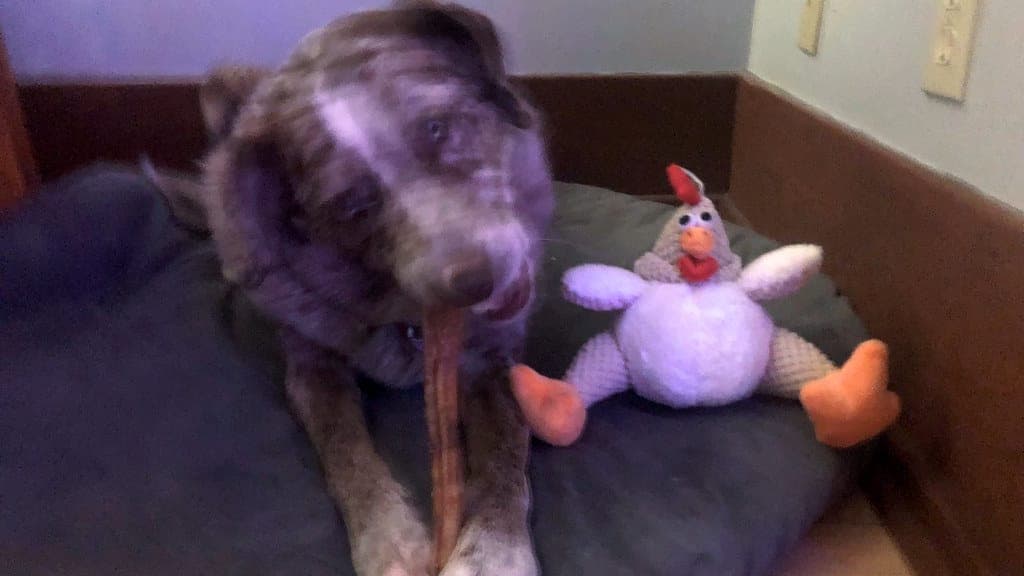
Toy and chew guarding often involves high-value items such as bully sticks, antlers, stuffed food toys or something the dog stole, like a tissue or sock. Chasing a dog who has grabbed something forbidden turns it into a high-stakes game and teaches him to guard harder next time.
Instead, trade. Teach a "drop" or "trade" cue using food, so giving up an object is always profitable. Most of the time, give the item straight back. Your dog learns that letting go does not mean losing.
Dog guarding owner or places
Some dogs guard furniture, beds, doorways, crates or a specific person. A dog might growl when another dog approaches you on the sofa, or stiffen when your partner sits beside you. This is often mislabeled as jealousy or "protecting" you, but it is usually guarding a resource: your attention, your lap or a comfortable spot.
Management is simple and effective. Invite the dog off furniture with a treat tossed onto the floor rather than pushing or pulling him off. Give him a comfortable bed of his own, and teach a "go to mat" cue. If guarding involves another dog in the household, read about dog aggression toward other dogs, as household tension often starts over resources.
How to treat resource guarding: a step-by-step plan
This plan uses desensitization and counter-conditioning. The goal is for your approach to predict something great, so your dog feels happy rather than worried when you come near his things. Work only at levels where your dog stays relaxed. If he freezes, stiffens or growls, you are too close.
- Find the starting distance. Note how close you can get while your dog is eating before he changes his eating speed, body posture or eye contact. Start well outside that distance.
- Approach and toss. Walk toward your dog while he eats or chews, toss a piece of something better than what he has (such as chicken) toward him, then walk away.
- Repeat until he looks up happily. When your dog begins to glance up with a relaxed, expectant face as you approach, you are ready to move a little closer.
- Shrink the distance gradually. Over many sessions, toss from closer, then drop the treat near the bowl, then eventually into the bowl.
- Teach a trade cue. Away from meals, offer a low-value toy, then say "trade," present a treat at his nose, and give the toy back after he eats. Build to higher-value items slowly.
- Generalize. Practice with different people (adults only, if there is any bite history), different rooms and different items.
- Keep management in place. Even as training progresses, feed high-value chews in a safe space where nobody will disturb your dog.
Management and safety, especially with children
Management prevents bites while you train and is often the most important part of the plan.
- Feed and give chews behind a closed door, gate or in a crate.
- Pick up toys and chews when they are not in use if they trigger guarding.
- Teach children never to approach a dog who is eating, chewing or resting, and supervise all interactions. Our guide to dogs, kids and bite prevention explains how to set up a safe home.
- Avoid situations where your dog might find something valuable, such as an open trash can.
When guarding calls for professional help
Get a qualified professional involved if your dog has bitten, if guarding is aimed at children, if it is getting worse, or if you feel unsafe working through the steps. A certified behavior consultant or veterinary behaviorist can assess the bite risk, build a tailored plan and work alongside your vet. Our guide to dog aggression and safe next steps explains more about assessing risk.
What to do next
Start today with management: give your dog a safe place to eat and chew where nobody bothers him. Then spend a few days watching for the earliest guarding signals, before any growl. Once you know where your dog's comfort line is, begin approach-and-toss practice from well outside it. Your aim is simple: a dog who looks up happily when you walk past, because you always bring something good.
Frequently asked questions
Is resource guarding normal in dogs?
Yes. Protecting valuable resources is a normal, adaptive behavior found in wild canids and most domestic dogs to some degree. It becomes a problem when the intensity puts people or other animals at risk, when it is directed at family members, or when it spreads to more items and places. Mild guarding can usually be improved with careful, reward-based training.
Should I take my dog's food away to stop resource guarding?
No. Repeatedly taking food away, or putting your hand in the bowl to prove you can, teaches your dog that people approaching the bowl really do mean loss. That increases guarding and bite risk. Instead, approach and add something better to the bowl, then walk away, so your approach predicts good things.
Can resource guarding be cured?
Many dogs improve a great deal, especially when guarding is caught early and handled with desensitization and counter-conditioning. Some dogs will always need management, such as eating in a separate room or having chews only when crated. The goal is a dog who is relaxed when people are near his things and who willingly trades items when asked.
Do puppies resource guard?
Yes, puppies can guard food, chews and toys, sometimes learned while competing with littermates. Early, gentle practice helps: approach and drop a treat in the bowl, trade toys for food and give them back often, and never chase a puppy who grabs an object. Seek help if a puppy freezes, growls hard or snaps, because these patterns are easier to change early.
Sources & further reading
- Donaldson, J. (2002). Mine! A Practical Guide to Resource Guarding in Dogs. Kinship Communications.
- Jacobs, J. A., Coe, J. B., Pearl, D. L., Widowski, T. M., & Niel, L. (2018). Factors associated with canine resource guarding behaviour in the presence of people: A cross-sectional survey of dog owners. Preventive Veterinary Medicine, 161.
- Mohan-Gibbons, H., Weiss, E., & Slater, M. (2012). Preliminary investigation of food guarding behavior in shelter dogs in the United States. Animals, 2(3), 331-346.
- American Veterinary Society of Animal Behavior. (2008). Position Statement on the Use of Dominance Theory in Behavior Modification of Animals. AVSAB.
This guide is for education only and does not replace an in-person assessment. If your dog's behavior changes suddenly, or you are worried about bites or aggression, speak to your veterinarian or a qualified behavior professional. See our disclaimer.