Body parts
Dog Eye Signals: Whale Eye, Soft Eyes, Hard Stares and What They Mean
Your dog's eyes reveal comfort, worry and warning. Learn to spot whale eye, soft eyes, hard stares and dilated pupils.
Key takeaways
- Whale eye, a crescent of white sclera visible while the dog's head is turned away, usually signals stress, discomfort or guarding.
- Soft eyes with relaxed lids, an almond shape and normal blinking indicate a calm, comfortable dog.
- A hard, unblinking stare, often with a frozen body, is a warning and can come shortly before a bite.
- Looking away is often a polite calming signal, not rudeness, guilt or disobedience.
- Dilated pupils reflect high arousal from fear, excitement or pain, so read them alongside the rest of the body and the lighting.
Jump to a section
Whale eye in dogs is when you can see a half-moon of white (the sclera) around the edge of the eye, usually because the dog has turned his head away but kept his eyes fixed on something. It's a common sign of stress, discomfort or guarding, and it often appears just before a growl or snap.
Eyes are among the most expressive parts of dog body language, but they're easy to overlook because the changes are small: a slight widening, a fixed gaze, a blink. This guide explains whale eye, soft eyes, hard stares, averted gaze and dilated pupils, plus how and when it's safe to look a dog in the eyes.
Whale eye dog meaning
Whale eye (also called half-moon eye) happens when a dog's eyes are pulled toward the corner while the head faces a different direction. The white of the eye becomes visible as a crescent. It reflects a dog who is monitoring something he's worried about without turning to face it directly.
Typical situations where whale eye appears:
- A child or adult hugging the dog
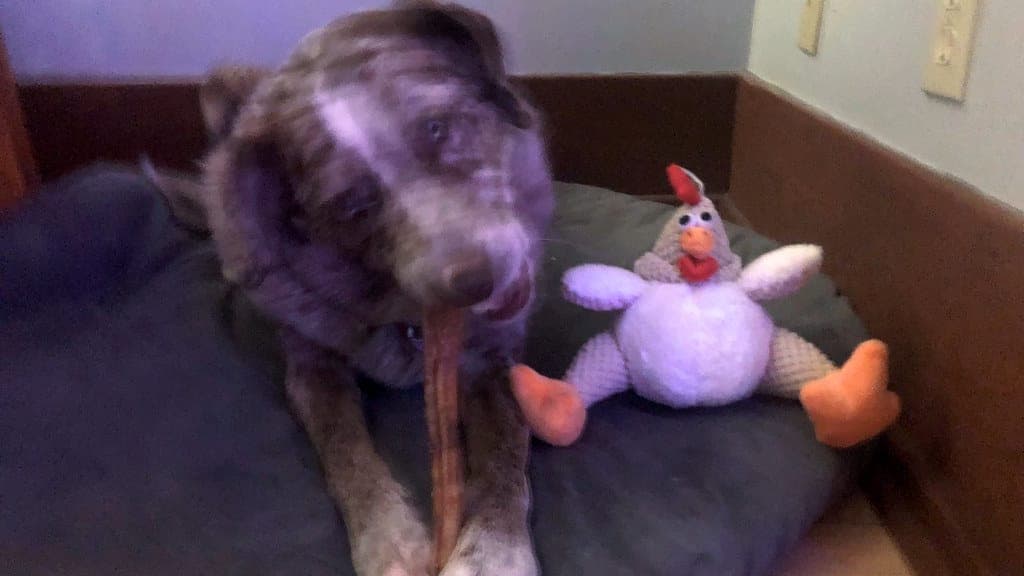
- Someone approaching while the dog has a bone, toy or food bowl
- A dog being cornered on a sofa or in a crate
- Handling at the vet or groomer
- Another dog getting too close during rest
When guarding is involved, whale eye often comes with a freeze over the item and a lowered head. That pattern is an early sign of resource guarding, which responds well to humane, reward-based training.
Safety note: Whale eye in a dog who is being hugged or held is one of the most commonly missed warnings in family bites. Teach children to stop and step back when they see the whites of a dog's eyes. Our dog bite prevention guide for families has simple rules kids can learn.
When whites of the eyes don't mean stress
Not every glimpse of sclera is whale eye. Many flat-faced breeds, such as Pugs and Shih Tzus, show white naturally because of their eye shape. A relaxed dog glancing up at you from a lying position, or rolling his eyes to follow you across the room, may show some white too. Look for the combination: head turned away, eyes fixed, body still or tense.
Dog soft eyes
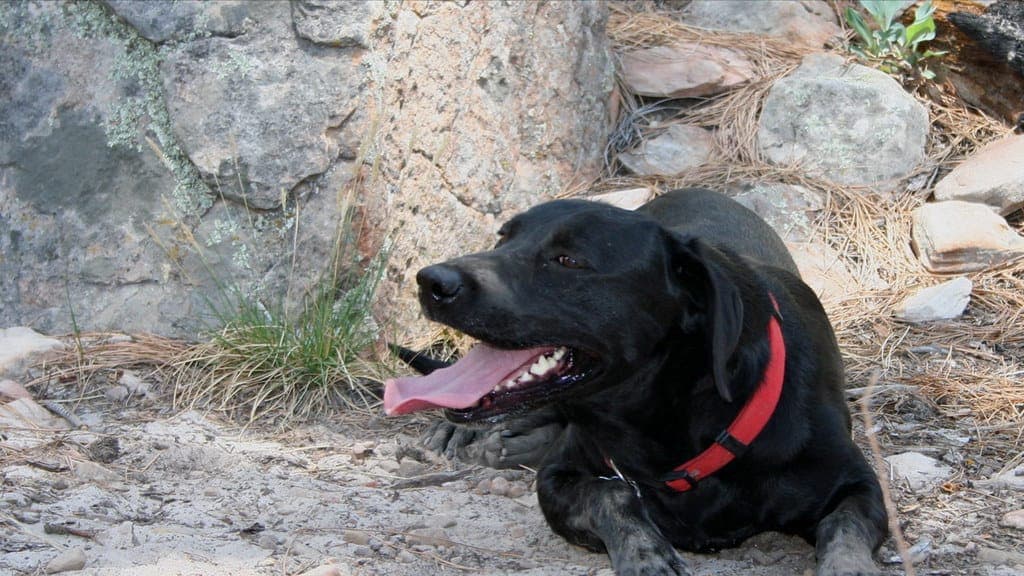
Soft eyes are the visual signature of a comfortable dog. The lids are relaxed, the eye shape is almond-like or slightly squinted, blinking is normal and the gaze moves freely. You'll usually see them alongside a loose, slightly open mouth and natural ear carriage.
Soft eyes are especially easy to spot during greetings with loved ones, when the eyes often narrow into a friendly squint. Combined with a wiggly body and relaxed facial expression, they're one of the best indicators that a dog is happy with what's happening.
Squinting: friendly or painful?
A brief squint in a social context is usually appeasing or friendly. But persistent squinting, especially of one eye, with tearing, redness or rubbing at the face, can indicate eye pain, injury or infection.
Vet check: Persistent squinting, cloudiness, redness, discharge, a visible third eyelid, or pupils of different sizes all need prompt veterinary attention. Eye problems can worsen quickly.
Dog hard stare
A hard stare is a fixed, direct, unblinking gaze, usually with a still body and closed mouth. The eyes may look rounder or slightly narrowed and intense. It's a clear message: "stop" or "back off." That is very different from the soft, blinking gaze your own dog gives you across the room, which we unpack in why does my dog stare at me.
Hard stares often appear as part of a freeze, a moment of total stillness that can come just before a lunge, snap or bite. You'll see them between dogs over resources, at a doorway, or toward a person approaching a dog who doesn't want company. Learn how this fits into the escalation sequence in our guide to aggressive dog body language.
Hard stare versus intense focus
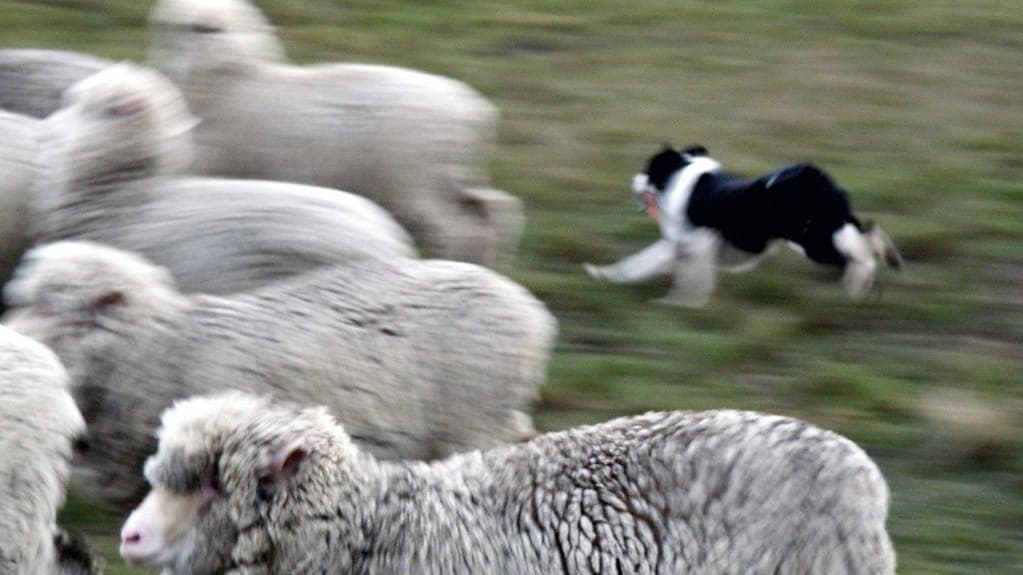
Not every fixed gaze is a threat. Herding breeds such as Border Collies use a crouched, intense "eye" when working livestock or playing with a ball, and many dogs stare fixedly at a toy waiting for it to be thrown. The difference lies in the body: a ball-obsessed dog is typically crouched and quivering with anticipation and will explode into motion, while a threatening dog is rigid with weight shifted forward or held still over something. Our guide to dog posture explains how to read that difference.
Dog avoiding eye contact
Looking away is one of the most common calming signals. In dog-to-dog communication, a direct stare can be confrontational, so turning the eyes or head aside is a polite way to say "I'm not a threat" or "let's keep this calm." Trainer Turid Rugaas described this as one of the core calming signals dogs use to defuse tension.
Your dog may avoid your eyes when you:
- Lean over or toward him
- Speak sharply or sound frustrated
- Stare at him while giving a cue
- Hold him still for grooming or handling
Teaching eye contact kindly
If you'd like your dog to look at you more, build it with rewards rather than pressure. Simply mark and reward the moments your dog glances at you on her own, or teach a "look" or "watch" cue by holding a treat near your face and rewarding the instant her eyes meet yours. Keep sessions short and your expression soft.
Never hold a dog's head or muzzle to force eye contact. For a worried dog, being made to meet a gaze is a stressor in itself, and a dog who avoids your eyes is often communicating politely, not ignoring you. Voluntary check-ins, offered because looking at you pays off, are far more useful on walks than enforced staring.
Guilty-looking eyes and what they really mean
Averted eyes, lowered head and ears back after a mishap are often interpreted as guilt. In a well-known study, Alexandra Horowitz (2009) found the "guilty look" was driven more by owners scolding their dogs than by whether the dog had actually disobeyed. The dog is appeasing in response to your body language, not confessing. Read more in our article on whether dogs feel guilty.
Dog dilated pupils meaning
Pupils widen when the sympathetic nervous system kicks in, the body's "fight or flight" system. In dogs, dilated pupils can reflect:
- Fear or anxiety, often with whale eye, ears back and a tense mouth
- High excitement, such as just before a ball is thrown or during intense play
- Pain, especially sudden or severe
- Low light, a normal physiological response
Because dilation has so many causes, it's a supporting clue rather than a standalone message. A dog with wide pupils, a closed mouth, a still body and whale eye is very likely afraid or stressed. A dog with wide pupils, a play bow and a wiggly body is probably just thrilled.
Should you look a dog in the eyes?
It depends on the dog and the kind of look.
With unfamiliar dogs: avoid a direct, sustained stare. Many dogs find it intimidating, especially when it comes from a stranger leaning over them. Look slightly to the side, keep your body turned partly away and let the dog choose to approach. Blinking slowly and glancing away now and then helps you look less threatening.
With your own dog: soft, relaxed mutual gaze is part of the human-dog bond. A study by Nagasawa and colleagues (2015) found that mutual gazing between dogs and their owners was associated with rising oxytocin levels in both. If your dog often looks up at you with soft eyes, you can read more about the reasons in our article on why your dog stares at you.
What to avoid: never try to "stare down" a dog to establish control. Prolonged staring at a dog who is already tense can provoke a bite, and it's based on outdated dominance ideas rather than how dogs actually communicate.
Eye signals at a glance
| Eye signal | Likely meaning | What to do |
|---|---|---|
| Soft, almond-shaped, normal blinking | Relaxed, comfortable | Carry on |
| Friendly squint during greeting | Appeasing, affectionate | Greet calmly |
| Whale eye (crescent of white) | Stress, discomfort, guarding | Stop and give space |
| Hard, fixed, unblinking stare | Warning, threat | Freeze your movement, then calmly increase distance |
| Looking away, turning head | Calming signal, avoiding conflict | Soften your posture, reduce pressure |
| Dilated pupils | Arousal: fear, excitement or pain | Check the rest of the body and the lighting |
| Persistent squint or one-sided changes | Possible eye pain or illness | See a vet |
What to do next
Next time your dog is relaxing, look at his eyes and memorize what "soft" looks like for him. Then watch for changes: when someone walks past his food bowl, when you pick him up, when a visitor arrives. If you spot whale eye or a hard stare, pause, give space and note what triggered it, because that trigger is your training starting point.
If your dog regularly freezes, stares hard or shows whale eye around people or other dogs, a qualified behavior professional can help you build a plan using desensitization and counter-conditioning.
Frequently asked questions
What does whale eye mean in dogs?
Whale eye means a dog is showing the whites of the eyes in a half-moon shape, usually because the head is turned away while the eyes stay fixed on something. It typically signals stress, discomfort or guarding, such as when a dog is hugged, cornered or protecting a bone. Stop what you're doing and give the dog space.
Should you look a dog in the eyes?
Avoid staring into the eyes of an unfamiliar dog, because a direct, sustained stare can feel threatening to dogs. Look slightly to the side, keep your face soft and let the dog approach. With your own dog, relaxed mutual gazing during calm moments is normal and has been linked to bonding, as long as your dog's eyes and body stay soft.
Why does my dog avoid eye contact with me?
Dogs often look away to avoid conflict and to signal that they mean no threat, especially when someone leans over them, raises their voice or stares. Looking away is polite in dog communication. If your dog avoids eye contact more than usual, check whether something in your tone or the environment feels tense, and consider whether pain could be a factor.
What do dilated pupils mean in a dog?
Dilated pupils usually reflect arousal: fear, stress, excitement or pain all trigger the sympathetic nervous system and widen the pupils. Low light also dilates them. Read pupils alongside the ears, mouth and posture. If one pupil is larger than the other, or the pupils stay dilated in bright light, contact your vet promptly.
Sources & further reading
- Nagasawa, M., Mitsui, S., En, S., Ohtani, N., Ohta, M., Sakuma, Y., Onaka, T., Mogi, K., & Kikusui, T. (2015). Oxytocin-gaze positive loop and the coevolution of human-dog bonds. Science, 348(6232), 333-336.
- Horowitz, A. (2009). Disambiguating the 'guilty look': Salient prompts to a familiar dog behaviour. Behavioural Processes, 81(3), 447-452.
- Rugaas, T. (2006). On Talking Terms With Dogs: Calming Signals (2nd ed.). Dogwise Publishing.
- Handelman, B. (2008). Canine Behavior: A Photo Illustrated Handbook. Dogwise Publishing.
- Horwitz, D. F., & Mills, D. S. (Eds.). (2009). BSAVA Manual of Canine and Feline Behavioural Medicine (2nd ed.). British Small Animal Veterinary Association.
This guide is for education only and does not replace an in-person assessment. If your dog's behavior changes suddenly, or you are worried about bites or aggression, speak to your veterinarian or a qualified behavior professional. See our disclaimer.