Signals & emotions
Aggressive Dog Body Language & the Warning Signs Before a Bite
Most dogs warn before they bite. Learn the ladder of aggression, the freeze, the growl and the snarl, and how to respond safely when you see them.
Key takeaways
- Most dogs give a series of warnings before biting, from subtle signals like lip licking and head turning up to freezing, staring, growling and snapping.
- The canine ladder of aggression shows how signals escalate when earlier ones are ignored, and dogs whose warnings are punished may skip rungs.
- Stiffening or freezing is often the last signal before a bite, so treat a sudden still, rigid dog as an emergency stop sign.
- Never punish growling or teeth showing; doing so removes the warning, not the underlying fear or discomfort.
- If a dog shows aggression, stop, give space, avoid staring and move away slowly, then involve a vet and a qualified behavior professional.
Jump to a section
Aggressive dog body language usually includes a stiff or frozen body, a hard stare or whale eye, a closed and tense mouth, raised hackles, a lifted lip or snarl showing the teeth, and a low growl. Most dogs work up to these signals gradually, starting with subtler signs such as lip licking and turning away, and they use them to say "back off" before resorting to a bite.
Understanding that sequence is the key to bite prevention. Aggression in dogs is almost always communication, driven most often by fear, pain, guarding or frustration, and it is rarely random. This guide builds on the whole-dog approach in our complete guide to dog body language and shows you how to recognize warnings early and respond safely.
Why dogs show aggression
Aggressive body language is a set of distance-increasing signals. The dog wants something to stop or go away: a person reaching for her food bowl, a stranger approaching her owner, a hand touching a painful hip, another dog crowding her space.
Common motivations include:
- Fear: the most common driver of aggression. A frightened dog who cannot escape may choose to fight.
- Pain or illness: sore joints, ear infections, dental disease and many other conditions lower tolerance.
- Resource guarding: protecting food, toys, resting spots or people; see our guide to resource guarding.
- Frustration: being restrained on leash or behind a barrier while wanting to reach something.
- Territorial or protective responses: reacting to perceived intruders at home or near the family.
Our in-depth guide to types of dog aggression covers causes and treatment in detail. Here we focus on what aggression looks like.
Myth: "Aggressive dogs are trying to be dominant." Most aggression is defensive and rooted in fear or discomfort, not a bid for status. Treating it as a dominance problem with confrontational methods tends to increase fear and escalate the behavior.
The canine ladder of aggression
The ladder of aggression, developed by UK veterinarian and behaviorist Kendal Shepherd, shows how dogs typically escalate their signals when a situation stays stressful. Read it from the bottom up.
| Rung | What you see | What it means |
|---|---|---|
| 1 | Yawning, blinking, nose licking | Mild discomfort, an early request to ease off |
| 2 | Turning the head away | "I am not looking for trouble" |
| 3 | Turning the body away, sitting, pawing | Stronger request for space |
| 4 | Walking away | Trying to leave the situation |
| 5 | Creeping, ears back | Increasing worry, trying to look small |
| 6 | Standing crouched, tail tucked | Clear fear |
| 7 | Lying down, belly up, leg raised | Appeasement; please stop |
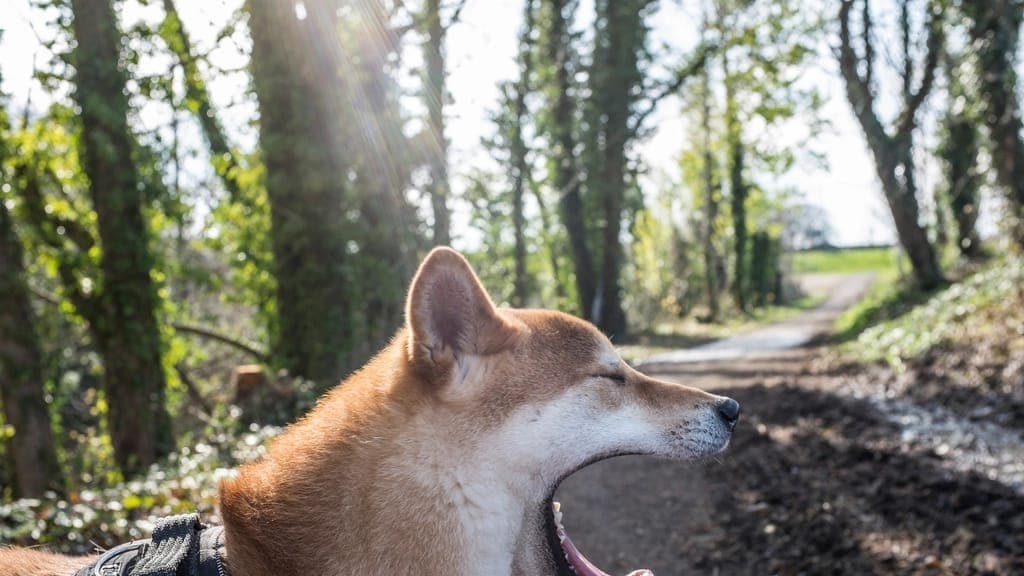
| 8 | Stiffening, staring | Last warning before escalation |
| 9 | Growling | Vocal warning: back off now |
| 10 | Snapping | Air snap or near miss, a final warning |
| 11 | Biting | The dog feels no other option has worked |
The lower rungs are the same behaviors described in our guide to calming signals. They are a dog's polite, low-cost way of avoiding conflict.
Dogs do not always climb one rung at a time. If quiet signals are repeatedly ignored, or if growls are punished, a dog may learn to skip straight to the top. Pain, sudden startle or a lack of escape options can also compress the whole ladder into a second or two.
Lunging, barking and charging
The ladder describes a dog who is close to the thing bothering her. When there is more distance, or a leash or fence in between, many dogs use a louder display instead: barking hard, lunging to the end of the leash, or charging toward a person or dog and pulling up short. In the escalation sequence, this sits alongside stiffening, staring and growling, rungs 8 and 9. It usually follows a quieter build-up of a forward freeze, fixed stare and closed mouth, and its aim is to make the trigger leave without any contact.
Most of these displays are driven by fear or frustration rather than a wish to fight, and many charges are bluffs that stop short. They still count as serious warnings, and a dog who is pushed past this point repeatedly can progress to snapping. The window for prevention is the moment you see the stare and the stillness, before the noise starts. Our guide to leash reactivity covers how to work on lunging and barking on walks.
Warning signs a dog will bite
Beyond the ladder, watch for these specific warning signs. Several together mean you should create distance immediately.
- Body: stiff, rigid and still; weight leaning forward or shifted sharply back.
- Eyes: a hard, fixed stare, dilated pupils, or whale eye with the head turned but the eyes locked on you.
- Mouth: closed and tight, lips pushed forward or pulled back, a lip lift, or a snarl.
- Ears: pinned back in fear or pricked hard forward in an offensive stance.
- Hackles: raised along the shoulders or back; our guide to raised hackles explains why this means arousal rather than aggression on its own.
- Tail: held high and stiff with a slow or fast flick, or tucked tight in a fearful dog.
- Sounds: a low, rumbling growl, often with a still body.
Offensive vs defensive aggression
Not all aggressive dogs look the same. A confident dog showing offensive aggression often leans forward, holds the tail high, pricks the ears forward and pushes the mouth corners (commissures) forward in a short, C-shaped snarl. A fearful dog showing defensive aggression usually leans back, tucks the tail, pins the ears and pulls the mouth corners back in a long snarl that shows the back teeth. Many dogs show a mix, which is a sign of conflict. For more on reading these whole-body cues, see our guide to dog posture.
Dog growling and showing teeth
A dog growling and showing teeth is giving a very clear, very valuable warning. She is saying, "Stop what you are doing, or I may have to escalate."
The lip lift is often the first visible tooth display: the upper lip rises slightly to show the canine tooth. A full snarl wrinkles the muzzle and exposes many teeth. Some dogs show their teeth silently; others pair a snarl with a growl.
Context matters. Play growls happen in a loose, bouncy body with a relaxed mouth, and some dogs show a "submissive grin" in friendly greetings. Our guide to why dogs growl explains how to tell play and warning growls apart.
Safety note: Never punish growling, snarling or teeth showing. These are warnings, and punishment teaches a dog to hide them, not to feel more comfortable. That is how dogs end up biting "without warning." Respect the warning, stop what you were doing, and work on the root cause.
Dog stiffening before a bite
The freeze is one of the most important signals to learn. Just before a bite, many dogs go suddenly and completely still: the body stiffens, breathing may pause, the mouth closes and the gaze becomes fixed or sideways. It may last only a fraction of a second.
You will see this, for example, when a child hugs a dog, when someone reaches toward a dog's food bowl, or when one dog approaches another who is guarding a chew. The dog is deciding what to do next.
If you see a freeze, stop moving immediately and calmly withdraw whatever was causing it: take your hand away, call the child back, or step away from the bowl. Do not lean in, stare, or try to "push through."
What to do if a dog shows aggression
If an unfamiliar dog is threatening you
- Stop moving. Running can trigger chase.
- Turn your side toward the dog and keep your arms close to your body.
- Look away. Watch the dog with your peripheral vision rather than staring.
- Stay quiet and calm. Avoid shouting or waving your arms.
- Back away slowly once the dog's attention shifts, without turning your back.
- Put something between you if possible, such as a bag, jacket, bike or bench.
- If knocked down, curl into a ball, cover your face and neck, and stay still.
If your own dog shows aggression
Stay calm, create space and end whatever triggered the warning, without scolding: a punished growl is a warning your dog may skip next time. Jot down what happened just before, use gates or a leash so the situation cannot repeat, and book a vet visit, because pain is a common hidden cause of sudden behavior changes.
What comes next is treatment rather than body language, and it is covered step by step in our guide to dog aggression: types, causes and treatment. Our comparison of dog trainers and behaviorists explains who is qualified to help.
Pro tip: Teaching your dog to wear a basket muzzle comfortably, using treats and positive reinforcement, is a smart safety step for any dog with a history of aggression. A well-fitted basket muzzle still lets her pant, drink and take treats.
Protecting children
Children are at highest risk of serious dog bites, and research on child-directed aggression has found that most bites involve a dog the child already knows, often the family dog. Common triggers include resource guarding, being disturbed while resting, and painful or startling handling.
Teach children to leave dogs alone when they are eating, sleeping or chewing, never to hug or kiss dogs, and to "be a tree" (stand still, hands folded, look at their feet) if a dog seems scary. Adults should actively supervise every interaction and watch for the lower rungs of the ladder. Our guide to dogs and kids covers bite prevention for families in detail.
What to do next
Learn the ladder well enough that you can spot the lower rungs: a lip lick, a head turn, a body turned away. Those early signals give you time to intervene long before a growl or a freeze.
If your dog has growled, snapped or bitten, take it seriously but do not despair. Book a vet exam to rule out pain, put simple management in place to keep everyone safe, and reach out to a qualified behavior professional. With an accurate diagnosis and a humane, structured plan, many dogs become far more comfortable and much safer to live with.
Frequently asked questions
What are the warning signs a dog will bite?
Common warning signs include a stiff or frozen body, a hard stare or whale eye, a closed tight mouth, ears pinned back or pricked hard forward, raised hackles, a lifted lip, a snarl showing teeth, and a growl. Before those, many dogs show quieter signals like lip licking, yawning and turning away. A dog who goes suddenly still is often moments from biting.
Do dogs always give a warning before they bite?
Most do, but the warnings can be subtle or very brief, and they are easy to miss. Dogs who have been punished for growling or snarling may learn to suppress those signals and appear to bite without warning. Pain, being startled awake, and some medical conditions can also shorten or remove the usual warning sequence.
What should I do the moment my dog growls or stiffens at someone?
Stop what you are doing and calmly increase distance, without scolding. Call or lure your dog away, or ask the person to step back, and avoid grabbing the collar of a tense dog. Give everyone a moment to settle, then note exactly what happened just before the warning. Those notes help a professional pinpoint the trigger and build a safe plan.
What should I do if a dog runs at me aggressively?
Stop moving and stand still with your side toward the dog, arms close to your body and gaze soft and lowered. Do not run, scream or stare. Many dogs will sniff and lose interest. If the dog stays, back away slowly without turning your back. If you are knocked down, curl into a ball, protect your face and neck, and stay still.
Can an aggressive dog be helped?
Many dogs who show aggression improve significantly with the right plan. Most aggression is driven by fear, pain, frustration or guarding, all of which can be addressed. Effective treatment combines a veterinary check for pain or illness, management to prevent incidents, and behavior modification using positive reinforcement under the guidance of a veterinary behaviorist or certified behavior consultant.
Sources & further reading
- Shepherd, K. (2002). Development of behaviour, social behaviour and communication in dogs. In D. F. Horwitz, D. S. Mills, & S. Heath (Eds.), BSAVA Manual of Canine and Feline Behavioural Medicine. British Small Animal Veterinary Association.
- American Veterinary Medical Association Task Force on Canine Aggression and Human-Canine Interactions. (2001). A community approach to dog bite prevention. Journal of the American Veterinary Medical Association, 218(11), 1732-1749.
- Reisner, I. R., Shofer, F. S., & Nance, M. L. (2007). Behavioral assessment of child-directed canine aggression. Injury Prevention, 13(5), 348-351.
- American Veterinary Society of Animal Behavior. (2007). Position Statement on the Use of Punishment for Behavior Modification in Animals.
- Overall, K. L. (2013). Manual of Clinical Behavioral Medicine for Dogs and Cats. Elsevier Mosby.
This guide is for education only and does not replace an in-person assessment. If your dog's behavior changes suddenly, or you are worried about bites or aggression, speak to your veterinarian or a qualified behavior professional. See our disclaimer.