Behavior Problems · Complete guide
Dog Behavior Problems: Causes, Humane Solutions & When to Get Help
Why dogs develop behavior problems, why ruling out pain comes first, and the humane, evidence-based way to change anxiety, reactivity, barking and more.
Key takeaways
- Most dog behavior problems are normal dog behaviors happening in the wrong place, at the wrong intensity, or driven by fear, frustration or unmet needs.
- Pain and illness sit behind a large share of behavior changes, so a veterinary check is the first step for any new, sudden or worsening problem.
- The humane hierarchy (LIMA) asks you to start with health, environment and positive reinforcement before anything more intrusive, and never to use pain or fear.
- Desensitization, counter-conditioning, management and teaching an alternative behavior are the core tools of modern dog behavior modification.
- Aggression, bites, severe anxiety or any problem that is not improving deserves a qualified professional such as a veterinary behaviorist or certified behavior consultant.
Jump to a section
- What counts as a dog behavior problem?
- Why dog behavior problems happen
- Rule out pain and illness first
- The humane hierarchy and LIMA: how to fix dog behavior problems
- Common dog behavior problems at a glance
- Anxiety & fear
- Reactivity & aggression
- Everyday problems
- Dog behavior modification: the core techniques
- Dog behavior training vs behavior modification
- Why punishment and dominance methods backfire
- Getting help: trainers, behavior consultants and veterinary behaviorists
- A step-by-step plan for any behavior problem
- What to do next
Dog behavior problems are behaviors that cause trouble for you, your dog or the people around you, such as barking, chewing, reactivity, anxiety or aggression. Almost all of them have an understandable cause: fear, frustration, boredom, pain or a habit that was accidentally rewarded. Fix the cause humanely, and the behavior usually follows.
That sounds simple, but the same behavior can mean very different things in different dogs. Barking at the window might be alert barking, frustration, or fear of strangers, and each needs a different plan. Below, you will learn how to tell the causes apart, why a vet check comes first, how the humane hierarchy guides every decision, and where to go next for each specific problem.
What counts as a dog behavior problem?
A dog behavioral issue is not a sign of a "bad dog." It is usually a normal canine behavior, such as barking, chewing, guarding, chasing or biting, that shows up in a setting, at an intensity or with a frequency that does not fit family life. A terrier digging in a field is being a terrier. The same dog digging through your sofa cushions every afternoon is a problem worth solving.
Behavior professionals tend to sort problems into three rough buckets:
- Normal behavior in the wrong place: jumping up, counter-surfing, chewing shoes, pulling on the leash.
- Emotional problems: fear, anxiety, phobias and frustration that drive barking, destruction, reactivity or avoidance.
- Safety problems: growling, snapping, biting or fighting, which put people or other animals at risk.
Understanding what normal dog behavior looks like helps you decide which bucket you are dealing with. Many owners discover that what they thought was defiance is actually a dog who is overwhelmed, under-exercised or physically uncomfortable.
Why dog behavior problems happen
Behavior never comes from nowhere. Every problem you see is the visible end of a chain that includes genetics, early experience, current environment, health and learning.
Emotions drive behavior
A frightened dog does what frightened animals do: tries to escape, freezes, or, when those fail, fights. A frustrated dog barks, spins or grabs things. When you understand the emotion, you understand the behavior. This is why learning dog body language is the single most useful skill for solving behavior problems, because the body tells you how your dog feels long before the problem behavior appears.
Unmet needs
Dogs need physical exercise, mental work, sniffing, chewing, social contact and rest. When any of these are missing, dogs invent their own outlets. A young working-breed dog who gets one short leash walk a day will often find "jobs" you will not like.
Learning history
Dogs repeat what works. If barking at the door makes the delivery driver leave, or jumping up gets your attention, the behavior is reinforced, even if the attention you give is a scolding. Behavior that is rewarded, even accidentally, grows stronger.
Genetics and early life
Breed tendencies, individual temperament and the quality of early socialization during the sensitive period (roughly 3 to 14 weeks) all shape how easily a dog copes with novelty. A dog with limited early exposure may find ordinary life frightening, which is why the socialization guide is closely linked to many of the problems below.
Trigger stacking
Stress adds up. A dog who copes fine with one stranger may snap after a vet visit, a thunderstorm and a crowded street in the same day. This trigger stacking explains many "out of the blue" incidents that were actually the final straw.
Rule out pain and illness first
Before any training plan, book a veterinary exam. This is not a formality. A review of the research by Mills and colleagues (2020) concluded that pain is under-recognized in dogs with problem behavior and estimated it may contribute to a substantial share of referral cases.
Pain lowers a dog's tolerance for handling, noise and other dogs. Itchy skin, sore joints, dental disease, ear infections, gastrointestinal discomfort, thyroid disease and age-related cognitive decline can all show up as irritability, guarding, house soiling, restlessness or sudden aggression.
Vet check: See your vet promptly if a behavior problem appeared suddenly, has worsened quickly, started after an injury or illness, or appears in a senior dog. Bring short videos of the behavior, a list of when it happens and any changes in eating, sleeping, toileting or movement.
If your dog has changed recently, read about sudden behavior changes and when to see a vet. Training cannot fix a sore hip, and no plan will succeed while your dog is hurting.
The humane hierarchy and LIMA: how to fix dog behavior problems
Modern behavior science offers a clear decision framework. The humane hierarchy, developed by behavior analyst Dr. Susan Friedman, ranks interventions from least to most intrusive. Professionals use it together with LIMA, which stands for "Least Intrusive, Minimally Aversive." The idea is simple: use the gentlest effective option first, and only move up if the gentler steps have genuinely been tried and failed.
The hierarchy runs roughly like this:
- Health, nutrition and physical condition. Address medical problems and comfort first.
- Antecedent arrangements. Change the environment so the problem is less likely: block window views, use baby gates, schedule walks at quieter times.
- Positive reinforcement. Reward the behavior you want to see more of.
- Differential reinforcement of alternative behaviors. Teach and reward a behavior that replaces the problem, such as sitting instead of jumping.
- Extinction, negative punishment and negative reinforcement. Used carefully and sparingly, only after the steps above.
- Positive punishment. At the very top, rarely if ever justified in companion dog training, and never involving pain, intimidation or fear.
In practice, almost every dog behavior problem can be solved within the first four levels. The American Veterinary Society of Animal Behavior (AVSAB) recommends reward-based training as the standard for all dogs and advises against aversive methods because of their risks to welfare and the human-dog bond.
Pro tip: Ask yourself three questions before trying anything new: Is my dog healthy and comfortable? Can I change the environment so this does not happen? What do I want my dog to do instead, and how can I reward it?
Common dog behavior problems at a glance
This table maps the most common dog behavior problems to their typical causes and the first humane step to try.
| Problem | Common causes | First humane step |
|---|---|---|
| Distress when left alone | Isolation fear, over-attachment, change in routine | Stop leaving the dog beyond his tolerance; start graduated absences |
| Fear of fireworks or thunder | Noise sensitivity, genetics, a single bad experience | Create a safe den, mask sound, talk to your vet before the season |
| Lunging and barking on leash | Fear, frustration, barrier frustration | Increase distance from triggers; pair triggers with food |
| Growling or biting people | Fear, pain, guarding, being cornered | Manage safety now; vet check; qualified professional |
| Fighting other dogs | Fear, guarding, poor social skills, household tension | Separate and manage; professional assessment |
| Guarding food, toys or places | Normal competition instinct, past loss of items | Stop taking things away; trade up; teach "drop" |
| Excessive barking | Alerting, boredom, demand, fear | Identify the bark type; meet the underlying need |
| Destructive chewing | Teething, boredom, anxiety | Provide legal chews; supervise and confine safely |
| Jumping on people | Greeting excitement, learned attention | Reward four paws on the floor; manage greetings |
| Puppy biting | Normal play and teething | Redirect to toys; build bite inhibition; enforce naps |
Each of these has a dedicated guide below, organized by the same groups used throughout the site.
Anxiety & fear
Fear and anxiety sit underneath a surprising number of behavior problems, including some that look like disobedience or "spite." The first step is learning to recognize what fear looks like in your individual dog, using our guides to the signs of stress in dogs and scared dog body language.
Separation anxiety
Dogs who bark, howl, pace, drool, try to escape or destroy doors and window frames only when left alone may be experiencing separation-related distress. It is a panic response, not revenge. Our dog separation anxiety training plan explains how to tell true separation anxiety apart from boredom, and how to build alone-time tolerance in tiny, carefully measured steps.
Fireworks, thunder and noise fear
Noise phobias are among the most common fear problems in dogs and often get worse with each exposure. If your dog trembles, hides, pants or tries to bolt during storms or celebrations, read how to help a dog scared of fireworks and thunder. It covers preparation, safe spaces, sound desensitization and when to ask your vet about medication support.
Myth: "Comforting a frightened dog rewards the fear." Fear is an emotion, not a trick, and calm comfort does not make it stronger. If your dog seeks you out during a storm, it is fine to help.
Reactivity & aggression
Reactivity and aggression are the problems most likely to strain the human-dog relationship and the ones where safety matters most. They are also deeply misunderstood. Most dogs who lunge, growl or snap are frightened or frustrated, not trying to dominate anyone.
Before working on any of these, learn the warning signs before a bite and why a dog's growl is valuable information that should never be punished.
Leash reactivity
A reactive dog overreacts to everyday triggers, often other dogs, people, bikes or cars, by barking, lunging and spinning on leash. Our reactive dog guide explains the difference between fear-based reactivity and barrier frustration, and walks you through threshold work and counter-conditioning on real-world walks.
Aggression toward people
Growling, snapping and biting are serious, but they are also communication. Our guide to dog aggression types and safe next steps covers fear aggression, pain-related aggression, territorial behavior and what to do if your dog suddenly bites, with clear advice on when professional help is essential.
Aggression toward other dogs
Some dogs are fine with people but struggle with other dogs, on leash, at the park or even at home. If you are living with this, read what to do when your dog is aggressive toward other dogs, which includes household fights and how to break up a dog fight as safely as possible.
Resource guarding
Stiffening over a food bowl, growling when you approach a chew, or blocking access to the sofa or a favorite person are all forms of resource guarding. It is a normal canine behavior that becomes dangerous when it escalates. Our guide to resource guarding in dogs explains how to reverse it with trades and positive associations instead of confrontation.
Safety note: If your dog has bitten, or if you feel you need to tiptoe around her, put management in place today (gates, leashes, muzzle training, no unsupervised contact with children) and contact a qualified professional. Do not try to "test" the behavior.
Everyday problems
Not every problem is rooted in fear. Many everyday frustrations are about unmet needs and accidental reinforcement, and they respond well to good management plus consistent reward-based training.
Barking
Dogs bark to alert, to demand, out of boredom, from fear and from frustration. Learning what different barks mean is the first step, and our guide on how to stop a dog from barking without punishment shows you how to match the solution to the bark.
Chewing and destruction
Chewing is a core canine need, especially for teething puppies and adolescent dogs. When it targets furniture, shoes or door frames, read why your dog is chewing everything and how to fix it. If destruction happens only when your dog is alone, separation anxiety is a strong possibility.
Jumping up
Jumping is a friendly greeting that gets rewarded by attention almost every time it happens. Our step-by-step guide on how to stop a dog from jumping on people shows you how to make "four on the floor" the behavior that pays.
Puppy biting
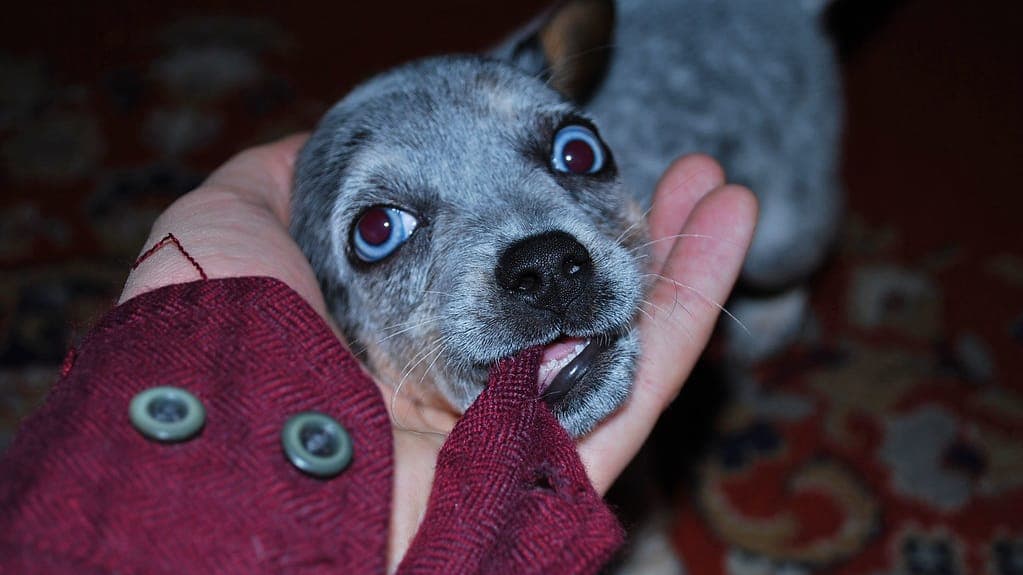
Mouthing is normal puppy behavior, but needle-sharp teeth hurt. Learn why puppy biting happens and how to stop it by redirecting to toys, building bite inhibition and recognizing the overtired puppy who needs a nap rather than more play.
Dog behavior modification: the core techniques
Dog behavior modification is the process of changing how a dog feels about something, and therefore how he behaves. It relies on a small set of well-researched techniques that work together.
Management
Management prevents the dog from practicing the problem while you train. Baby gates, frosted window film, a long line, a closed door, or simply avoiding the trigger all count. Every repetition of the problem strengthens it, so management is not "cheating"; it is part of the plan.
Desensitization
Desensitization means exposing your dog to a trigger at an intensity low enough that he notices it but stays relaxed, then increasing the intensity very gradually. The skill lies in staying below threshold, the point at which your dog can no longer think, eat or respond to you.
Counter-conditioning
Counter-conditioning pairs the trigger with something your dog loves, usually high-value food, so the trigger starts to predict good things. Over time, the emotional response shifts from "Oh no" to "Oh good." Desensitization and counter-conditioning are almost always used together.
Teaching an alternative behavior
Instead of only stopping a behavior, you teach and reward a better one: sit to greet, go to a mat when the doorbell rings, look at you when another dog appears. This is called differential reinforcement, and it gives your dog a clear way to succeed.
Enrichment and meeting needs
Sniff walks, food puzzles, chew items, scent games and appropriate play reduce the frustration and boredom that fuel many problems. A dog whose needs are met has less reason to invent his own entertainment.
Dog behavior training vs behavior modification
Owners often use these terms interchangeably, but they target different things. Dog behavior training usually means teaching skills and manners: sit, stay, come, loose-leash walking. Behavior modification addresses emotional responses such as fear, anxiety and frustration that sit underneath problem behaviors.
A dog who jumps on guests may only need training. A dog who barks and lunges at guests because he is frightened needs behavior modification, because no amount of "sit" practice will make a terrified dog sit calmly. Many plans combine both: you change the emotion and teach a reliable alternative behavior.
Why punishment and dominance methods backfire
It can be tempting to try a quick fix: a leash correction, a squirt bottle, a shock collar, or an "alpha roll." The evidence is clear that these methods carry real risks. Herron and colleagues (2009) found that confrontational techniques such as hitting, staring down or forcing a dog onto his back frequently provoked aggressive responses from the dogs they were used on. A review by Ziv (2017) concluded that aversive methods can harm welfare and are not more effective than reward-based training.
Punishment can suppress a behavior in the moment while increasing the fear or frustration behind it. It also suppresses warning signals: a dog punished for growling may learn to skip the growl and bite instead.
Much of the old advice rests on dominance theory, the idea that dogs are constantly trying to climb a pack hierarchy over their humans. Our article on the alpha dog myth explains why this view is outdated and how it leads owners to misread fear as defiance. AVSAB's position statement on dominance theory makes the same point.
Myth: "My dog knows he did wrong. Look at his guilty face." That look is an appeasement response to your body language and tone, not an admission of guilt. Read more about whether dogs feel guilty.
Getting help: trainers, behavior consultants and veterinary behaviorists
Knowing who to call saves time, money and stress. Credentials in the dog world vary widely, and titles such as "behaviorist" are not legally protected in many places.
- Your general practice veterinarian rules out medical causes and can discuss whether medication might support a behavior plan.
- Certified trainers (for example, CPDT-KA) are well suited to manners, puppy training and mild problems.
- Certified behavior consultants (for example, CDBC or CBCC-KA) and certified applied animal behaviorists (CAAB) handle fear, anxiety, reactivity and aggression.
- Veterinary behaviorists (board-certified through the American College of Veterinary Behaviorists) can diagnose, prescribe and manage complex or dangerous cases.
Our detailed comparison of a dog trainer vs a behaviorist explains the credentials and helps you decide who you need. You can also search for a veterinary behaviorist through the American College of Veterinary Behaviorists.
Whoever you hire, ask how they would handle a mistake. If the answer involves pain, fear, intimidation or "corrections," keep looking.
A step-by-step plan for any behavior problem
Whatever problem you are facing, this sequence follows the humane hierarchy and works as a starting framework.
- Describe the behavior precisely. Write down exactly what your dog does, not a label. "Barks and lunges at dogs within 20 meters on leash" is more useful than "aggressive."
- Book a vet exam. Rule out pain, illness and age-related changes, especially for new or sudden problems.
- Track the pattern. Note when, where, with whom and how often. Look for triggers and trigger stacking.
- Read the body language. Identify the earliest signs your dog is uncomfortable, such as a tight mouth, lip licking or a hard stare.
- Put management in place. Stop the rehearsals while you work on the problem.
- Meet your dog's needs. Add sniffing, chewing, mental work and rest.
- Change the emotion. Use desensitization and counter-conditioning for anything driven by fear or frustration.
- Teach and reward an alternative. Give your dog a clear, rewarding thing to do instead.
- Progress slowly. Keep sessions short and below threshold, and expect setbacks.
- Call in a professional early if there is aggression, a bite, severe anxiety, or no improvement within a few weeks.
What to do next
Start with the guide that matches your dog's biggest challenge, whether that is separation anxiety, leash reactivity or resource guarding. Then spend a week simply watching your dog. Note what comes before the problem, how your dog's body changes and what happens after.
That observation will tell you more than any quick fix. Combine it with a vet check, a gentle plan built on the humane hierarchy, and support from a qualified professional when the stakes are high, and most dogs can become calmer, safer and easier to live with.
Frequently asked questions
What are the most common dog behavior problems?
The problems owners report most often are excessive barking, destructive chewing, jumping on people, pulling and reactivity on leash, puppy biting, separation-related distress, noise fears, resource guarding and aggression toward people or other dogs. Many of these share the same roots: fear, frustration, boredom, a learning history that accidentally rewarded the behavior, or underlying pain.
Can dog behavior problems be fixed?
Most can be improved significantly, and many resolve fully once the cause is addressed. Success depends on the problem, the dog's genetics and history, how long it has been practiced and how consistently the plan is followed. Fear and aggression are usually managed and reduced rather than erased, so the realistic goal is a safer, calmer dog with a better quality of life.
How long does dog behavior modification take?
Simple training problems such as jumping up often improve within a few weeks of consistent practice. Emotional problems such as separation anxiety, reactivity or fear-based aggression usually take several months, because you are changing how the dog feels, not just what he does. Progress is rarely a straight line, and setbacks after stressful events are normal.
At what age do dogs develop behavior problems?
Problems can appear at any age. Puppies commonly show mouthing, chewing and house-training issues, while many fear and reactivity problems become obvious during adolescence and social maturity, roughly between six months and three years. A new problem in a previously well-behaved adult or senior dog is a strong reason to see a vet first, because pain or illness is a common trigger.
Should I see a vet or a trainer for my dog's behavior?
Start with your vet whenever a problem is new, sudden, worsening or involves aggression, because pain and medical conditions often drive behavior changes. Once health issues are addressed, a certified trainer can help with everyday manners, while a certified behavior consultant or veterinary behaviorist is the right choice for anxiety, aggression or complex cases.
Sources & further reading
- American Veterinary Society of Animal Behavior. (2021). Position Statement on Humane Dog Training. AVSAB.
- American Veterinary Society of Animal Behavior. (2008). Position Statement on the Use of Dominance Theory in Behavior Modification of Animals. AVSAB.
- Herron, M. E., Shofer, F. S., & Reisner, I. R. (2009). Survey of the use and outcome of confrontational and non-confrontational training methods in client-owned dogs showing undesired behaviors. Applied Animal Behaviour Science, 117(1-2), 47-54.
- Mills, D. S., Demontigny-Bédard, I., Gruen, M., Klinck, M. P., McPeake, K. J., Barcelos, A. M., Hewison, L., Van Haevermaet, H., Denenberg, S., Hauser, H., Koch, C., Ballantyne, K., Wilson, C., Mathkari, C. V., Pounder, J., Garcia, E., Darder, P., Fatjó, J., & Levine, E. (2020). Pain and problem behavior in cats and dogs. Animals, 10(2), 318.
- Ziv, G. (2017). The effects of using aversive training methods in dogs: A review. Journal of Veterinary Behavior, 19, 50-60.
- Friedman, S. G. (2009). What's wrong with this picture? Effectiveness is not enough. Journal of Applied Companion Animal Behavior, 3(1).
This guide is for education only and does not replace an in-person assessment. If your dog's behavior changes suddenly, or you are worried about bites or aggression, speak to your veterinarian or a qualified behavior professional. See our disclaimer.