Dog Behavior · Complete guide
Dog Behavior Explained: Why Dogs Do What They Do (and What's Normal)
From licking and staring to zoomies and grass eating, here's the science behind everyday dog behavior and how to tell normal from worrying.
Key takeaways
- Almost every dog behavior is shaped by four overlapping forces: genetics and breed, learning, emotional state and physical health.
- Most behaviors owners find strange, such as zoomies, grass eating, butt sniffing and circling, are normal canine behavior with sensible explanations.
- Behavior only makes sense in context, so read the whole dog, the situation and what happened just before and after.
- A sudden or unexplained change in behavior is often the first sign of pain or illness and deserves a veterinary check.
- The old dominance or 'alpha' model is outdated; modern science explains behavior through emotion, learning and communication.
Jump to a section
- What drives dog behavior? The four big forces
- How dogs sense the world (and why it explains so much)
- Dog behavior vs. body language: how they fit together
- What counts as normal dog behavior?
- Affection and attachment: why your dog sticks so close
- Emotions and the canine mind
- Dog intelligence and cognition
- Play behavior
- Quirky behaviors: weird dog behaviors explained
- Health and age: when behavior is a symptom
- The dominance myth and other outdated ideas
- When normal behavior becomes a problem
- How to observe your dog like a behaviorist
- Behavior through life stages
- Putting it together: your next steps
Dog behavior is the sum of what a dog inherits, what it has learned, how it feels in the moment and how its body is working. Licking, staring, digging and zoomies are not random: each behavior serves a purpose for the dog, even when that purpose is invisible to us.
The catch is that the same action can mean very different things. A lick can be affection, appeasement or a sign of nausea; following you around can be devotion or anxiety. This guide explains the forces behind canine behavior, walks through the most common (and most puzzling) things dogs do, and shows you how to tell normal from "time to call the vet."
What drives dog behavior? The four big forces
Understanding dog behavior starts with a simple idea: every behavior has a function. Scientists who study canine behavior usually look at four overlapping influences.
Genetics and breed history
Dogs were selectively bred for herding, guarding, retrieving, hunting by scent or sight, and companionship. A border collie that stares down the family cat and a beagle that cannot ignore a scent trail are both doing what their ancestors were bred to do. Breed doesn't dictate personality, but it loads the dice.
Personality and temperament
Every dog is an individual. Researchers describe canine personality along dimensions such as fearfulness, sociability with people and other dogs, playfulness, excitability and responsiveness to training. These traits tend to be fairly stable through adulthood, although early experience, socialization and health all shape how they show up.
Breed tendencies are real across large groups of dogs, but they predict far less about an individual dog than many people assume. A large 2022 study in Science, which combined owner surveys with DNA from thousands of dogs, found that breed explained only around 9 percent of the variation in individual dogs' behavior. Some traits, such as how readily a dog responds to human direction, were more closely linked to breed than others, but none reliably predicted a single dog's temperament. The practical lesson: get to know the dog in front of you rather than the label on the breed.
Learning and reinforcement
Behavior that pays off gets repeated. If pawing at your arm reliably earns a scratch, your dog will paw more. If barking at the mail carrier always ends with the carrier leaving, barking "works." Much of what owners call stubbornness or naughtiness is simply learning doing its job.
Emotional state
Dogs feel fear, frustration, excitement, relief and attachment, and those emotions drive behavior. A dog who is scared will look for safety; one who is frustrated may bark or chew. Emotional state also lowers or raises a dog's threshold for coping with stress.
Health and age
Pain, illness, hormones, sensory decline and brain aging change behavior, often before any obvious physical sign appears. Research reviewing pain and problem behavior in dogs suggests that a substantial share of behavior cases have an underlying physical component, which is why behavior professionals ask for a vet check first.
How dogs sense the world (and why it explains so much)
Many behaviors that look strange to us make perfect sense once you remember that dogs live in a different sensory world. We are primarily visual animals; dogs are primarily olfactory ones.
A dog's nose contains far more scent receptors than ours, commonly estimated at up to around 300 million compared with roughly 6 million in humans, and a large part of the dog brain is devoted to analyzing smells. Dogs also have a vomeronasal (Jacobson's) organ that detects chemical signals from other animals. That is why a walk is really a "read" of the neighborhood's news, why dogs greet each other rear-first, and why a patch of grass can hold their attention for minutes.
Hearing matters too. Dogs detect higher-pitched sounds than we can, and they can hear faint noises at greater distances, which explains barking at "nothing" and sudden alertness to sounds in the walls. Their color vision is more limited than ours, roughly comparable to a person with red-green color blindness, but they are very sensitive to movement.
When a behavior puzzles you, ask what your dog might be smelling, hearing or detecting that you are not. The answer often turns a "weird" behavior into an obvious one.
Dog behavior vs. body language: how they fit together
Behavior is what your dog does; body language is how your dog communicates while doing it. You need both to interpret a situation. A dog who leans on your legs with soft eyes and a loose tail is seeking contact; the same lean with a tucked tail, tight mouth and whale eye during a thunderstorm is a dog seeking safety.
If you want to get fluent in the signals themselves, start with the complete guide to reading dog body language, then come back here to put those signals into behavioral context. Learning the small, early calming signals such as head turns and lip licks will make almost every behavior on this page easier to read.
Pro tip: Read the whole dog, not one body part. Ears, eyes, mouth, tail, weight distribution and movement together tell you far more than any single signal.
What counts as normal dog behavior?
"Normal" doesn't mean "convenient." Chewing, digging, sniffing everything, barking at noises and eating things off the ground are all normal dog behavior, even when they are unwelcome. The more useful question is whether a behavior is healthy, safe and proportionate.
| Usually normal | Worth a closer look |
|---|---|
| Short bursts of zoomies, then settling | Spinning or tail chasing that is hard to interrupt |
| Following you from room to room | Panic, howling or destruction when left alone |
| Occasional grass eating | Frantic grass eating, repeated vomiting or appetite loss |
| Licking your hands or face in greeting | Constant licking of people, floors or objects |
| Circling once or twice before lying down | Circling repeatedly or always in one direction |
| Gradual slowing down with age | Night pacing, confusion or getting stuck in corners |
| Growling during play with relaxed body language | New growling or snapping when touched |
The right-hand column doesn't mean something is definitely wrong, but it does mean you should observe carefully and, in most cases, talk to your veterinarian.
Affection and attachment: why your dog sticks so close
Dogs are a deeply social species, and research using an adapted version of the Strange Situation Test from child psychology found that dogs show attachment behavior toward their owners that resembles the bond between children and caregivers. Many of the most-searched dog behaviors are simply attachment in action.
Licking
Licking starts in puppyhood, when pups lick their mother's mouth, and carries into adulthood as a greeting, a way to gather information and an appeasement gesture. Our guide to why your dog licks you breaks down nine reasons, from affection and salty skin to stress and nausea, and explains when licking becomes excessive.
Following you everywhere
Some dogs shadow their people from the kitchen to the bathroom. For most, this is normal social behavior plus the fact that you are where good things happen. If you're wondering whether your dog follows you everywhere because of love, habit or anxiety, the context and how your dog copes when you leave are the key clues.
Leaning
A dog who presses their weight into your legs is usually seeking contact and comfort. It is not a dominance move. Our article on why dogs lean on people explains the difference between affectionate leaning, leaning for reassurance and pressing behaviors that point to a medical problem.
Pawing
A paw on your knee can be a request for attention, a play invitation, a polite "please stop" or a learned trick that has paid off many times. Read more about why your dog puts a paw on you and how to manage pawing without punishment.
Staring
Dogs look at human faces far more than wolves do, and they use gaze to ask for help, request food and check what we're about to do. Mutual soft gazing between dogs and owners has even been linked to a rise in oxytocin. Find out what it means when your dog stares at you, including during toileting and the less common habit of staring at walls.
Emotions and the canine mind
Dogs are not furry humans, but they are not machines either. Modern canine science accepts that dogs experience basic emotions such as fear, joy, anger, disgust and attachment. Where researchers are more cautious is with complex, self-reflective emotions such as guilt or shame.
Love and attachment
People often ask whether their dog truly loves them. Science can't measure love directly, but it can measure attachment, preference and stress relief, and dogs score high on all three. Our evidence-based list of signs your dog loves you covers those signals and how to deepen your bond.
The "guilty look"
That lowered head and averted gaze after a chewed shoe looks like guilt, but a well-known 2009 study found dogs showed the "guilty look" most when owners scolded them, regardless of whether the dog had actually disobeyed. Read the full story behind whether dogs feel guilty and why the look is better understood as appeasement.
Low mood and grief
Dogs can become withdrawn, lose interest in play and sleep more after a loss, a move or a change in routine. Those same signs can also signal illness. Our guide to dog depression explains the signs, how dogs grieve companions and how to help, starting with a vet visit.
Myth: "My dog knows he did something wrong." Dogs are excellent at reading our anger and responding with appeasement signals. That is not the same as understanding a rule they broke hours ago.
Dog intelligence and cognition
Research into how dogs think has grown rapidly since the late 1990s, with labs such as the Family Dog Project at Eötvös Loránd University (ELU) in Budapest studying pet dogs rather than lab animals. Much of that work focuses on social cognition: how dogs read, follow and communicate with people.
Reading human gestures
In a 2002 study published in Science, Hare and colleagues showed that dogs could use a human point or gaze to find hidden food, outperforming chimpanzees and human-raised wolves on the same tasks. Even young puppies with little human experience could follow a point, which suggests domestication shaped this sensitivity. Dogs also tend to look back at a person when a problem becomes too hard, something wolves rarely do. That "help me" look is part of why your dog stares at you when a toy rolls under the sofa.
Learning words
Rico, a border collie studied by Kaminski, Call and Fischer (2004), knew the names of around 200 objects and could pick out a new toy by name from a group of familiar ones, apparently by a process of exclusion similar to the "fast mapping" seen in young children. Later work at ELU, including its Genius Dog Challenge, confirmed that these "gifted word learner" dogs exist but are rare. Most dogs learn very few object names even with practice, although nearly all respond well to cues for actions such as sit, come and down.
Pro tip: Intelligence in dogs isn't one ability. Memory, problem solving, social skill and independence vary from dog to dog. A dog who doesn't respond to a cue is usually distracted, stressed or untrained in that setting, not stupid or stubborn.
Play behavior
Play is one of the clearest windows into a dog's emotional state. Dogs keep playing well into adulthood, with other dogs and with people, a trait often linked to domestication. Relaxed, mutual play is a good sign that a dog feels safe and well, while a sudden loss of interest in play can be an early clue to pain or low mood.
How dogs signal "this is just a game"
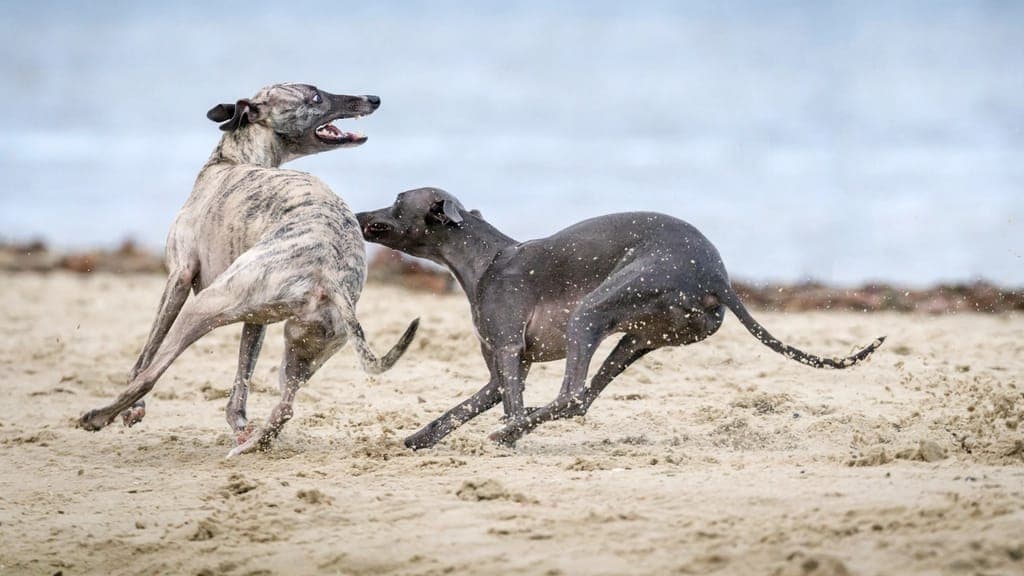
Play borrows moves from hunting and fighting: chasing, wrestling, pouncing and mouthing. To keep those moves from being misread, dogs use meta-signals, signals about the signals. The play bow is the best known, and ethologist Marc Bekoff found that bows often appear right before or after an action that could look like aggression, working like punctuation that says "still playing." Other meta-signals include a relaxed, open-mouthed play face and bouncy, exaggerated, deliberately inefficient movement.
Good players also self-handicap. A larger or stronger dog may lie down, soften bites, slow down or let a smaller partner "win," and well-matched dogs take turns chasing and being chased. These role reversals and frequent short pauses are hallmarks of healthy play.
Playing with people
Fetch, tug, chase and hide-and-seek all strengthen your relationship and give your dog a safe outlet for energy and natural predatory sequences. Tug is fine for most dogs when it has simple rules: a cue to start, a "drop" that is rewarded with the game continuing, and a pause if teeth touch skin. Letting your dog win does not make them "dominant." Play is also one of the most powerful rewards you can use in training.
When rough play crosses a line
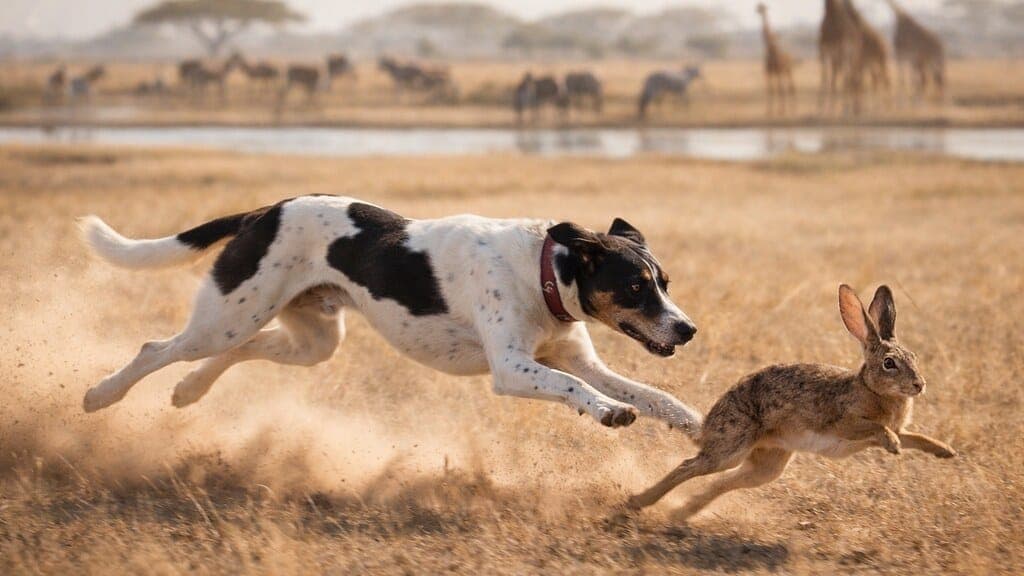
Noisy wrestling with growls and open mouths is often perfectly friendly. What matters is balance and flexibility: loose bodies, swapped roles and both dogs choosing to continue. Trouble tends to build gradually, as movements stiffen, pauses disappear and one dog keeps ending up pinned or looking for an exit. If you're unsure, briefly separate them and watch whether the smaller or quieter dog heads straight back in. The full checklist for telling whether dogs are playing or fighting walks through each sign, and the guide to dog park body language shows how tension builds in a group.
Quirky behaviors: weird dog behaviors explained
This is where many owners start their search. The good news is that most odd-looking habits have practical explanations rooted in a dog's nose, instincts or need to burn off energy.
Zoomies
Sudden laps around the yard, often after a bath, a poop or a long period of rest, are known as FRAPs (frenetic random activity periods). They are a normal release of energy and excitement. Learn why dog zoomies happen and how to keep them safe.
Head tilting
The head tilt may help some dogs locate or process sounds, and a 2022 study from Eötvös Loránd University found that dogs who had learned the names of many toys tilted their heads more often when hearing those familiar words. Our guide explains why dogs tilt their heads and when a persistent tilt points to an ear or balance problem.
Eating grass
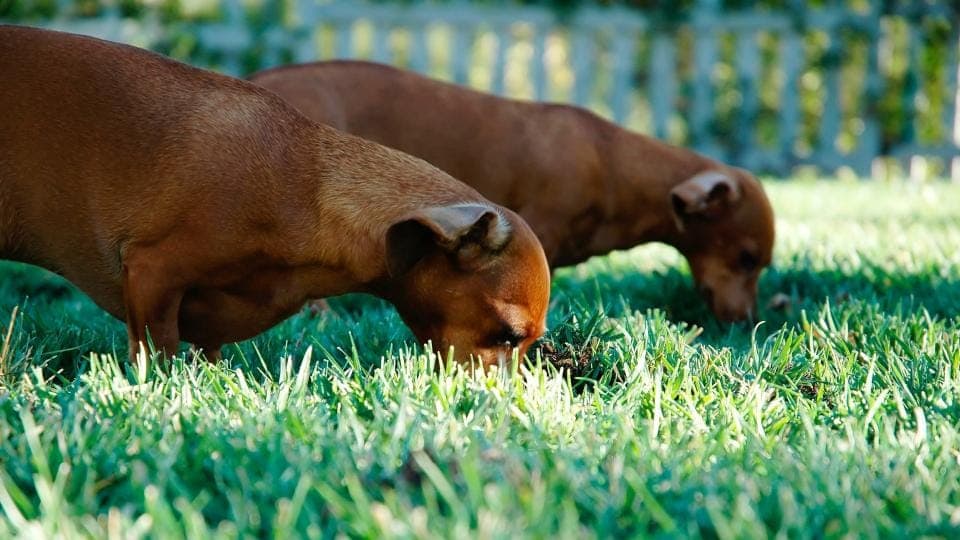
Grass eating is extremely common. Owner surveys suggest most dogs that eat plants show no sign of illness beforehand and only a minority vomit afterward. Find out why dogs eat grass, when it's harmless and when frantic grass eating means you should call your vet.
Butt sniffing
A dog's nose and anal sacs together form a chemical ID system. One sniff gives information about sex, health and possibly emotional state. Here's why dogs sniff butts, why they sometimes sniff people in awkward places, and what polite canine greetings look like.
Rolling in smelly things
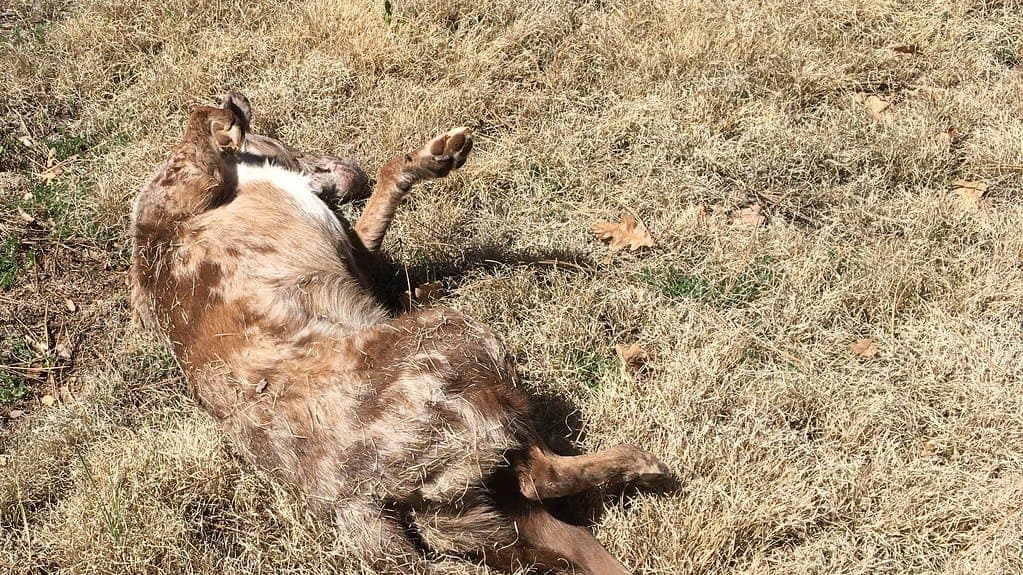
Few habits frustrate owners more. Theories range from masking their own scent to "bringing home" interesting odors, and researchers have not settled on a single answer. Read about why dogs roll in poop and how to reduce it with a strong recall.
Kicking after pooping
Those vigorous back-leg scrapes spread scent from glands between the toes and leave a visual mark. It's normal communication, not tidiness. See why dogs kick after pooping and whether you should ever stop it.
Circling before lying down
Turning a few times before settling may flatten bedding, check surroundings or find a comfortable position. Repeated, compulsive circling is different. Learn why dogs circle before lying down and when circling is a medical concern.
Humping
Mounting is usually about arousal, excitement, play or stress, not sex or social status, and it is seen in spayed and neutered dogs of both sexes. Here's why dogs hump and how to redirect it kindly.
Digging
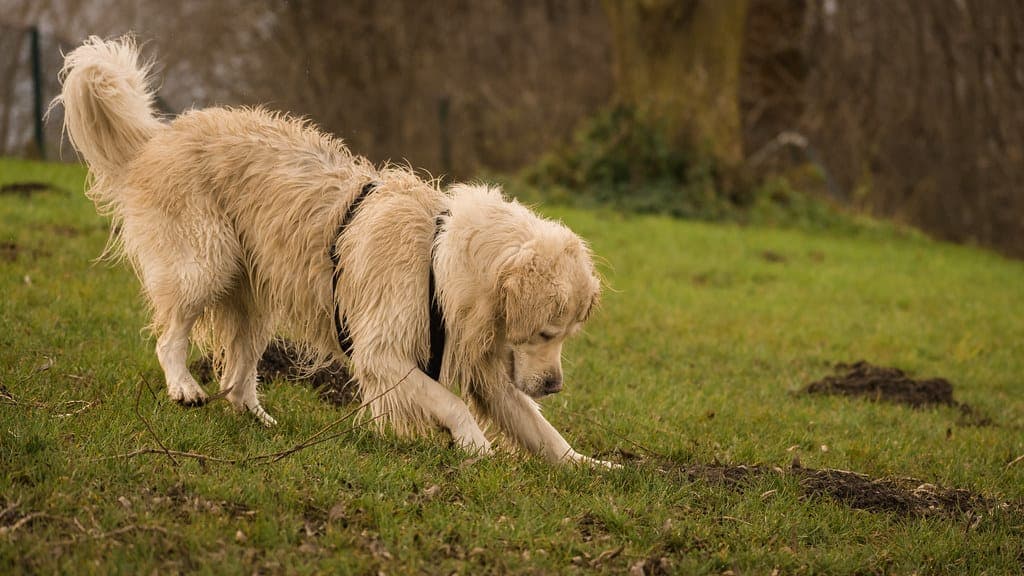
Digging can be about cooling down, hunting, burying, nesting or simply having fun, and some breeds were developed specifically to dig. Our guide to why dogs dig covers yards, beds and couches, and how to give digging a legitimate outlet.
Health and age: when behavior is a symptom
Behavior is often the first window into how a dog feels physically. Dogs are good at masking pain, so the early signs tend to be behavioral: reluctance to jump, irritability when touched, restlessness at night or withdrawal from the family.
Sudden changes
A friendly dog who suddenly snaps, a confident dog who suddenly hides, or a housetrained dog who starts having accidents needs a medical work-up first. Our guide to sudden changes in dog behavior lists the most common causes and the signs of pain that owners often miss.
Senior dogs
Aging brings slower movement, more sleep and sometimes canine cognitive dysfunction, which vets often screen for using the DISHAA framework: disorientation, social interaction changes, sleep-wake changes, house soiling, activity changes and anxiety. Learn to spot senior dog behavior changes early, when management helps most.
Vet check: Any behavior change that is sudden, worsening, or paired with appetite, thirst, weight, mobility or toileting changes warrants a veterinary exam before you start a training plan.
The dominance myth and other outdated ideas
For decades, dog behavior was explained through "pack leader" and "alpha" theories based on early observations of unrelated captive wolves. That model has been abandoned by researchers who study free-living wolves and by veterinary behavior organizations.
Leaning, pawing, walking through doors first, sleeping on the bed and humping are not attempts to take over the household. Explaining them that way leads people to use confrontational methods that increase fear and the risk of bites.
Wolves, dogs and domestication
The alpha idea grew largely out of mid-20th-century observations of unrelated adult wolves housed together in captivity, where tension was high. Field research on free-living wolves, notably by L. David Mech, found that a natural pack is usually a family: two breeding parents and their offspring, with the "leaders" simply being the parents.
Dogs are not wolves anyway. Genetic evidence suggests they descend from an ancient, now-extinct wolf population and were domesticated more than 15,000 years ago, with selection favoring tolerance of people and sensitivity to human cues. Free-ranging village dogs, the majority of the world's dogs, mostly scavenge alone or in loose groups rather than living in wolf-style packs. Read why the alpha dog myth persists and what modern science uses instead.
When normal behavior becomes a problem
The line between "normal" and "problem" is mostly about intensity, frequency, safety and welfare. Barking is normal; barking for hours is a problem. Three issues in particular start as ordinary emotions or instincts and often get mistaken for disobedience.
Distress when left alone
Following you is normal; panicking when you shut the bathroom door is not. Dogs with separation-related distress may howl, drool, pace, toilet indoors or chew at doors and window frames, usually within minutes of being alone. A phone or camera recording of your departure is the quickest way to see what is really happening. The damage is a panic response, not spite, so punishment only adds fear. Recovery usually comes from very gradual, below-threshold absences, and our separation anxiety training plan explains how to build them.
Fear of loud noises
Trembling, hiding, pacing and clinging during storms or celebrations are signs of genuine fear, one of the most common in pet dogs. Noise sensitivity can appear or worsen later in life, and it has been associated with musculoskeletal pain in some dogs, so a vet check makes sense if it is new. Comforting a frightened dog will not reinforce the fear; offering a den-like hiding spot and masking sound helps more than ignoring them. For predictable events, your vet can discuss whether short-term medication is appropriate. Here's how to help a dog scared of fireworks and thunder before, during and after.
Guarding food, toys and spaces
Protecting valuable things is a normal survival strategy, so a dog who eats faster, freezes over a chew or stiffens when someone approaches the sofa is communicating, not misbehaving. It becomes a safety issue when those early signals escalate to a hard stare, a growl, a snap or a bite. Taking items away by force or punishing the warning tends to make guarding worse. Trading up for something better, managing access around children, and gradual counter-conditioning work far better, as described in the guide to resource guarding in dogs.
Choosing the right kind of help
When a behavior is causing harm, stress or conflict, the companion guide to dog behavior problems explains humane, evidence-based solutions for reactivity, aggression, destructive chewing, excessive barking and more. If you're unsure whether you need a trainer or a medical professional, this overview of a dog trainer vs. a behaviorist will help you choose.
Safety note: If your dog has bitten, is showing escalating warning signs, or you feel unsafe, contact your veterinarian and a qualified professional such as a veterinary behaviorist (DACVB) or a certified behavior consultant (CDBC or CAAB). Don't try to fix aggression with punishment.
How to observe your dog like a behaviorist
Professionals don't guess at meaning from one glance. They gather information systematically. You can do the same with any behavior that puzzles you.
- Describe, don't label. Write "tail low, ears back, licking lips, turning away" rather than "being stubborn" or "acting guilty."
- Note the context. Where were you, who was present, what time was it, and what changed recently?
- Identify the antecedent. What happened in the seconds before the behavior? A doorbell, a hand reaching, another dog?
- Record the consequence. What happened right after? Did your dog get attention, food, space or relief? That consequence is likely maintaining the behavior.
- Track frequency and intensity. A quick daily tally shows whether things are improving, stable or getting worse.
- Rule out the body. If the behavior is new or escalating, book a vet visit before starting training.
- Change one thing at a time. Adjust management, enrichment or training gradually so you know what's working.
This approach also builds your skill at spotting subtle signs of stress before they escalate, and you can test yourself with the dog body language quiz.
Behavior through life stages
Behavior isn't fixed; it develops. Puppies go through a sensitive socialization period, roughly between 3 and 14 weeks of age, when positive exposure to people, places and sounds has a lasting effect. Gentle, well-planned dog socialization at this stage and beyond helps dogs grow into confident adults.
Adolescence, from around six months to two years depending on size and breed, often brings a temporary dip in reliability and a spike in exploration. Adulthood usually brings more stability, and the senior years bring the health-related changes described above. Expect behavior to shift as your dog ages, and adjust your expectations and care accordingly.
Putting it together: your next steps
Every dog behavior makes more sense once you ask: what does this do for my dog? Start with the behaviors that matter most in your home, using the groups above: attachment habits like licking and following, emotional questions like love and guilt, how your dog thinks and plays, quirky habits like zoomies and digging, and health-related changes that need a vet's eye.
Keep a short behavior diary for anything that puzzles you, learn the body language that goes with it, and reward the behavior you'd like to see more of. When something is new, intense or worrying, get a veterinary check first and then a qualified behavior professional. If you meet an unfamiliar term along the way, the dog behavior glossary has plain-English definitions.
Frequently asked questions
What is considered normal dog behavior?
Normal dog behavior includes sniffing, chewing, digging, barking, play, licking, following family members, scent rolling and short bursts of zoomies. A behavior is usually normal if it fits the dog's age and breed, happens in a predictable context, stops easily and doesn't cause injury, distress or danger. Behavior that is new, intense, repetitive or hard to interrupt deserves a closer look and often a vet check.
Is it dog behavior or dog behaviour?
Both are correct. 'Behavior' is the US spelling and 'behaviour' is the UK, Irish, Australian and Canadian spelling. The science is identical: canine behavior research is published under both spellings, and search engines treat them as the same topic. If you are looking for a professional, both spellings appear in job titles such as veterinary behaviorist or clinical animal behaviourist.
Why does my dog do weird things?
Most weird dog behaviors make sense once you think like a dog. Dogs experience the world mainly through smell, carry instincts from their working and wild ancestors, and repeat whatever has paid off in the past. Head tilting, rolling in smelly things and kicking grass after pooping all have functional explanations. If a weird habit is new, compulsive or paired with other changes, ask your vet.
Can a dog's behavior change suddenly?
Yes, and a sudden change is one of the most important things to take seriously. Pain, thyroid problems, ear infections, vision or hearing loss, neurological disease and cognitive decline can all show up first as irritability, clinginess, hiding, house soiling or new aggression. Book a veterinary exam before assuming the change is purely behavioral or training-related.
How can I better understand my dog's behavior?
Watch your dog in context. Note the situation, the trigger, what the whole body is doing, and what happens straight afterward. Learn the basics of canine body language, keep a simple diary for any behavior that puzzles you, and remember that behavior that gets rewarded tends to be repeated. For persistent concerns, work with a certified behavior consultant or a veterinary behaviorist.
Sources & further reading
- Miklósi, Á. (2015). Dog Behaviour, Evolution, and Cognition (2nd ed.). Oxford University Press.
- Bradshaw, J. (2011). Dog Sense: How the New Science of Dog Behavior Can Make You a Better Friend to Your Pet. Basic Books.
- Horowitz, A. (2009). Disambiguating the 'guilty look': Salient prompts to a familiar dog behaviour. Behavioural Processes, 81(3), 447-452.
- Topál, J., Miklósi, Á., Csányi, V., & Dóka, A. (1998). Attachment behavior in dogs (Canis familiaris): A new application of Ainsworth's (1969) Strange Situation Test. Journal of Comparative Psychology, 112(3), 219-229.
- Nagasawa, M., Mitsui, S., En, S., Ohtani, N., Ohta, M., Sakuma, Y., Onaka, T., Mogi, K., & Kikusui, T. (2015). Oxytocin-gaze positive loop and the coevolution of human-dog bonds. Science, 348(6232), 333-336.
- Mills, D. S., Demontigny-Bédard, I., Gruen, M., Klinck, M. P., McPeake, K. J., Barcelos, A. M., et al. (2020). Pain and problem behavior in cats and dogs. Animals, 10(2), 318.
- Landsberg, G. M., Nichol, J., & Araujo, J. A. (2012). Cognitive dysfunction syndrome: A disease of canine and feline brain aging. Veterinary Clinics of North America: Small Animal Practice, 42(4), 749-768.
- American Veterinary Society of Animal Behavior. (2008). Position Statement on the Use of Dominance Theory in Behavior Modification of Animals. AVSAB.
- Hare, B., Brown, M., Williamson, C., & Tomasello, M. (2002). The domestication of social cognition in dogs. Science, 298(5598), 1634-1636.
- Kaminski, J., Call, J., & Fischer, J. (2004). Word learning in a domestic dog: Evidence for 'fast mapping'. Science, 304(5677), 1682-1683.
- Morrill, K., Hekman, J., Li, X., McClure, J., Logan, B., Goodman, L., et al. (2022). Ancestry-inclusive dog genomics challenges popular breed stereotypes. Science, 376(6592), eabk0639.
- Bekoff, M. (1995). Play signals as punctuation: The structure of social play in canids. Behaviour, 132(5-6), 419-429.
- Mech, L. D. (1999). Alpha status, dominance, and division of labor in wolf packs. Canadian Journal of Zoology, 77(8), 1196-1203.
This guide is for education only and does not replace an in-person assessment. If your dog's behavior changes suddenly, or you are worried about bites or aggression, speak to your veterinarian or a qualified behavior professional. See our disclaimer.