Signals & emotions
Calming Signals: How Dogs Ask to Keep Things Calm
Head turns, slow sniffing, curving and splitting are your dog's polite ways of asking everyone to settle down. Here is how to spot them and respond.
Key takeaways
- Calming signals are small, often fleeting behaviors such as head turning, lip licking, slow movement and sniffing that dogs use when a situation feels tense.
- Norwegian trainer Turid Rugaas popularized the term and catalogued around 30 of these signals in her book On Talking Terms With Dogs.
- Scientists debate whether dogs use these signals deliberately to calm others, but they reliably indicate mild stress or social conflict.
- A dog who turns away, sniffs or slows down is usually asking for more space or less pressure, and respecting that request prevents escalation.
- You can use calming signals yourself by turning sideways, moving slowly, curving your approach and avoiding direct staring.
Jump to a section
- What are calming signals? Turid Rugaas's work
- Calming signals list: the signals you will see most
- Dog turning head away
- Dog sniffing the ground when stressed
- Dog splitting behavior
- What the science says (and what it does not)
- How to use calming signals yourself
- When calming signals are ignored
- What to do next
Dog calming signals are small, often fleeting behaviors, such as turning the head away, licking the lips, sniffing the ground, slowing down or curving around another dog, that dogs show when a social situation feels tense. They act like polite requests to lower the pressure, and they usually appear well before growling or snapping.
Because these signals are quick and subtle, most owners miss them entirely. Some also have ordinary meanings (dogs sniff to smell, yawn when tired), so the skill is reading them in context. They are one of the most useful layers of dog body language to learn, because spotting them early lets you step in long before your dog feels she has to shout.
What are calming signals? Turid Rugaas's work
The term "calming signals" comes from Turid Rugaas, a Norwegian dog trainer who spent years observing how dogs defuse tension with each other. In her book On Talking Terms With Dogs: Calming Signals, she described around 30 behaviors that dogs appear to use to calm themselves, avoid conflict and signal peaceful intent.
Rugaas's central idea is simple and practical. Dogs have a rich vocabulary for avoiding fights, and they use it constantly with other dogs and with people. If we learn that vocabulary, we can respect it, avoid putting dogs under pressure, and even "speak" some of it back.
Her work became hugely influential among trainers and shelter staff, and the phrase "calming signals" is now standard in pet-dog training. Veterinary behaviorists and ethologists often use related terms instead, such as appeasement behaviors, cut-off signals or displacement behaviors.
Calming signals list: the signals you will see most
Here are the calming signals owners encounter most often, with what they typically look like and when they tend to appear.
| Signal | What it looks like | Common context |
|---|---|---|
| Head turning | Head turns briefly or fully to one side, eyes look away | A person leans over, a dog approaches head-on, a camera points at her |
| Turning away | Whole body turns sideways or shows its back | Rough play gets too intense, a person looms or scolds |
| Lip or nose licking | A quick flick of the tongue over the nose or lips | Being hugged, handled, photographed or spoken to sternly |
| Yawning | A full yawn when not tired | Vet visits, tense greetings, family arguments |
| Sniffing the ground | Nose suddenly drops to the ground | Another dog or person approaching |
| Slowing down or freezing | Movement becomes slow-motion or stops entirely | Being called in an angry voice, a dog staring at her |
| Curving | Walks in an arc instead of a straight line | Approaching another dog or person |
| Sitting or lying down | Sits or lies down, often turned away | A dog approaches too fast, play gets too rough |
| Play bow | Front end down, rear end up | Breaking tension or inviting a calmer kind of play |
| Splitting | Walks between two dogs or people | Two others getting close, tense or overexcited |
| Soft eyes and blinking | Eyes narrow, blink, gaze softens | Being stared at |
| Paw lift | One front paw raised briefly | Uncertainty during an approach or handling |
The play bow deserves a note: it is mostly an invitation to play, explained fully in our guide to the play bow, but dogs also use it to reset tension mid-play. Yawning and lip licking have their own breakdown in why dogs yawn and lick their lips.
Dog turning head away
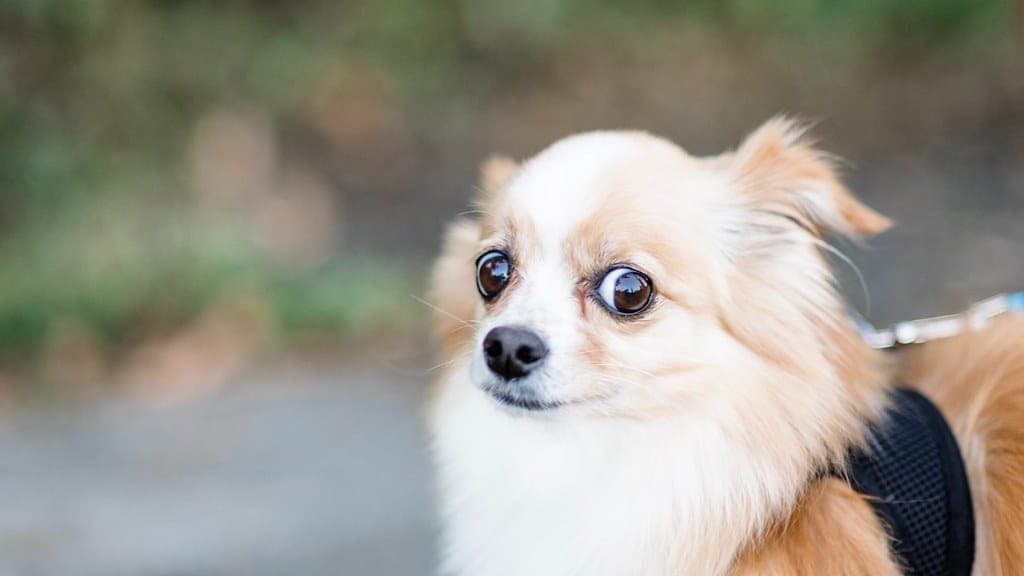
A dog turning her head away is one of the clearest and earliest calming signals. Picture a child bending over your dog to hug her: she turns her head to the side, maybe licks her lips, and her eyes slide away. She is saying, "I am not a threat, and I would like this to stop."
Head turning also matters because a direct stare between dogs can feel confrontational. Looking away is a polite way of declining that confrontation. Our guide to dog eye signals explains how gaze avoidance differs from whale eye, where the dog keeps her head turned but her eyes fixed on the worry.
When you see a head turn, take the hint. Pause, straighten up, give her a little more room and let her choose whether to re-engage.
Dog sniffing the ground when stressed
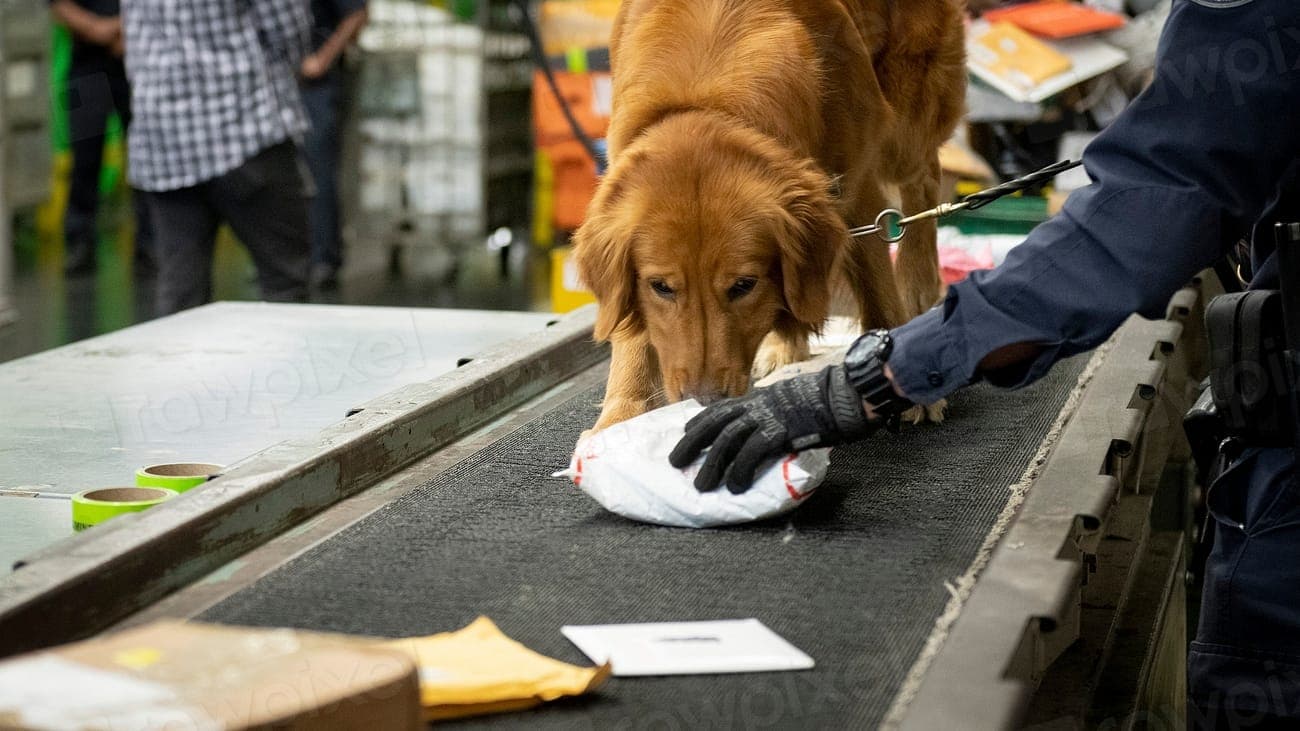
Sudden sniffing is one of the most misread calming signals. You are walking your dog, another dog appears ahead, and your dog's nose drops to a patch of grass she ignored a moment ago. That abrupt interest is often a way of lowering social pressure: she avoids staring, slows the approach and signals she is not looking for trouble.
How to tell stress sniffing from ordinary sniffing:
- Timing: It starts the moment something socially tense appears.
- Intensity: The sniffing looks a bit fixed or distracted rather than eager and investigative.
- Ending: It stops once the other dog passes or the pressure eases.
- Company: It comes with other signals, such as a slower pace, a lowered tail or a lip lick.
Do not drag your dog away from stress sniffing or hurry her toward the other dog. Let her take her time. On walks, sniffing is also a genuine stress reliever, so a slow, sniffy route is one of the kindest things you can give an anxious dog.
Dog splitting behavior
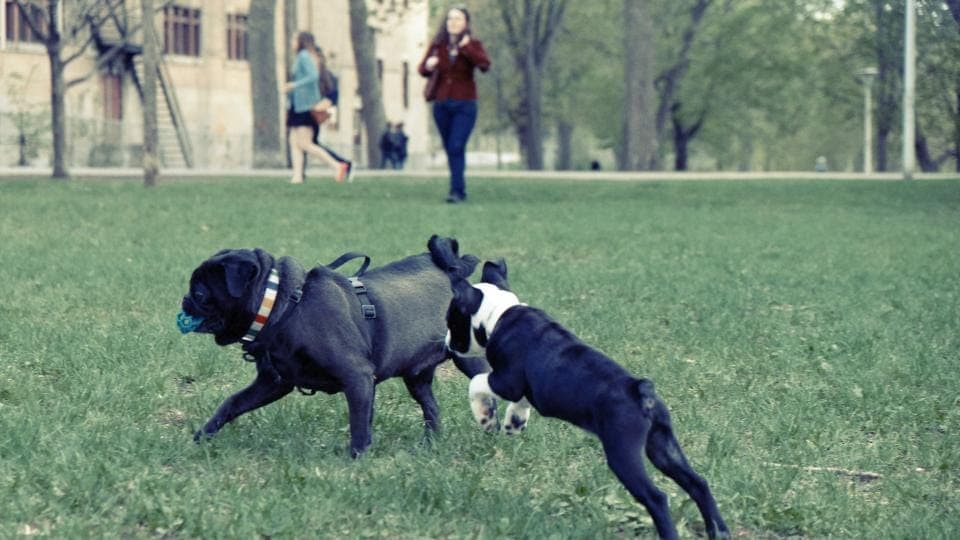
Splitting is when a dog physically moves between two other individuals: two dogs playing too roughly, two people hugging, or a child and another dog. Some dogs nose in between; others simply walk through the gap and stand there.
Rugaas interpreted splitting as an attempt to prevent conflict by breaking up tension. Owners sometimes read it as jealousy or "dominance," but in most cases the splitter is a dog who finds the closeness or excitement uncomfortable. Herding breeds often seem especially prone to it.
If your dog repeatedly splits dogs at play, it is usually a sign the play has become too intense for her taste. Call everyone for a short break. If she splits people who are hugging, she may be unsettled by the sudden closeness rather than possessive.
Myth: "A dog who walks between you and your partner is being dominant or jealous." Splitting is better understood as a dog trying to defuse a situation that looks tense to her. The outdated dominance model misreads many behaviors like this one.
What the science says (and what it does not)
Rugaas's work came from careful field observation rather than controlled experiments, and some scientists question whether dogs deliberately use these behaviors to calm others. An alternative explanation is that many of them are displacement behaviors, ordinary actions that pop up out of context when a dog feels conflicted.
Research is starting to fill in the picture. A pilot study by Mariti and colleagues in 2017 found that dogs frequently showed calming signals during interactions with unfamiliar dogs, and that aggressive behavior from the other dog often subsided after a calming signal was shown. Firnkes and colleagues (2017) found that dogs showed more appeasement-type behaviors, such as lip licking and looking away, when people behaved in a threatening way toward them.
For owners, the debate about intent matters less than the practical takeaway. Whether a dog is "trying" to calm you or is simply stressed, these behaviors reliably tell you that she is uncomfortable. That is reason enough to respond.
Pro tip: Look for clusters rather than single behaviors. One yawn means little. A head turn, a lip lick and a sudden sniff within ten seconds of a stranger approaching means a lot.
How to use calming signals yourself
Dogs read our bodies all the time, and many everyday human habits, such as walking straight at a dog, leaning over her, staring and reaching for her head, look rude or threatening in dog terms. You can soften all of this by borrowing from the calming signal vocabulary:
- Curve your approach. Walk in a gentle arc rather than heading straight for a dog.
- Turn sideways. Present your side rather than your front, especially with nervous dogs.
- Look away. Use soft, brief glances and avoid a fixed stare.
- Slow down. Move slowly and smoothly; avoid sudden grabs.
- Crouch side-on at a distance. Let the dog come to you rather than bending over her.
- Yawn or blink. Some owners find a slow yawn or soft blink helps a worried dog settle, and it costs nothing to try.
These ideas form the basis of polite greetings; our guide on how to greet a dog puts them into a step-by-step routine. They are also invaluable when introducing two dogs, where curved, parallel walking lets both dogs use their own signals.
When calming signals are ignored
Calming signals sit at the bottom of a ladder of communication. If a dog's quiet requests are repeatedly ignored, she may escalate to stiffening, staring, growling, lip lifting and eventually snapping or biting. Some dogs learn that their subtle signals never work and begin skipping straight to louder ones.
This is why calming signals are so important for families. Children often hug, chase and lean over dogs, all of which trigger head turns and lip licks that adults miss. Our guide to dogs and kids explains how to supervise so those early signals are noticed and respected.
Safety note: If your dog shows lots of calming signals in a particular situation, such as being handled at the vet, meeting other dogs on leash or being approached by children, treat that as an early warning. Reduce the pressure now and work on the situation gradually rather than waiting for a growl.
Frequent calming signals are also a window into your dog's overall stress load. If you see them many times a day, look at our guide to signs of stress in dogs and consider what could be lightened in her routine. Dogs who show calming signals on leash and then explode at other dogs often fit the picture described in our leash reactivity guide.
What to do next
Spend a week simply watching. Notice when your dog turns her head, licks her lips, slows down or suddenly sniffs, and jot down what was happening. Patterns will appear fast, and they will show you exactly where your dog needs a little more space.
When you see a signal, respond: pause, back off slightly, turn sideways, or give her a way to leave. Keep a copy of our printable dog body language chart on the fridge so everyone in the household learns the same vocabulary.
Frequently asked questions
What are the most common dog calming signals?
The signals owners see most often are turning the head away, licking the nose or lips, yawning, sniffing the ground, slowing down or freezing, turning the whole body away, sitting or lying down, and curving around instead of approaching head-on. Each one is brief, so watch for clusters of signals and what triggered them rather than reacting to a single behavior.
Is a dog sniffing the ground always a calming signal?
No. Dogs sniff because they are gathering information, and most sniffing on a walk is just that. Sniffing becomes a likely calming or displacement behavior when it starts suddenly in a socially tense moment, such as another dog approaching or a person reaching toward your dog, and stops once the pressure eases.
Do dogs use calming signals with people?
Yes. Dogs commonly show head turns, lip licks, yawns and body turns toward people, especially when someone leans over them, hugs them, stares or speaks harshly. Research on dog-human interactions has found these behaviors become more frequent when people act in a threatening way. Responding by backing off slightly and softening your body helps your dog feel heard.
What happens if calming signals are ignored?
If a dog's quieter signals are repeatedly ignored, she may escalate to clearer warnings such as stiffening, a hard stare, growling, a lip lift or snapping. Some dogs learn that subtle signals do not work and skip straight to louder ones. Noticing and respecting early signals is one of the most effective ways to prevent bites.
Can I teach my dog calming signals?
Calming signals are part of a dog's natural repertoire, so they do not need teaching. What you can do is avoid suppressing them, give your dog chances to use them by not forcing interactions, and reward calm choices. You can also mirror some signals yourself, such as turning sideways, moving slowly and yawning, to lower the pressure in a tense moment.
Sources & further reading
- Rugaas, T. (2006). On Talking Terms With Dogs: Calming Signals (2nd ed.). Dogwise Publishing.
- Mariti, C., Falaschi, C., Zilocchi, M., Fatjo, J., Sighieri, C., Ogi, A., & Gazzano, A. (2017). Analysis of the intraspecific visual communication in the domestic dog (Canis familiaris): A pilot study on the case of calming signals. Journal of Veterinary Behavior, 18, 49-55.
- Firnkes, A., Bartels, A., Bidoli, E., & Erhard, M. (2017). Appeasement signals used by dogs during dog-human communication. Journal of Veterinary Behavior, 19, 35-44.
- Aloff, B. (2005). Canine Body Language: A Photographic Guide. Dogwise Publishing.
- Shepherd, K. (2002). Development of behaviour, social behaviour and communication in dogs. In D. F. Horwitz, D. S. Mills, & S. Heath (Eds.), BSAVA Manual of Canine and Feline Behavioural Medicine. British Small Animal Veterinary Association.
This guide is for education only and does not replace an in-person assessment. If your dog's behavior changes suddenly, or you are worried about bites or aggression, speak to your veterinarian or a qualified behavior professional. See our disclaimer.