Safety
Dog Park Body Language: How to Spot Trouble Before It Starts
Healthy play, bullying or a fight brewing? Learn the dog park warning signs that tell you when to interrupt, and when it's time to go home.

Key takeaways
- Healthy dog park play is loose, bouncy and reciprocal, with frequent pauses and dogs taking turns chasing and being chased.
- Stiffening, freezing, hard stares, a closed mouth and a high, rigid tail are the clearest warning signs that play is turning into conflict.
- Bullying looks like one dog repeatedly targeting another that is trying to escape, hide behind people or tuck its tail.
- A consent test, separating the dogs briefly and seeing whether both choose to return, tells you whether play is still mutual.
- Leave the dog park when your dog stops enjoying it, when a group starts mobbing, or when an owner won't manage a dog that is bullying.
Jump to a section
- What healthy dog park play looks like
- Dog park warning signs: the early red flags
- Dog bullying at the dog park: how to recognize it
- Group dynamics: mobbing and chasing packs
- The consent test: is everyone still having fun?
- Dog park fights: what to do if one starts
- Reading your own dog: stress signals to know
- When to leave the dog park
- What to do next
Dog park body language tells you, moment by moment, whether dogs are enjoying themselves or heading for trouble. Healthy play is loose, bouncy and taken in turns; trouble shows up as stiffening, freezing, hard stares, closed mouths and one dog relentlessly targeting another. Spot those shifts early and you can step in calmly, long before anyone gets hurt.
The tricky part is that good play and real conflict share a lot of the same moves: chasing, growling, wrestling and mouthing. What separates them is the quality of the movement and whether both dogs are still choosing to take part. This guide shows you exactly what to watch for, building on the basics in our complete guide to dog parks.
What healthy dog park play looks like
Before you can spot trouble, you need a clear picture of normal. Researchers who study canine play describe it as a mix of exaggerated, inefficient movements and frequent "punctuation" signals that keep everyone on the same page.
Signs that play is going well:
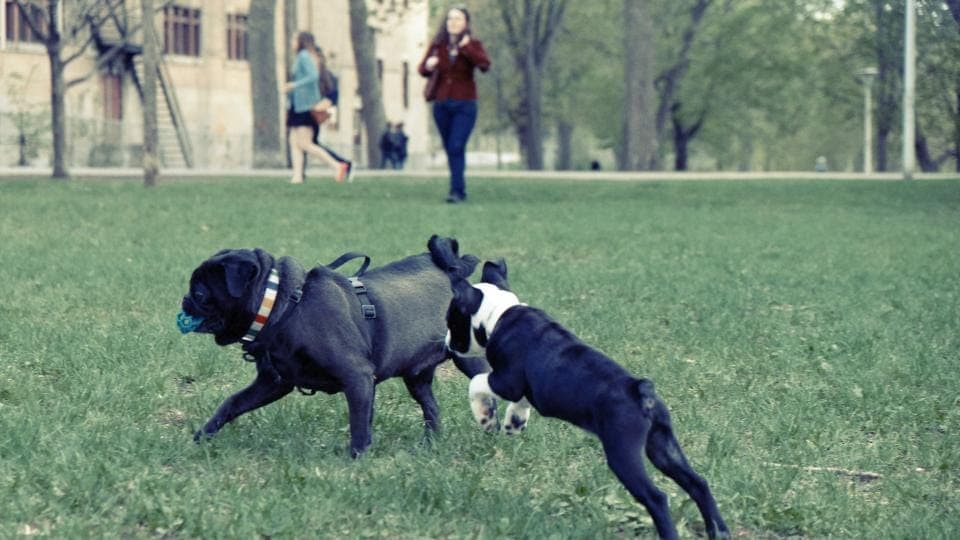
- Loose, wiggly bodies. Movements are curvy and bouncy rather than straight and direct.
- Play signals. A play bow, a goofy open-mouthed "play face" or a bouncy sideways approach invites the game to continue or restarts it after a rough moment.
- Role reversal. The chaser becomes the chased; the dog on the bottom gets to be on top. Bigger dogs often self-handicap, lying down or softening their bites to keep things fair for a smaller partner.
- Inhibited mouthing. Lots of open-mouthed contact, very little pressure.
- Natural pauses. Dogs break off every few seconds to sniff, shake off or trot away, then return voluntarily.
Pro tip: Count the pauses. Dogs who stop for a second or two every so often are self-regulating. Dogs who play nonstop, faster and faster, are more likely to tip over into overarousal.
For a deeper side-by-side comparison, see our guide to telling whether dogs are playing or fighting.
Dog park warning signs: the early red flags
Most dog park fights don't come out of nowhere. They follow a build-up of small signals that are easy to miss if you're chatting or looking at your phone. Watch for these, especially in combination:
Stiffening and freezing
A dog who suddenly goes still, with weight braced and muscles tight, is making a decision. Freezing is one of the most important pre-conflict signals in dog posture. If two dogs freeze while facing each other, interrupt immediately.
Hard eyes and a closed mouth
A relaxed dog has a soft gaze and an open, loose mouth. When the mouth snaps shut, the lips tighten and the eyes lock onto another dog without blinking, tension is rising fast. You may also see whale eye, where the whites of the eyes show as a dog watches something without turning its head.
High, rigid tail and forward weight
A tail held high and stiff, sometimes with a short, fast flick-wag, combined with a body leaning forward over the front legs, signals arousal and possible confrontation, not friendliness.
Raised hackles in context
Raised hackles (piloerection) mean a dog is aroused, which can happen in excited play too. On their own they don't predict a fight. Combined with stiffness, staring or a closed mouth, they're a strong reason to step in.
Standing over, chin and paw on the shoulders
One dog repeatedly placing its head or paws over another's shoulders, especially while the other dog stands still or turns its head away, is often a bid for control or space that the other dog isn't welcoming.
Low, continuous growling
Play growls tend to be higher-pitched, broken up and paired with bouncy movement. A low, rumbling, steady growl from a dog who has gone still is a warning.
Dog bullying at the dog park: how to recognize it
Bullying is one-sided play. One dog is having a great time; the other is not. It's one of the most common problems in off-leash areas and one of the easiest to overlook, because the bully often looks "playful."
| Behavior | Mutual play | Bullying |
|---|---|---|
| Chasing | Dogs take turns chasing and being chased | One dog always chases; the other never gets a turn |
| Body slams and pinning | Rare, followed by role reversal or a pause | Repeated, with the target unable to get up or away |
| Target dog's tail | Loose or wagging at mid-height | Tucked low or clamped under the belly |
| Target dog's ears | Relaxed or moving freely | Pinned flat back |
| Target dog's behavior | Re-engages after a break | Hides behind people, under benches, or tries to exit |
| Calming signals from target | Occasional | Constant: turning away, lip licking, sniffing the ground |
| Response to a yelp | Play softens or stops | Pursuit continues or intensifies |
Watch the dog being targeted more than the dog doing the chasing. Repeated calming signals such as turning away, sniffing the ground and lip licking are a polite request for space. When those requests are ignored, the dog may escalate to snapping, or may learn to fear other dogs.
Myth: "He's just showing he's the dominant one." Research on domestic dogs doesn't support the idea that dogs are constantly trying to climb a rigid hierarchy. Bullying is usually overarousal, poor social skills or a lack of feedback, not a rank battle, and it needs management rather than permission.
Group dynamics: mobbing and chasing packs
Two dogs playing is a conversation. Four or five dogs all chasing one is a crowd, and crowds change behavior. When a group forms behind a single running dog, arousal climbs quickly and normally tolerant dogs can join in a way they never would one-on-one.
Interrupt early if you see:
- Several dogs chasing one dog that has its tail tucked or is running toward people.
- Dogs bunching up around the entrance gate when a new dog arrives.
- A crowd forming around a toy, ball or someone's treat pouch.
Gate greetings are a known hotspot. A newcomer surrounded by sniffing dogs in a narrow space often feels trapped. Waiting until the crowd disperses, or walking your dog away from the gate quickly, prevents a lot of trouble. Our dog park etiquette guide covers more of these unwritten rules.
The consent test: is everyone still having fun?
When you're unsure whether play is still mutual, ask the dogs.
- Gently separate them. Call your dog, or calmly take the collar of the dog who seems to be "winning."
- Hold for a few seconds. Keep things light. No scolding.
- Watch the other dog. Let go of the more pushy dog, or release the quieter dog first.
- Read the answer. If the released dog runs straight back, bowing or bouncing, play is welcome. If it moves away, shakes off, or goes to its owner, it was asking for a break.
- Respect the answer. If the answer was "no thanks," keep the dogs apart for a while or move to another area of the park.
This takes ten seconds and is one of the most reliable tools you have, because it removes guesswork.
Dog park fights: what to do if one starts
Even with good supervision, scuffles happen. Most are noisy but brief and end without injury. Real fights, where dogs grip and hold, are less common but serious.
Safety note: Never reach toward the heads or collars of fighting dogs. Even the gentlest dog can redirect and bite a hand in the chaos, and bite injuries to people often happen this way.
Safer options to break up a dog park fight:
- Interrupt with a sudden noise such as a loud clap or an air horn, or by banging a trash can lid, which can be enough to break focus in a scuffle.
- Put a barrier between them, such as a board, a folded chair, a bag or a jacket.
- Use water from a bottle or hose if one is available.
- The wheelbarrow method, as a last resort with two people: each grabs one dog's back legs above the knees and walks backwards, then turns the dog away. Only attempt it if you are physically able to.
Afterwards, leash your dog, leave the park and check them carefully. Puncture wounds can be hidden under fur and are prone to infection, so have your vet examine any bite. If your dog was involved in a fight or has started reacting to dogs since, our guide to dog aggression toward other dogs explains the next steps, including when to involve a certified behavior consultant or veterinary behaviorist.
Reading your own dog: stress signals to know
Your dog may not be the bully or the target but still be having a hard time. Many dogs tolerate the dog park rather than enjoy it. Signs your dog is overwhelmed include:
- Clinging to you or staying near the gate
- Panting heavily with the corners of the mouth pulled back tight
- Yawning, lip licking or repeated shaking off
- Tail held low or tucked, ears back
- Snapping at dogs who approach, after previously tolerating them
- Refusing treats they normally love
Small dogs, puppies, seniors and dogs in pain are especially likely to struggle. If you're questioning whether the park suits your dog at all, read are dog parks safe for honest pros, cons and alternatives.
Vet check: A dog who suddenly becomes snappy at the park may be sore. Joint pain, an ear infection or an injury can lower tolerance for bumps and body slams. If the change is new, rule out pain with your vet.
When to leave the dog park
Leaving isn't a failure. It's how you protect your dog's confidence and keep the park a positive place. Use this quick checklist; if any box is ticked, it's time to go:
- Your dog is showing repeated stress signals or trying to leave.
- A group of dogs keeps chasing or mobbing one dog.
- Another owner won't manage a dog that is bullying or fixated on yours.
- Play has become nonstop, faster and louder, with no pauses.
- Your dog has been in a scuffle, even a minor one.
- The park is too crowded for you to watch your dog closely.
- Your dog is tired, overheated or starting to ignore your recall.
Aim to leave while your dog is still having fun. Fifteen to thirty minutes of good play is better than an hour that ends in a fight.
What to do next
Reading dog park body language is a skill that builds with practice. Spend your next few visits watching rather than chatting: notice the pauses, the role reversals and the small moments where a dog turns away or freezes. Step in early and calmly, use the consent test whenever you're unsure, and leave on a good note.
If you're heading to a new park, or introducing a young dog for the first time, follow our step-by-step first dog park visit plan. And if your dog consistently struggles, a qualified certified behavior consultant can help you build skills and find outlets that suit your individual dog better.
Frequently asked questions
How can I tell if my dog is being bullied at the dog park?
A bullied dog tries to get away rather than re-engage. Look for a tucked tail, ears pinned back, hiding behind your legs or under a bench, repeated lip licking and turning away, while the other dog keeps pursuing, pinning or body-slamming. If your dog never gets a turn to chase and keeps looking for an exit, call them out and leave or move to a quieter area.
What are the warning signs of a dog park fight?
Fights are usually preceded by a sudden change in tempo. Watch for dogs going stiff, freezing, staring hard at each other, closing their mouths, raising their tails high and rigid, standing over one another, or a group of dogs clustering around one dog. Growls that become low and continuous instead of playful also signal rising tension. Interrupt calmly at the first of these signs.
Should I let dogs work it out themselves at the dog park?
No. The idea that dogs should be left to sort out conflicts is outdated and risky. Unchecked tension can escalate into injuries and can teach a dog that other dogs are frightening or that aggression works. Calmly calling your dog away, taking a short break, and returning only if both dogs are relaxed is safer and kinder than waiting to see what happens.
Is it normal for dogs to growl and bite each other's necks at the dog park?
It can be. Play growls, open-mouthed neck biting and wrestling are normal in rough play as long as the bites are inhibited, the bodies stay loose, both dogs take turns and they pause regularly. It stops being play when one dog yelps and the other keeps going, when bodies stiffen, or when one dog is always on top and the other is trying to leave.
When should I leave the dog park?
Leave when your dog shows repeated stress signals such as panting with a tight mouth, yawning, clinging to you or trying to exit, when the park becomes crowded or chaotic, when a group starts chasing one dog, or when another owner won't manage a dog that is bullying. Leaving on a good note, before your dog is overtired or overwhelmed, keeps the park a positive place.
Sources & further reading
- Bekoff, M. (1995). Play signals as punctuation: The structure of social play in canids. Behaviour, 132(5-6), 419-429.
- Horowitz, A. (2009). Attention to attention in domestic dog (Canis familiaris) dyadic play. Animal Cognition, 12(1), 107-118.
- Ward, C., Bauer, E. B., & Smuts, B. B. (2008). Partner preferences and asymmetries in social play among domestic dog, Canis lupus familiaris, littermates. Animal Behaviour, 76(4), 1187-1199.
- Bradshaw, J. W. S., Blackwell, E. J., & Casey, R. A. (2009). Dominance in domestic dogs: Useful construct or bad habit? Journal of Veterinary Behavior, 4(3), 135-144.
- Rugaas, T. (2006). On Talking Terms With Dogs: Calming Signals (2nd ed.). Dogwise Publishing.
This guide is for education only and does not replace an in-person assessment. If your dog's behavior changes suddenly, or you are worried about bites or aggression, speak to your veterinarian or a qualified behavior professional. See our disclaimer.