Dog Body Language · Complete guide
Dog Body Language: The Complete Guide to Reading Your Dog
How dogs talk with their ears, eyes, tail, posture and voice, and a simple method for reading the whole dog in context.
Key takeaways
- Dog body language is a dog's main way of communicating how it feels and what it wants, expressed through the ears, eyes, mouth, tail, posture, coat and voice.
- No single signal has one fixed meaning, so always read the whole dog, the situation and what happened just before.
- Loose, curvy, wiggly bodies usually mean comfort, while stiffness, stillness and leaning away are signs to slow down and give space.
- Small signals such as lip licking, yawning and turning away often appear long before a growl, and noticing them prevents most bites.
- A sudden change in your dog's usual body language can be a sign of pain or illness and is worth a vet check.
Jump to a section
- What dog body language means
- Dog communication signals: the four channels
- How to read dog body language in five steps
- Body parts: reading your dog from nose to tail
- Signals and emotions: what your dog is feeling
- Vocal communication: growls, barks and whines
- Dog body language signs at a glance
- What is my dog trying to tell me? Common scenarios
- How signals escalate: the ladder of communication
- Dog body language and children
- Context is everything: why single signals mislead
- Common dog body language myths
- Breed, shape and individual differences
- Body language and your dog's health
- Practice: how to get fluent
- Putting it together
Dog body language is the system of visual, vocal and physical signals dogs use to communicate how they feel and what they intend: ear position, eye shape, mouth tension, tail carriage, posture, raised hackles and sounds such as growls and whines. Reading it well means looking at all of these together, in context.
That last part is where most owners get stuck. A wagging tail can mean joy or an impending bite, a yawn can mean tiredness or stress, and a dog rolling onto her back may want a belly rub or may be asking you to back off. This guide gives you a method for reading the whole dog, then walks you through each body part, emotion and sound in depth, so you can understand what your dog is telling you in the moment it matters.
What dog body language means
Canine body language is a dog's primary language. Dogs do vocalize, and they communicate heavily through scent, but most of the moment-to-moment information they exchange with each other and with us is visual: a shift of weight, a softening of the eyes, a tail that rises or drops by a few inches.
These signals evolved to help dogs avoid conflict. A dog who can say "I'm not a threat" with a lowered head, or "please stop" with a lip lick and a turned head, rarely needs to fight. That's why most canine communication is about negotiating distance: signals that invite closeness (loose wiggles, play bows, soft eyes) and signals that ask for more space (stiffening, freezing, staring, growling).
Understanding dog body language therefore isn't a party trick. It's the single most practical skill for preventing bites, building trust, choosing the right training approach and noticing early when something is wrong with your dog's health.
Dog communication signals: the four channels
Dogs use several channels at once. Knowing which ones you can and cannot observe helps you avoid overconfident readings.
Visual signals
Visual signals are the core of dog communication signals and the focus of this guide: ears, eyes, mouth, tail, coat (hackles), and overall posture and movement. They change quickly, often within a second, so watching for changes is more useful than staring at a frozen snapshot.
Vocal signals
Growls, barks, whines, yelps, howls and sighs add urgency and emotional tone. They rarely mean much on their own; a growl during tug is very different from a growl over a food bowl.
Scent
Dogs read urine marks, anal gland secretions and the scent of other dogs' bodies in ways we can't. Sniffing the ground can also serve as a social signal, as you'll see in the section on calming signals.
Touch and proximity
Leaning, nudging, pawing, resting a chin on you or choosing to move away are all communication. How close a dog chooses to be is often the clearest statement of comfort you'll get.
How to read dog body language in five steps
Reading a dog is a skill, not a lookup table. Use this sequence every time you're unsure:
- Know the baseline. Learn what this dog looks like when completely relaxed: where the ears sit, how high the tail rests, how the mouth hangs. Everything else is a departure from that.
- Scan the whole dog, nose to tail. Ears, eyes, mouth, tail, body weight, coat. Don't stop at the first signal you notice.
- Look for loose versus tight. Curvy, bouncy, wiggly bodies tend to mean comfort. Straight lines, stillness and tension mean the dog's arousal or worry is rising.
- Ask what just changed. A signal makes sense only in context. Did someone reach over his head, did another dog appear, did you pick up the leash?
- Watch what happens next. Does the dog move toward the thing or away? Body language is a conversation; the next frame often clarifies the first.
Pro tip: Narrate quietly to yourself: "ears back, eyes soft, mouth open, tail low and sweeping, body wiggly." Describing what you see before deciding what it means stops you from jumping to the wrong conclusion.
Body parts: reading your dog from nose to tail
Each body part contributes a piece of the message. The detailed guides below explain each one fully; here is what to look for at a glance.
The tail
The tail is the first thing most people look at and the most commonly misread. A wag signals arousal and willingness to engage, not necessarily happiness. Height, speed, stiffness and even direction matter: researchers found that dogs tended to wag more to their right when seeing their owner and more to their left when facing an unfamiliar dominant dog (Quaranta et al., 2007). Our full guide to dog tail wagging meaning and tail positions covers tucked tails, upright "flag" tails, the friendly helicopter wag and the slow, uncertain wag.
The ears
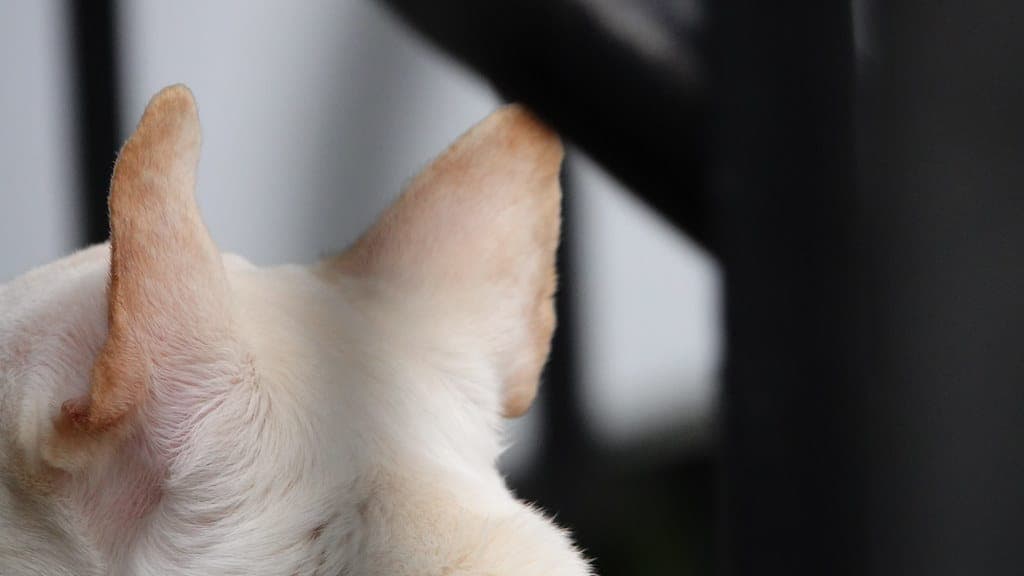
Ears are a fast-moving emotional barometer. Forward ears signal interest or alertness, soft ears drawn back often accompany friendly greetings, and ears pinned flat against the head usually mean fear or strong discomfort. Floppy and cropped ears make this harder to read, so watch the base of the ear. Learn the full vocabulary, including "airplane ears," in our guide to dog ear positions.
The eyes
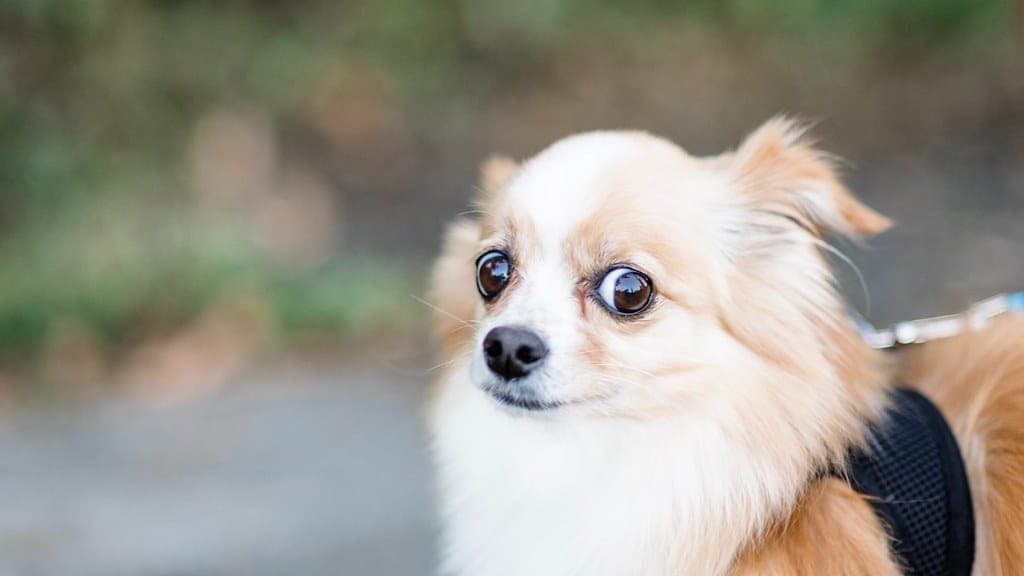
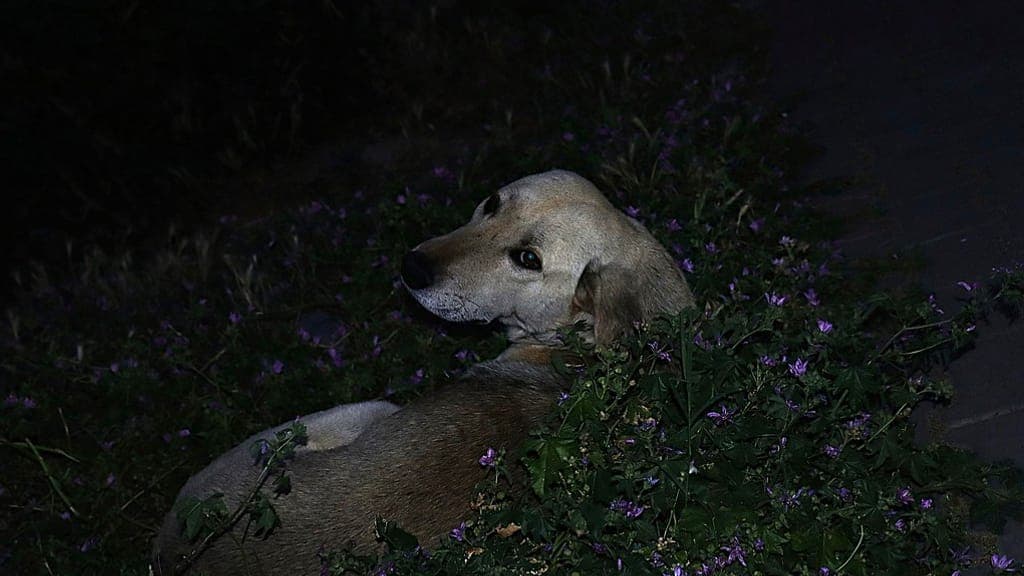
Soft, almond-shaped eyes with relaxed lids say "all is well." A hard, unblinking stare is a warning. Whale eye, where the whites of the eye (the sclera) show in a crescent as the dog keeps his head turned away but his eyes fixed on something, is one of the most important stress signals to recognize. Read more about whale eye, soft eyes and hard stares, including when it's fine to look a dog in the eyes.
The face and mouth
A relaxed, slightly open mouth with a loose tongue is the canine "smile." A closed, tight mouth, lips pulled back at the corner (the commissure), or a forward, puckered lip shows rising tension. A lip lift or snarl is an explicit warning. Dogs also have an inner-eyebrow muscle that wolves largely lack, which may help explain the famous puppy-dog eyes (Kaminski et al., 2019). Explore the details in our guide to dog facial expressions.
Submissive grin vs. snarl
Both expressions show teeth, so people confuse them in both directions. A submissive grin pulls the lips back sideways, often showing only the front teeth, and the dog delivering it is wiggly, squinting and usually heading toward you, sometimes with a sneeze. A snarl lifts the upper lip upward over the canines and wrinkles the top of the muzzle, and the body behind it is still or stiff.
When the face is hard to judge, look away from the mouth: movement toward you with a loose rear end points to a greeting, while stillness points to a warning. Close-up comparisons of both are in our guide to mouth and lip signals.
Posture and weight
Posture integrates everything. Is the weight shifted forward toward something or back away from it? Is the body loose, crouched, stiff or frozen? A dog who suddenly goes still is giving you important information. Our guide to dog posture meaning explains freezing, leaning, crouching and standing over another dog.
The coat and hackles
When the hair along a dog's shoulders, back or rump stands up, it's called piloerection. It's an involuntary sign of arousal, the canine equivalent of goosebumps, and it can occur with fear, excitement or play, not only aggression. See what raised hackles really mean before you assume the worst.
Signals and emotions: what your dog is feeling
Body parts combine into recognizable emotional states and social signals. These are the patterns that answer the question most owners actually have: how does my dog feel right now?
Invitations to play
The play bow, front end down and rear end up, is a dog's clearest way of saying "what comes next is a game." It often appears just before or after rough moves that might otherwise be misread. Learn how to tell a play bow from a stretch in our guide to what it means when your dog bows.
Calming signals and displacement behaviors
Norwegian trainer Turid Rugaas popularized the term calming signals for small behaviors that dogs use to defuse tension: turning the head away, sniffing the ground, slowing down, curving around another dog instead of approaching head-on, or walking between two dogs who are getting tense. Read the complete list in our guide to dog calming signals.
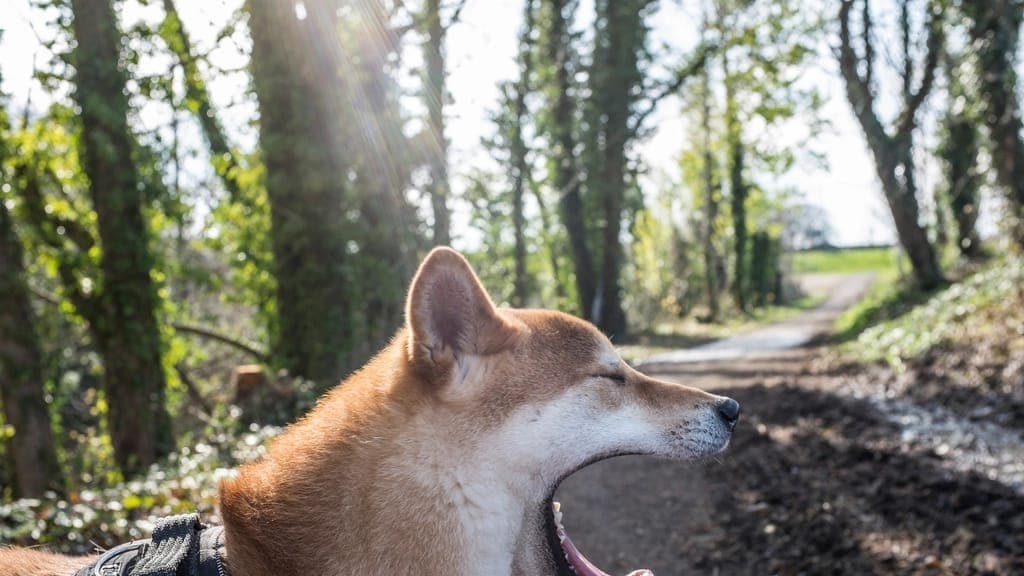
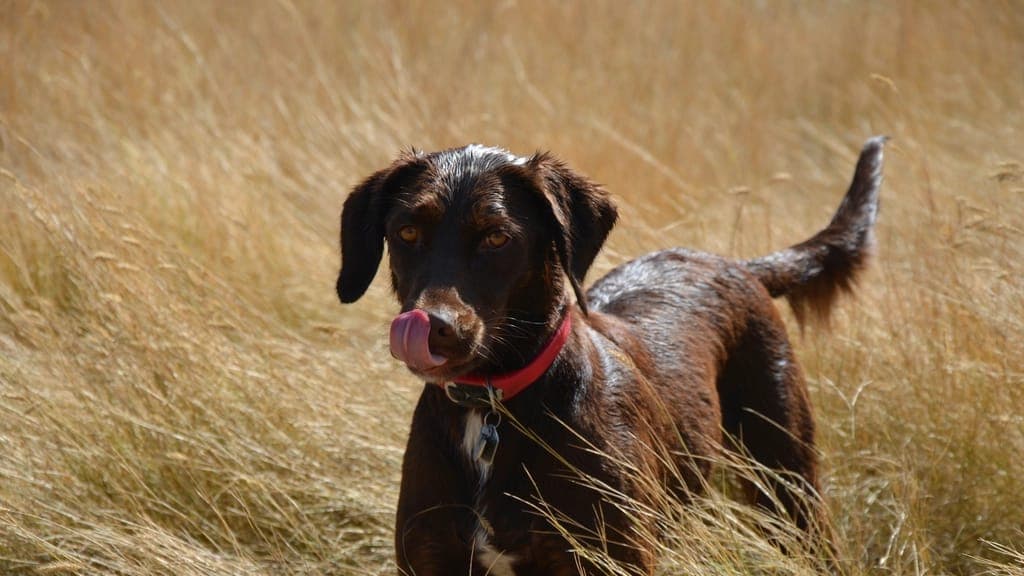
Closely related are displacement behaviors, normal actions that appear out of context when a dog feels conflicted. A dog who yawns when you hug her, licks his lips when a child approaches, or does a full-body shake-off after an awkward greeting is often releasing tension. Find out more about why dogs yawn, lick their lips and shake off.
Stress and anxiety
Stress shows up as a cluster: panting when it isn't hot, pacing, drooling, shedding suddenly, whale eye, ears back, tail lowered, sweaty paw prints and an inability to settle or take food. These are the signs of stress in dogs worth memorizing, because they come long before aggression or a meltdown.
Sweaty paws and dilated pupils
A few stress signs come from the autonomic nervous system rather than from anything the dog chooses to do, which makes them hard to fake. Dogs have sweat glands in their paw pads, so a nervous dog can leave damp prints on a vet's table or a shiny floor even in a cool room. Adrenaline also widens the pupils, so the eyes look darker and rounder than usual.
Treat both as supporting evidence rather than proof. Pupils also open up in dim light and during excited play, and paws get wet on dewy grass. Combined with a closed mouth and a frozen body, though, they confirm that a dog is under real strain.
Fear
Fear makes a dog smaller and more ready to escape: low body, tail tucked, ears pinned, weight shifted back, trembling, freezing or trying to hide. A frightened dog may still bite if escape is blocked. Learn how to recognize and help with scared dog body language.
Happiness and relaxation
Content dogs look loose. The mouth is soft and often open, the eyes are soft, the ears sit in their natural position, the tail is at or slightly below neutral and the body moves with fluid, wiggly curves. Our guide to happy dog body language shows the subtle differences between relaxed, playful and overexcited.
Aggression and warning signs
Aggression is almost always preceded by warnings: stiffening, freezing, a hard stare, a lip lift, a growl. Many dogs climb what behaviorists call the "ladder of aggression," moving from subtle signals to more obvious ones when the earlier ones are ignored. Learn the full sequence in our guide to aggressive dog body language and warning signs before a bite.
Offensive or defensive? Reading the threat style
Threat displays come in two broad flavors, and the difference tells you what the dog expects to happen next. A dog on the offensive moves into the conflict: body tall and pitched forward, tail up, ears aimed at the target, eyes direct. A dog on the defensive would rather leave: body lowered and pulled back, tail down, ears flattened, eyes showing white, teeth bared from a retracted mouth.
Mixed pictures, such as a forward lean with pinned ears, show a dog torn between approach and escape. No style is "safer." Defensive dogs often bite fast when cornered, and offensive dogs may close distance quickly, so both call for calm space and professional input. The full warning sequence is mapped in our guide to aggressive dog body language.
Showing the belly
A dog lying on her back can be relaxed and inviting a rub, or appeasing and asking you to stop approaching. Loose, wiggly and solicitous is different from stiff, with a tucked tail and averted eyes. Read why dogs show their belly before you reach in.
Rest and sleep
How a dog sleeps tells you about comfort, temperature and security. Belly-up sprawls usually mean a dog is very relaxed in his environment; a tight curl often conserves warmth. Discover what common dog sleeping positions can and can't tell you.
Puppies
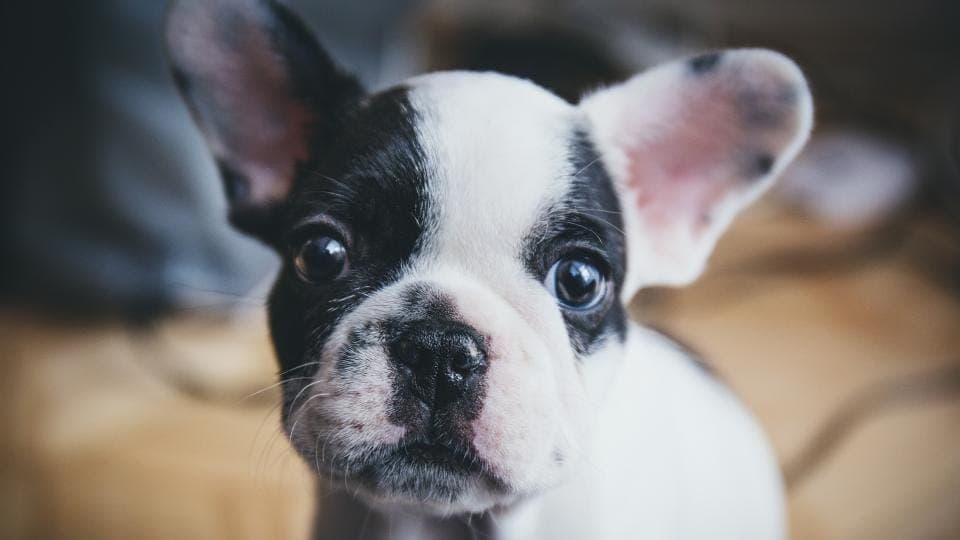
Puppies use the same language, but in an exaggerated, still-developing form. They tend to be wiggly, mouthy and loud, and their stress signals are easy to miss among all the bouncing. Our guide to puppy body language helps you tell play from overwhelm during those crucial early months.
Vocal communication: growls, barks and whines
Sounds add emotional intensity to what the body is already saying. Pair every sound with what you see.
Growling is communication, not misbehavior. A play growl during tug comes with a loose body and bouncy movement; a warning growl comes with stillness, a hard stare and a closed mouth. Punishing a growl removes the warning, not the feeling behind it. Read why dogs growl and what to do.
Barking varies in pitch, rhythm and context. Rapid, lower-pitched barks often accompany alarm, while higher-pitched, spaced barks are more typical of play or wanting something. Our guide to types of dog barks and what they mean breaks these down.
Whining usually signals wanting, frustration, anxiety or pain. Context and accompanying behavior, such as pacing or restlessness, tell you which. Find out why your dog is whining and when it points to a health issue.
Dog body language signs at a glance
This table summarizes common dog body language signs. Use it as a starting point, then confirm with the rest of the body and the situation. For a printable version to keep on the fridge, see our dog body language chart.
| Signal | Often means | Check also |
|---|---|---|
| Loose, sweeping tail wag with wiggly body | Friendly, social, happy to engage | Soft eyes, relaxed open mouth |
| High, stiff, fast tail wag | High arousal, possibly a challenge | Freezing, hard stare, closed mouth |
| Tail tucked under body | Fear, anxiety or pain | Ears pinned, body low, weight back |
| Ears pinned flat back | Fear or strong discomfort | Whale eye, trembling, lip licking |
| Ears forward with stiff body | Alert, focused, possibly about to react | Leaning forward, mouth closed |
| Whale eye (crescent of sclera) | Stress, guarding, wanting space | Head turned away, freezing |
| Soft eyes, relaxed lids | Calm and comfortable | Loose mouth, neutral ears |
| Lip licking or yawning out of context | Mild stress or conflict | What just happened around the dog |
| Play bow with bouncy movement | Invitation to play | Play face, loose body |
| Raised hackles | High arousal (fear, excitement or tension) | Whether the body is loose or stiff |
| Freezing or sudden stillness | Serious discomfort, possible warning before a bite | Hard stare, closed mouth |
| Lip lift or snarl | Clear warning to back off | Growl, stiff posture |
What is my dog trying to tell me? Common scenarios
Real life rarely looks like a textbook photo. Here are a few everyday situations and how to read them.
Your dog yawns and turns away while being hugged. Most dogs tolerate hugs rather than enjoy them. A yawn, a turned head and whale eye mean "I'm uncomfortable." Swap hugs for chest scratches and let your dog choose when to lean in.
Your dog's ears flatten and he licks his lips when a visitor reaches over his head. He's appeasing and asking for space. Ask guests to let him approach, crouch sideways and scratch the chest instead. Our guide on how to greet a dog has the full routine.
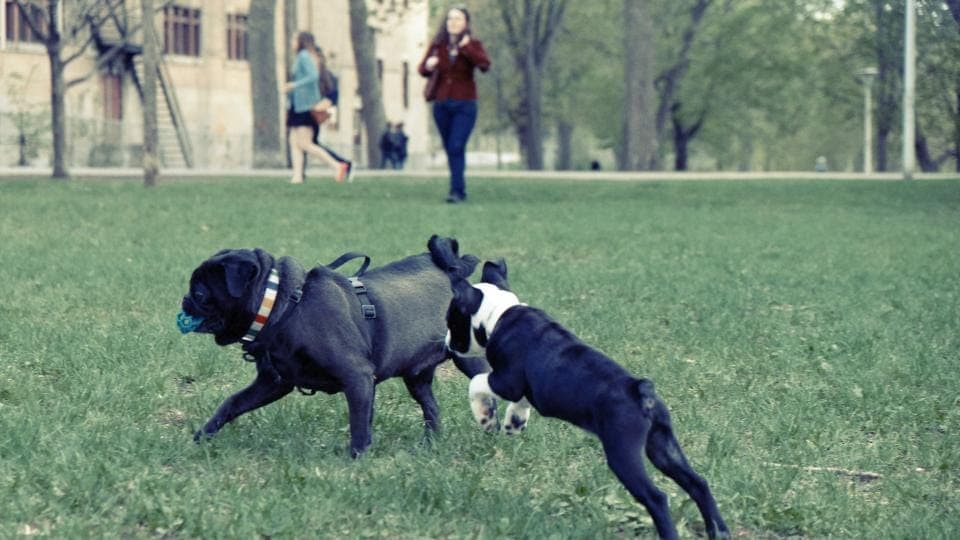
Two dogs are wrestling, growling and showing teeth. Loose, bouncy bodies, frequent role swaps and regular pauses all point to healthy play. If one keeps trying to escape or bodies go stiff, interrupt. See how to tell whether dogs are playing or fighting.
Your dog stares at you, then at the door, then back at you. That's a request, often for a walk or a potty break. Dogs are skilled at directing human attention with gaze alternation.
Your dog looks "guilty" when you come home to a chewed shoe. Research suggests the "guilty look" (ears back, eyes averted, tail low) is mostly a response to the owner's behavior in the moment, not evidence the dog understands what he did earlier (Horowitz, 2009). He's appeasing you, not confessing.
How signals escalate: the ladder of communication
Most dogs give a series of increasingly clear signals before they bite. A common version of this sequence runs roughly:
- Blinking, lip licking, yawning, turning the head away
- Turning the body away, walking away, sniffing the ground
- Ears back, crouching, tail tucked
- Freezing, hard stare, weight shifted forward or rigidly back
- Lip lift, snarl, growl
- Snap or air bite
- Bite
Dogs don't always climb every step in order. Dogs who've learned that early signals are ignored, or punished, may skip straight to the top. That's why the subtle signals at the bottom matter so much: when you respond to a lip lick by giving space, your dog never needs to growl.
Safety note: If your dog regularly growls, snaps or bites, or if you feel unsafe, work with a qualified professional such as a veterinary behaviorist or a certified behavior consultant. Our guide to choosing a dog trainer or a behaviorist explains the difference.
Dog body language and children
Children are the people least equipped to read the ladder above. Research with preschoolers has found that many of them read an angry, teeth-baring dog face as a happy one, and young children naturally do the things dogs find most intense: hugging, kissing faces, running past, and following a dog who has walked away. Their faces are also closer to the dog's head.
That puts the job of reading body language on the adults. Three signals deserve an immediate "child steps away" response: the dog leaving and the child following, a dog going still under a child's hand, and whale eye during cuddles. A gated, child-free retreat gives the dog a way to say no without escalating. Our family bite prevention guide sets out supervision routines and age-appropriate rules.
Context is everything: why single signals mislead
Every signal in this guide has more than one possible meaning. Panting can mean heat, exercise, pain or anxiety. Raised hackles can mean fear or excitement. Even the classic "smile" can be relaxed panting or a stressed, drawn-back grimace.
Three principles keep you accurate:
- Clusters beat single signals. Three stress signals together tell you far more than one.
- Change beats state. A dog whose mouth suddenly closes when a stranger approaches is giving you a clearer message than one whose mouth was closed all along.
- Trigger stacking is real. Stressors add up. A dog who copes with a visitor on a quiet day may snap at the same visitor after a vet visit and a thunderstorm.
Myth: "A dog who growls, stares or stands over another dog is trying to be dominant." Modern behavior science treats these as emotional and situational signals, not attempts to climb a household hierarchy. The idea that you must be the "alpha" has been rejected by veterinary behavior organizations (AVSAB, 2008). Read more about why the alpha dog myth is outdated.
Common dog body language myths
Folk wisdom about dogs is persistent, and a few beliefs regularly lead to bites or damaged trust. Here is what each one gets wrong.
| Myth | What is actually going on | Go deeper |
|---|---|---|
| "He's wagging, so he's happy and fine to pet." | A wag shows arousal, and even a genuinely friendly one is not consent to be touched. Let the dog come to you, pet briefly, then pause and see whether he asks for more. | Tail signals |
| "A belly-up dog wants a rub." | Many dogs roll over mid-greeting to slow things down. Reaching in can feel like pressure, not affection. | Belly-up dogs |
| "Her guilty face proves she knows she was bad." | The look is appeasement aimed at your mood right now. Scolding after the event only makes your arrival unpredictable. Preventing access to shoes and bins is what changes behavior. | The guilty look |
| "A growling dog is a bad dog." | The growler is often the safer dog. One whose growls have been punished out of her vocabulary may go straight from discomfort to a bite. A growl is a dog still talking. | Growling explained |
Breed, shape and individual differences
Dogs have been bred into shapes that change how their signals look. Docked tails remove one of the most visible signals. Heavy double coats can hide hackles. Floppy ears move less visibly than prick ears. Flat-faced (brachycephalic) breeds have less mobile faces and often show some sclera naturally. Researchers have even found that breeds that look more juvenile, or paedomorphic, tend to display fewer of the ancestral wolf-like signals (Goodwin et al., 1997).
Individual temperament matters too. Some dogs are expressive and dramatic; others are subtle and stoic. Some greyhounds naturally carry their tails low; many spitz-type dogs naturally curl theirs high. Always compare a dog to their own baseline, not to a generic picture.
Body language and your dog's health
Behavior changes are often the first sign of illness or pain. A dog in pain may become stiff, reluctant to move, quick to growl when touched in one area, or withdrawn. Hunched posture, a persistently low tail, squinting, frequent lip licking, restlessness at night and new sensitivity to handling all deserve attention.
Vet check: If your dog's body language changes suddenly, for example a friendly dog begins growling when touched, a confident dog starts hiding, or a dog stops wagging, book a veterinary exam before assuming it's a training problem. Our guide to sudden changes in dog behavior lists red flags.
Practice: how to get fluent
Like any language, fluency comes from exposure and feedback. A few practical habits help:
- Film everyday moments. Watch them back in slow motion. You'll spot lip licks and freezes you missed live.
- Watch other dogs at a distance. A café patio or park bench offers a stream of greetings to read without pressure. Our guide to dog park body language shows what to look for in groups.
- Test yourself. Try our dog body language quiz to see how many signals you can identify from photos and scenarios.
- Learn the vocabulary. Terms like commissure, piloerection, displacement behavior and trigger stacking are defined in plain English in our dog behavior glossary.
- Teach children the basics. Kids are bitten most often by dogs they know. Our dog bite prevention guide for families gives simple rules children can follow.
Putting it together
Reading dog body language comes down to one habit: look at the whole dog, in context, and respond to what you see. When your dog is loose and wiggly, enjoy the moment. When you see stiffness, stillness, lip licks or a turned head, slow down and give space. Your dog will learn that their quiet signals work, and they'll have less reason to shout.
Start with your own dog today. Spend five minutes observing their relaxed baseline, then work through the body-part guides, starting with tail wagging and ear positions, and keep the printable chart nearby. If you want to understand the broader picture of why dogs act the way they do, continue to our guide to dog behavior explained.
Frequently asked questions
What is my dog trying to tell me with body language?
Most of the time your dog is telling you one of a few things: I'm comfortable, I want something, I'm unsure, or I need space. Look at the ears, eyes, mouth, tail and weight distribution together, then ask what just changed around your dog. The combination, not any single part, reveals the message.
How can I learn to read dog body language faster?
Start by learning what your own dog looks like when fully relaxed, because every other state is a change from that baseline. Then watch short moments, such as greetings or a knock at the door, and describe the ears, eyes, mouth, tail and posture out loud. Practice with photos, charts and quizzes speeds this up considerably.
Is a wagging tail always a sign of a happy dog?
No. A wagging tail means a dog is emotionally aroused and engaged, not necessarily happy. A loose, sweeping wag with a wiggly body usually is friendly, but a high, stiff, fast wag can come before a bite, and a low, slow wag often signals uncertainty. Always read the tail alongside the rest of the body.
Do all dogs use the same body language?
Dogs share the same basic signal system, but breed shape and individual history change how it looks. Docked tails, heavy coats, floppy or cropped ears and flat faces can hide or exaggerate signals. Some dogs are also more expressive than others, so it pays to learn each dog's normal resting expression and posture.
What body language means a dog might bite?
Warning signs include freezing, a hard stare, a closed tense mouth, whale eye, weight shifted forward or rigidly away, a high stiff tail, a lip lift, snarling and growling. Many dogs show earlier stress signals first, such as lip licking or turning away. If you see these, stop what you're doing and calmly give the dog space.
Is whale eye ever normal in dogs?
Some white showing is not always a warning. Flat-faced breeds and dogs with prominent eyes often show sclera at the corners all the time, and any dog may flash white when glancing sideways or looking up while lying down. Whale eye matters when the head is turned away but the eyes stay locked on something, together with a tense mouth or stillness. Compare it with your dog's relaxed face.
Why can't I always see my dog's hackles go up?
Coat type makes a big difference. Thick double coats, long or curly coats and wiry coats can hide piloerection almost completely, while short, smooth coats show it clearly. Rhodesian Ridgebacks carry a permanent ridge of reversed hair that is not raised hackles at all. If the coat hides this signal, rely more on posture, tail carriage, mouth tension and the eyes to judge arousal.
Why do dogs yawn, lick their lips or sniff the ground when nothing seems to be happening?
Usually something is happening that we have overlooked, such as a camera pointed at the dog, someone leaning over her, a raised voice or another dog staring from across the room. These out-of-context actions are displacement or calming signals that release tension. Note what changed just before, ease the pressure, and treat them as an early, polite request rather than a quirk.
Does a dog rolling onto her back mean she is being submissive?
Not in the old dominance sense. Rolling over can be appeasement, a way of saying she means no harm and would like things to slow down, but it can also be play, cooling off, comfort or a learned bid for attention. The rest of her body tells you which: loose and wiggly means relaxed or playful, while stiff, still and tucked means she wants space.
Sources & further reading
- Rugaas, T. (2006). On Talking Terms With Dogs: Calming Signals (2nd ed.). Dogwise Publishing.
- Handelman, B. (2008). Canine Behavior: A Photo Illustrated Handbook. Dogwise Publishing.
- Aloff, B. (2005). Canine Body Language: A Photographic Guide. Dogwise Publishing.
- Quaranta, A., Siniscalchi, M., & Vallortigara, G. (2007). Asymmetric tail-wagging responses by dogs to different emotive stimuli. Current Biology, 17(6), R199-R201.
- Kaminski, J., Waller, B. M., Diogo, R., Hartstone-Rose, A., & Burrows, A. M. (2019). Evolution of facial muscle anatomy in dogs. Proceedings of the National Academy of Sciences, 116(29), 14677-14681.
- Horowitz, A. (2009). Disambiguating the 'guilty look': Salient prompts to a familiar dog behaviour. Behavioural Processes, 81(3), 447-452.
- Goodwin, D., Bradshaw, J. W. S., & Wickens, S. M. (1997). Paedomorphosis affects agonistic visual signals of domestic dogs. Animal Behaviour, 53(2), 297-304.
- American Veterinary Society of Animal Behavior. (2008). Position Statement on the Use of Dominance Theory in Behavior Modification of Animals.
This guide is for education only and does not replace an in-person assessment. If your dog's behavior changes suddenly, or you are worried about bites or aggression, speak to your veterinarian or a qualified behavior professional. See our disclaimer.