Body parts
Raised Hackles in Dogs: What Piloerection Really Means
Raised hackles mean arousal, not automatically aggression. Learn what the ridge of fur on your dog's back is telling you and how to read it in context.
Key takeaways
- Raised hackles (piloerection) are an involuntary reflex driven by the sympathetic nervous system, so they signal arousal rather than one specific emotion.
- Fear, excitement, surprise, uncertainty and defensive aggression can all raise a dog's hackles, which is why the rest of the body matters more than the hair.
- Hackles up while playing is common and usually fine if the play stays loose, bouncy and balanced, with frequent short breaks.
- Raised hackles combined with a stiff body, hard stare, closed mouth or freezing mean a dog needs more space right now.
- Never punish raised hackles; your dog cannot control them, and the helpful response is to add distance and let arousal settle.
Jump to a section
- What raised hackles are: piloerection in dogs
- Why do dogs' hackles go up?
- Dog hair standing up on the back: reading where it rises
- Are raised hackles a sign of aggression?
- Hackles up while playing: normal or a warning?
- A quick checklist for reading hackles in context
- Breed and coat differences
- What to do when your dog's hackles go up
- Putting it together
When a dog's hackles go up, the hair along her neck, shoulders, back or rump stands on end because tiny muscles at the base of each hair contract. This reflex, called piloerection, tells you your dog is aroused: something has spiked her adrenaline. It does not, by itself, tell you whether she feels afraid, excited, unsure or ready to defend herself.
That missing piece is why raised hackles cause so much confusion. The same ridge of fur shows up on a dog wrestling happily with a friend and on a dog about to snap at a stranger. To read it correctly you have to look at the whole animal, the situation and what happens next, which is the core skill covered in our complete guide to dog body language.
What raised hackles are: piloerection in dogs
"Hackles" is the everyday name for the strip of hair that runs from the back of a dog's neck down the spine toward the tail. The scientific term for hair standing up is piloerection. Each hair follicle has a small arrector pili muscle attached to it, and when that muscle contracts, the hair is pulled upright.
These muscles are controlled by the sympathetic nervous system, the same branch responsible for the fight, flight or freeze response. When your dog perceives something important, adrenaline (epinephrine) is released, her heart rate climbs, her pupils may dilate and the hair along her back lifts. People experience a faint version of the same reflex as goosebumps.
The key point for owners: piloerection is involuntary. Your dog is not choosing to raise her hackles any more than you choose to get goosebumps. It is a readout of her internal state, not a deliberate message.
Myth: "Raised hackles mean a dog is being dominant." Piloerection is an arousal reflex, not a status display, and the idea that dogs constantly try to outrank their people is outdated. See why dominance-based training has been abandoned by modern behavior professionals.
Why do dogs' hackles go up?
Anything that sharply increases arousal can trigger piloerection. The most common causes are:
- Fear or alarm: an unexpected noise, a person looming out of the dark, an unfamiliar dog approaching fast.
- Excitement: a favorite playmate, a squirrel, a game of chase.
- Uncertainty or conflict: your dog is not sure whether something is safe and is gathering information.
- Defensive or offensive aggression: a dog preparing to guard, warn or fight.
- Startle: being woken suddenly or bumped from behind.
Raised hair also makes a dog look bigger, which is one reason the reflex is thought to have survived in canids and many other mammals. A taller silhouette may help discourage a threat without a fight. Whether your dog "means" to look bigger is a separate question; the reflex happens automatically.
Dog hair standing up on the back: reading where it rises
Owners often notice the hair standing up in different places from one moment to the next. Some trainers have proposed rules linking the pattern to confidence, but these are informal observations rather than established science. Treat the table below as a list of things to notice, not a code to decode.
| Where the hair stands up | What it often accompanies | What to check next |
|---|---|---|
| Over the shoulders and neck only | Alert attention, early arousal, sizing up something new | Is the body loose or stiffening? Is the mouth soft or closed? |
| Over the rump and tail base only | Mixed arousal or uncertainty | Is weight shifting back? Is the tail low or tucked? |
| Shoulders and rump, gap in the middle | Rising arousal in a dog who is unsure | Avoidance (turning away, lip licking) or forward movement? |
| One continuous stripe from neck to tail | High arousal | Play signals, or stiffness and staring? Decide quickly. |
| Wide, puffed patch over much of the body | Very high arousal, often startle or fear | Give space; this dog is near or over threshold |
What matters more than the shape is the trend. Hackles that flick up for a second and settle as your dog sniffs and moves on are very different from hackles that rise and stay up while her body goes rigid.
Are raised hackles a sign of aggression?
Not on their own. Raised hackles mean "aroused," and aggression is only one possible outcome of arousal. Plenty of dogs raise their hackles when they are nervous and would much rather leave. Many raise them during perfectly friendly play.
That said, hackles are often present when a dog is moving toward aggressive behavior, because aggression almost always involves high arousal. The signals that tell you a dog with raised hackles may escalate are:
- A stiff, still body or sudden freezing, explained in our guide to reading dog posture
- A hard, fixed stare, or whale eye showing the whites
- A closed, tight mouth, a lip lift, a snarl or a growl
- A high, rigid tail that moves slowly or not at all (compare the different tail positions and wags)
- Weight leaning forward onto the front legs, or weight shifted back with a tucked tail, which is fear that may turn defensive
If you see hackles with several of these signals, read our breakdown of aggressive dog body language and create distance immediately.
Safety note: Never reach over, grab the collar of, or step between dogs whose hackles are up and whose bodies are stiff. Calmly increase distance instead. If your dog regularly reaches this state, work with a certified behavior consultant (CDBC or CAAB) or a veterinary behaviorist.
Hackles up while playing: normal or a warning?
Hackles up while playing is extremely common and, on its own, nothing to worry about. Play is an exciting, high-energy activity, and excitement triggers the same reflex as alarm. Many dogs who adore each other keep a ridge of fur standing up through a whole wrestling session.
What separates healthy play from a brewing fight is the quality of the movement, not the hair. Look for:
- Play signals: play bows, bouncy loping, an open "play face" mouth, and exaggerated, inefficient movements. Ethologist Marc Bekoff described these signals as punctuation that keeps rough play clearly marked as play.
- Role reversal: dogs take turns chasing and being chased, being on top and on the bottom.
- Self-handicapping: the bigger or stronger dog softens bites and lets the other one "win."
- Breaks: brief pauses to sniff, shake off or look away, after which both dogs choose to re-engage.
Step in if the movement becomes stiff and straight-lined, one dog is always pinned or trying to escape, vocalizations change pitch, or play stops while the staring continues. Our guide to telling whether dogs are playing or fighting includes a simple consent test you can use.
Pro tip: A cheerful recall every couple of minutes lets arousal drop before it tips over. If both dogs bounce straight back to each other afterward, play is going well.
A quick checklist for reading hackles in context
Run through these questions whenever you notice your dog's hackles up:
- Trigger: What just happened? A new dog, a sudden noise, a person approaching, a toy, food?
- Body: Is it loose and wiggly, or stiff and still?
- Weight: Is it centered, leaning forward or shifted back?
- Face: Soft eyes and an open mouth, or a hard stare and a closed mouth?
- Ears and tail: Relaxed and mobile, or pinned, tucked, or high and rigid?
- Movement: A curvy, bouncy approach, or a straight-line beeline?
- Trend: Do the hackles settle within a few seconds, or do they rise further?
If most of your answers point to looseness and movement, you are probably watching excitement. If most point to stillness and tension, act on it.
Breed and coat differences
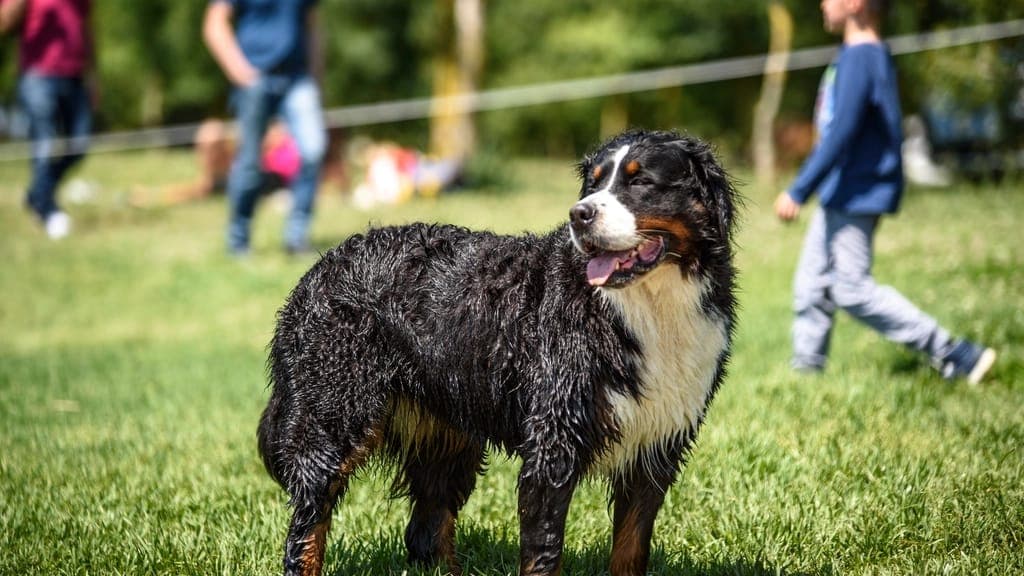
How visible piloerection is depends heavily on coat. Smooth, short-coated dogs such as Boxers, Vizslas, Labradors and pit bull-type dogs show raised hackles clearly. Dogs with thick double coats, such as Huskies, Malamutes and Chow Chows, may show only a subtle puff, and long, corded or heavily groomed coats can hide it altogether.
A few breeds carry a permanent ridge. The Rhodesian Ridgeback and Thai Ridgeback have a stripe of hair growing in the opposite direction along the spine. That is a coat feature, not raised hackles, and it does not change with mood.
Individual dogs vary too. Some raise their hackles at the slightest surprise; others rarely do, even when quite upset. That is another reason to treat hackles as one data point among many.
What to do when your dog's hackles go up
- Stay calm and keep breathing. Tension travels down the leash, and a tight leash can add to your dog's arousal.
- Identify the trigger. Look where your dog is looking.
- Create distance. Turn and walk away in an arc, or put a parked car, tree or fence between your dog and the trigger.
- Give her something easy to do. Scatter a few treats for a sniffing break, or ask for a simple, well-known cue.
- Watch the hackles settle. Once her body softens and she can take food gently, she is back under threshold.
- Note the pattern. Triggers that raise her hackles again and again are good candidates for desensitization and counter-conditioning, practiced at a distance where she stays relaxed.
Dogs who lunge and bark on leash while their hackles are up usually benefit from a structured plan; our guide to leash reactivity walks through one.
Do not scold or correct a dog for raised hackles. Punishment cannot switch off an involuntary reflex, and it adds fear and conflict to an already aroused dog, which raises the risk of a bite.
Vet check: If your dog suddenly starts raising her hackles at familiar people, dogs or situations she used to handle easily, pain or illness may be lowering her tolerance. Book a vet exam, and see our guide to sudden behavior changes for other signs to watch.
Putting it together
Raised hackles are your dog's adrenaline made visible. They tell you something has her full attention, and they invite you to look closer: at her posture, face, tail and movement, and at whatever triggered the response. Most of the time that closer look shows an excited player or a startled dog who settles within seconds.
The next time the fur along her back stands up, run the checklist, add distance if you are unsure, and let the rest of her body tell the story. For busy settings where several dogs are aroused at once, our guide to dog park body language shows how to apply the same skills in real time.
Frequently asked questions
Is it bad when a dog's hackles go up?
No. Raised hackles are an involuntary arousal reflex, similar to goosebumps in people. They mean your dog's adrenaline has spiked because something caught her attention, which may be exciting, worrying or threatening. Look at the rest of her body: a loose, wiggly dog with raised hackles is usually fine, while a stiff, staring dog with raised hackles needs space right away.
Why does my dog's hair stand up when he sees other dogs?
Meeting another dog is one of the most arousing moments in a dog's day. The hair may rise from excitement, uncertainty, frustration on leash or fear. Watch how he approaches: a curved, loose approach with sniffing suggests interest, while freezing, staring or lunging suggests stress. If it happens on most walks, a reactivity plan built on distance and positive reinforcement can help.
Do a dog's hackles go up when scared?
Often, yes. Fear triggers the same sympathetic nervous system response as excitement, so a frightened dog may raise her hackles along with a tucked tail, flattened ears, a lowered body and weight shifted away from the trigger. A scared dog with raised hackles may bite if she feels trapped, so give her an escape route instead of approaching or reaching for her.
Can puppies raise their hackles?
Yes. Puppies have the same reflex and often show raised hackles during rough play, when startled or when meeting something new. It is usually brief and does not mean you have an aggressive puppy. Use it as a prompt to check how your puppy is coping: if she recovers quickly and stays curious, carry on; if she backs away or freezes, add distance and slow down.
Should I stop my dog when his hackles are up?
Do not scold or punish, because he cannot control the reflex. Instead, manage the situation calmly. If he is playing loosely, let play continue with regular breaks. If he is stiff, staring or fixated, move him away from the trigger, offer a sniffing break or an easy cue, and let his arousal settle. Repeated episodes are worth discussing with a qualified behavior professional.
Sources & further reading
- Overall, K. L. (2013). Manual of Clinical Behavioral Medicine for Dogs and Cats. Elsevier Mosby.
- Horwitz, D. F., & Mills, D. S. (Eds.). (2009). BSAVA Manual of Canine and Feline Behavioural Medicine (2nd ed.). British Small Animal Veterinary Association.
- Aloff, B. (2005). Canine Body Language: A Photographic Guide. Dogwise Publishing.
- Bekoff, M. (1995). Play signals as punctuation: The structure of social play in canids. Behaviour, 132(5-6), 419-429.
- American Veterinary Society of Animal Behavior. (2008). Position Statement on the Use of Dominance Theory in Behavior Modification of Animals.
This guide is for education only and does not replace an in-person assessment. If your dog's behavior changes suddenly, or you are worried about bites or aggression, speak to your veterinarian or a qualified behavior professional. See our disclaimer.