Body parts
Dog Posture Meaning: How to Read the Whole Body, Not Just the Tail
Posture ties every signal together. Learn what stiffness, freezing, leaning, crouching and weight shifts tell you about your dog.
Key takeaways
- Posture integrates every other signal and shows whether a dog wants to move toward something or away from it.
- Loose, curved, bouncy bodies usually mean comfort, while straight lines, stiffness and stillness mean rising tension.
- Freezing is one of the most important warning signs and often comes immediately before a snap or bite.
- Weight shifted forward signals approach or confidence, while weight shifted back signals avoidance, fear or uncertainty.
- Standing over another dog is not about dominance; it is a social pressure signal that should be judged by how the other dog responds.
Jump to a section
Dog posture shows whether your dog wants to move toward something or away from it, and how tense she feels about it. A loose, balanced, curvy body means comfort. Weight shifted forward signals interest or confidence, weight shifted back signals worry, and stiffness or freezing is a warning that tension is rising fast.
Posture is the frame that holds every other signal together. A wagging tail on a stiff, frozen body means something very different from the same wag on a loose, wiggly one. That's why experienced trainers read posture first when learning dog body language, and then fill in the details from the ears, eyes, mouth and tail.
The big picture: loose and curvy versus stiff and straight
The fastest posture check is to ask one question: is this dog loose or tight?
Loose and curvy looks like: relaxed muscles, a soft, bending spine, bouncy or fluid movement, weight evenly spread, the head carried naturally, and a tail that moves freely. This is a comfortable dog.
Stiff and straight looks like: hard, tense muscles, a straight back, slow or halted movement, weight committed in one direction, and a still or rigidly held tail. This is a dog whose arousal, worry or frustration is climbing.
Most of what follows is a more detailed version of this distinction.
Dog posture meaning chart
| Posture | Likely meaning | Look for |
|---|---|---|
| Balanced, loose, weight evenly spread | Relaxed, comfortable | Soft eyes, open mouth, neutral tail |
| Loose, bouncy, curved, wiggly | Friendly, playful | Play face, play bows, sweeping wag |
| Stiff, upright, weight forward | Confident arousal, possible challenge | Hard stare, closed mouth, high tail |
| Frozen, completely still | Serious warning, assessing, guarding | Hard stare, whale eye |
| Weight shifted back | Avoidance, fear, uncertainty | Ears back, head turned away |
| Crouched low, weight back | Fear or appeasement | Tail tucked, ears pinned |
| Crouched low, weight forward, intense focus | Stalking in play or herding | Quick release into a chase |
| Hunched back, tucked belly | Possible pain or discomfort | Reluctance to move, restlessness |
| Standing over another dog | Social pressure, play or rudeness | The other dog's response |
Dog stiff body language
A stiff body is one of the clearest signs that something has shifted. The muscles harden, the movement slows or stops, and the dog may hold her head and tail in a fixed position. You might notice the change most easily when you're touching your dog: she suddenly feels hard under your hand.
Stiffness can come from fear, frustration, guarding, high excitement or anticipation of a confrontation. Context tells you which, but the response is the same: stop adding pressure. Don't lean in, reach or stare. Give the dog space and let her body soften before continuing.
Stiffness often travels with raised hackles and a high, rigid tail. Together, these say the dog is highly aroused, and whether that arousal tips into play or conflict depends on what happens next.
Dog freezing meaning
A freeze is a moment of total stillness. It can last several seconds or be so brief that you only spot it on video. Freezing is a decision point: the dog is assessing the situation and deciding what to do.
Common contexts for freezing include:
- A dog guarding a bone or food bowl as someone approaches
- A dog being hugged, restrained or reached for
- Two dogs meeting nose to nose
- A dog spotting a trigger on a walk
Outside play, a freeze combined with a hard stare and closed mouth is one of the most serious warnings a dog can give. It often comes immediately before a snap, lunge or bite. Our guide to aggressive dog body language explains where freezing sits in the escalation sequence.
Safety note: If a dog freezes while you're touching or approaching him, stop moving, look away and slowly withdraw your hand or body. Don't push through the freeze to "finish" what you were doing. Calm withdrawal is the safest response.
Freezing in play
Dogs also freeze in play, but these freezes look different. They're brief, often happen in a crouched or stalking position, and end in an explosive bounce, chase or play bow. The body stays loose even while still, and the face looks soft. That's healthy play punctuation, not a warning.
Dog leaning forward
When a dog shifts his weight onto his front legs, he's oriented toward something. On a loose, curious dog with a soft face and sniffing nose, forward weight is interest. You'll see it when he investigates a new smell or tentatively approaches a person.
Forward weight with a stiff body, high tail, forward ears, closed mouth and hard stare is different. This is confident, potentially offensive arousal, the posture of a dog who may be about to lunge or challenge. Increase distance and redirect his attention before he commits.
Note that dogs also lean into people. A dog pressing his body against your legs is usually seeking contact or reassurance, which we explain in our article on why dogs lean on people.
Dog weight shift back
Weight shifted back onto the hind legs means a dog is pulling away from something. The front legs may be braced, the head lowered or turned, and the ears drawn back. The dog may be uncertain, worried or preparing to flee.
A backward weight shift is a very useful early signal because it appears before more obvious fear. If you see a dog lean back while a stranger reaches toward her, she's saying "not yet" or "no thanks." Respect it: invite rather than approach, and let her choose to come forward.
The raised front paw
A single front paw lifted and held off the ground often appears at the same decision point. It can signal uncertainty or mild anxiety, especially with a lowered head, a lip lick and weight shifted slightly back. In other contexts it reflects anticipation, such as a dog waiting for a ball, or intense focus, as in pointing breeds locking onto a scent. As always, the rest of the body tells you which: a loose dog with soft eyes is curious, while a still dog with ears back is unsure.
Dog crouching low
A crouch has two very different meanings depending on where the weight goes.
Crouching with weight back: fear or appeasement
A dog crouching low with weight back, tail tucked, ears pinned and eyes averted is frightened or appeasing. He's trying to look small and non-threatening. Don't loom over him or reach for him. Turn sideways, crouch at a distance and let him approach if he wants to.
Crouching with weight forward: stalking and play
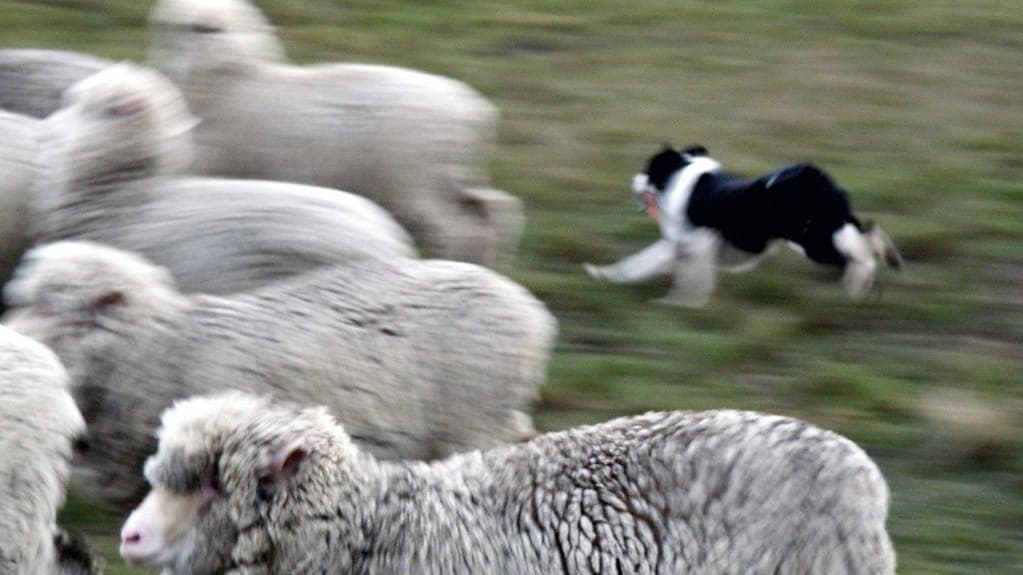
A dog crouching low with weight forward, eyes fixed on a toy or another dog and muscles coiled is often stalking, a normal part of play, especially in herding breeds. The tell is what follows: a sudden bounce, chase or play bow. If the other dog is enjoying the game and takes turns chasing, all is well.
Dog standing over another dog
Standing over is when one dog positions himself above or across another dog, sometimes placing his chin, chest or front paws on the other dog's shoulders or back. Many people call this "dominance," but that label isn't helpful. Modern behavior science doesn't support the idea that dogs are constantly striving for rank over each other or over people (AVSAB, 2008). Read more in our article on why the alpha dog myth is outdated.
Standing over can happen:
- In play, when it's brief, loose and followed by role reversals
- In tense greetings, when it's stiff, slow and the other dog freezes
- From overexcited or socially inexperienced dogs, who simply haven't learned polite manners yet
The key is the other dog's response. If the dog underneath stays loose, wriggles free and keeps playing, it's fine. If he freezes, tucks his tail, turns his head away or tries to leave, interrupt calmly and give both dogs a break. Our guide on whether dogs are playing or fighting gives more detail.
Posture and pain
Changes in posture are some of the earliest signs of pain. A hunched back, tucked belly, stiff gait, reluctance to sit or lie down, shifting weight off one leg, or holding the head low can all indicate discomfort. Some dogs adopt a "prayer" position, front end down and rear end up, held for a long time, which can indicate abdominal pain.
Vet check: If your dog's usual posture changes, especially with restlessness, reluctance to move, vomiting or a sudden change in temper, see a vet promptly. Our guide to sudden changes in dog behavior lists other warning signs.
Putting it together
Next time you watch your dog, start with posture before anything else. Ask: is she loose or tight? Is her weight forward, back or balanced? Is she moving or still? Then check the face, ears and tail to fill in the details.
That simple sequence, posture first and details second, catches most warning signs early and keeps you from being fooled by a single misleading signal like a wagging tail.
Frequently asked questions
What does it mean when a dog's body goes stiff?
A stiff body means a dog's arousal or worry has risen sharply. The muscles tense, movement becomes slow or stops, and the dog may hold a hard stare. It can occur with fear, guarding, frustration or the moment before a reaction. Stop approaching, avoid staring and calmly create distance until the dog's body loosens again.
Why does my dog freeze?
Dogs freeze when they are assessing a threat, feel trapped, are guarding something or are about to react. A freeze may last only a fraction of a second. In play, brief freezes followed by a bounce are normal. Outside play, a freeze with a hard stare or closed mouth is a serious warning, so pause and give the dog room.
Why does my dog crouch low when he sees other dogs?
Crouching low can mean fear, appeasement or stalking. A fearful dog crouches with weight shifted back, tail tucked and ears pinned. A herding-type dog may crouch with intense focus before springing into play. Watch the weight and face: forward weight with a soft, bouncy release is usually play, while backward weight and tension mean worry.
Is my dog dominant if he stands over other dogs?
No. Standing over another dog, sometimes with the chin or a paw on the shoulders, is a form of social pressure that can happen in play, in tense greetings or when a dog is rude or overexcited. It isn't evidence of a fixed rank. What matters is how the other dog responds. If they try to move away or freeze, interrupt calmly.
Sources & further reading
- Handelman, B. (2008). Canine Behavior: A Photo Illustrated Handbook. Dogwise Publishing.
- Aloff, B. (2005). Canine Body Language: A Photographic Guide. Dogwise Publishing.
- Goodwin, D., Bradshaw, J. W. S., & Wickens, S. M. (1997). Paedomorphosis affects agonistic visual signals of domestic dogs. Animal Behaviour, 53(2), 297-304.
- American Veterinary Society of Animal Behavior. (2008). Position Statement on the Use of Dominance Theory in Behavior Modification of Animals.
- Horwitz, D. F., & Mills, D. S. (Eds.). (2009). BSAVA Manual of Canine and Feline Behavioural Medicine (2nd ed.). British Small Animal Veterinary Association.
This guide is for education only and does not replace an in-person assessment. If your dog's behavior changes suddenly, or you are worried about bites or aggression, speak to your veterinarian or a qualified behavior professional. See our disclaimer.