Body parts
Dog Facial Expressions: Reading the Mouth, Lips and the 'Smiling' Dog
Is your dog smiling, grinning, or warning you? Learn to read the mouth, lips and brow, and discover the science of puppy dog eyes.
Key takeaways
- A relaxed, slightly open mouth with a loose tongue and soft eyes is the closest thing to a genuine dog smile.
- A submissive grin shows the front teeth with horizontally drawn-back lips and a wiggly, lowered body, and it is an appeasing greeting rather than a threat.
- A closed, tight mouth and lips pulled back or pushed forward at the commissure signal rising tension.
- A lip lift and a snarl are clear warnings that should never be punished, because they allow a dog to communicate without biting.
- Dogs have a well-developed inner-eyebrow muscle that wolves largely lack, which helps produce puppy dog eyes.
Jump to a section
Dog facial expressions are read mainly through the mouth, lips and brow. A loose, slightly open mouth with a soft tongue is the canine "smile" of a relaxed dog. A closed, tight mouth signals tension, a submissive grin is a friendly appeasement gesture, and a lip lift or snarl is a clear warning to back off.
The tricky part is that very different expressions can look alike in a photo. A stressed dog panting with the lips pulled far back can resemble a happy smile, and a friendly grin can look like a snarl to the untrained eye. To read faces accurately, you need to look at the eyes, ears and body too, which is the core principle of all dog body language. This guide shows you how.
The anatomy of a dog's face
A few terms make facial expressions much easier to describe:
- Commissure: the corner of the mouth, where upper and lower lips meet. Whether it's pulled back, relaxed or pushed forward is one of the most useful facial clues.
- Muzzle: the nose and mouth area. Wrinkling across the top of the muzzle shows tension.
- Brow: the area above the eyes. Furrows and raised inner eyebrows change the whole expression.
- Lips and flews: the upper lips, which can be tight, relaxed or lifted.
Reading flat-faced, heavy-lipped and bearded dogs
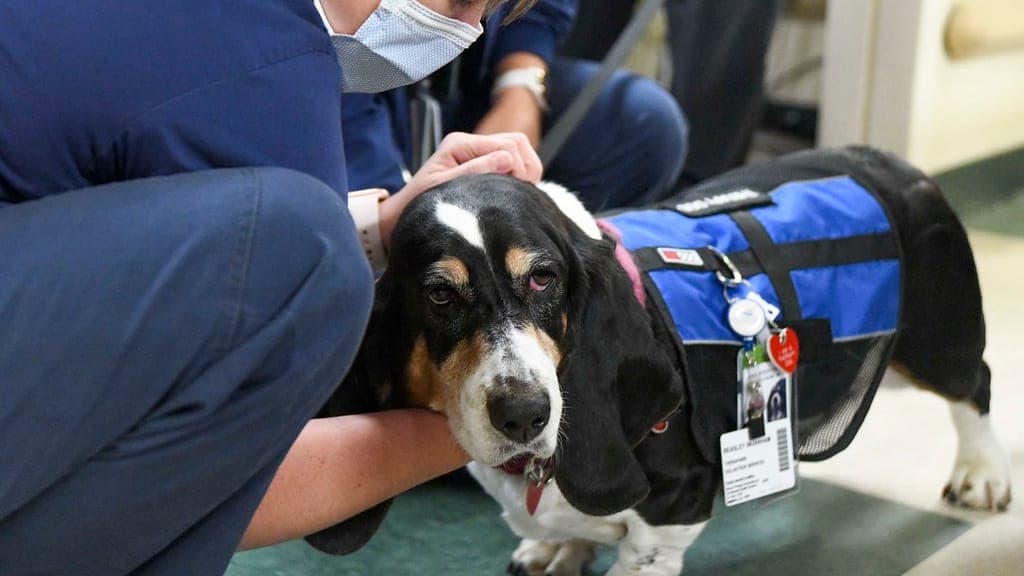
Breed matters a lot. Flat-faced (brachycephalic) dogs such as Bulldogs and Pugs have shorter, less mobile muzzles, so the commissure and lip movements are harder to see, and many pant more at rest because of their airway anatomy. Heavy-lipped dogs such as Mastiffs and Bloodhounds may look sad or tense when they're perfectly relaxed, and their loose flews can hide a lip lift. Bearded and heavily coated breeds, such as Schnauzers and Old English Sheepdogs, cover much of the mouth and brow.
With these dogs, lean more on the eyes, ears, head position and posture, and learn your individual dog's neutral face first. Photos taken when your dog is clearly relaxed make a useful reference point.
Dog smiling meaning
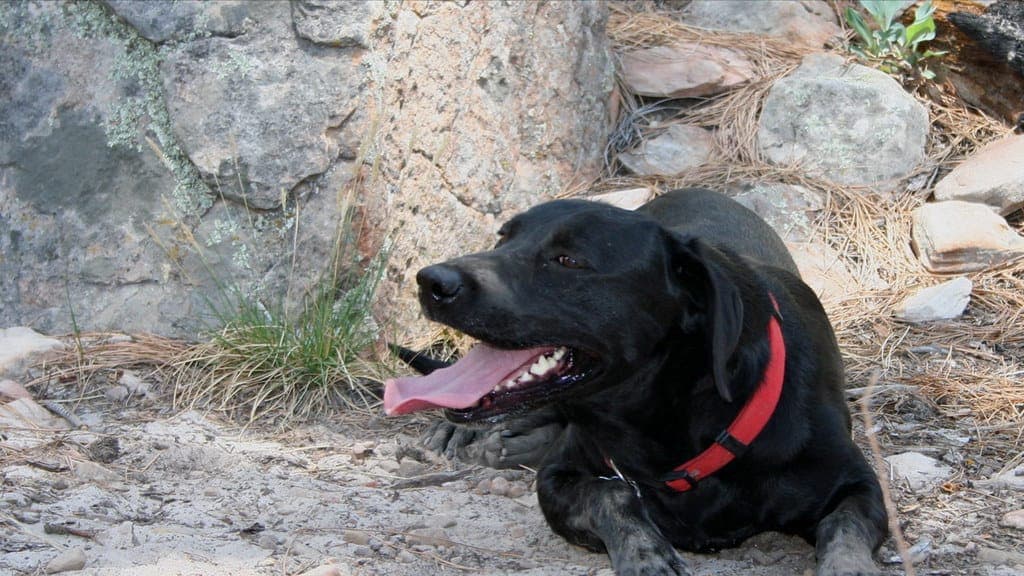
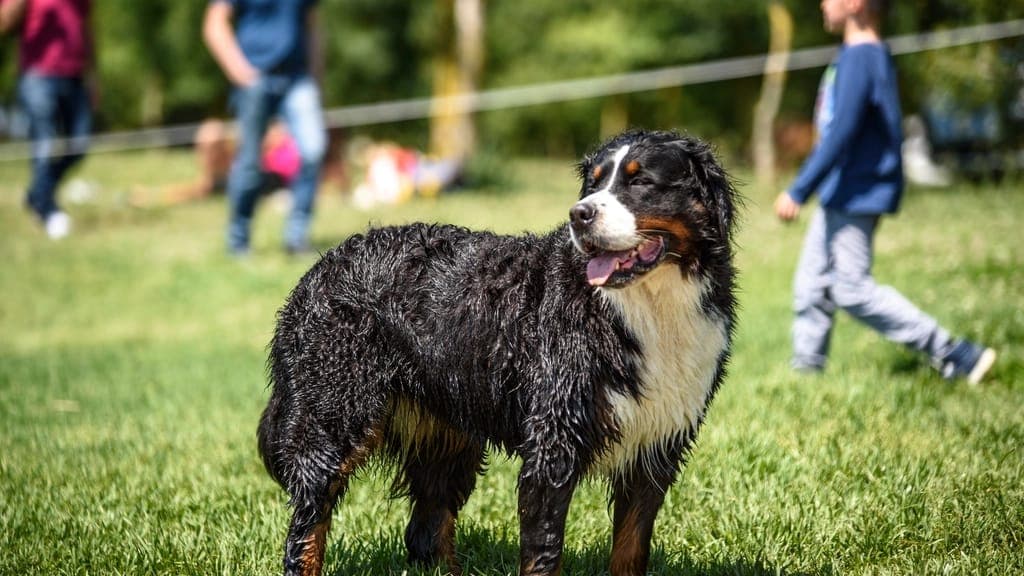
The relaxed "smile" looks like this: mouth slightly open, lips loose, tongue soft and possibly resting over the lower teeth, commissure relaxed rather than pulled tight, eyes soft and ears in their natural position. This is one of the best indicators of a calm, content dog.
You'll often see it after a walk, during gentle play, or while a dog lies comfortably watching the world.
Myth: "If a dog looks like it's smiling, it's happy." A stress pant can look like a big grin. Look for a wide-open mouth with the commissure pulled far back, a long, spoon-shaped tongue, tense brow and wide eyes. That combination, especially when it isn't hot and the dog hasn't been exercising, signals stress, not joy.
Relaxed smile versus stress pant
| Feature | Relaxed "smile" | Stress pant |
|---|---|---|
| Mouth | Slightly open, loose | Wide open, tense |
| Commissure | Relaxed, short | Pulled far back |
| Tongue | Soft, rounded, resting | Long, wide, spatulate |
| Eyes | Soft, almond-shaped | Wide, possibly whale eye |
| Brow | Smooth | Furrowed |
| Context | Calm or after play | New place, vet visit, noise |
Submissive grin dog
The submissive grin, more accurately called an appeasement grin, is one of the most misunderstood dog expressions. The dog pulls the lips back horizontally to expose the front teeth, sometimes all of them. To a startled visitor it can look like bared teeth.
The rest of the body tells a different story. A grinning dog usually has:
- A lowered head and body, often wiggling
- Squinty eyes and ears softly back
- A low, sweeping tail wag
- Sometimes sneezing, snorting or pawing
This is a friendly, deferential greeting, most often directed at people the dog knows. It's not a threat and shouldn't be corrected. Some people interpret it as a "guilty" face, but research suggests that look is mostly a response to the owner's current behavior (Horowitz, 2009). You can read more about that in our article on whether dogs feel guilt.
Tense mouth dog
A closed, tight mouth is one of the earliest and most reliable facial signs that something has changed. If your dog was panting gently and suddenly closes his mouth when a stranger approaches, he's assessing and possibly worried.
Watch the commissure:
- Pulled back (long lips): often fear, stress or appeasement. The dog is drawing away.
- Pushed forward (short "C" shape, puckered lips): more often offensive tension, a dog who may be preparing to stand his ground.
A tense mouth often comes with other subtle stress signals: a quick tongue flick, a yawn, or a lip lick. These are covered in our guide to why dogs yawn and lick their lips.
Dog lifting lip
A lip lift is when the upper lip rises, usually on one side, to reveal a canine tooth, often with the mouth closed. It's a quiet but explicit warning: "I'm uncomfortable. Stop."
Lip lifts commonly appear when a dog is guarding food, a toy or a resting spot, when being handled in a sensitive area, or when another dog crowds him. Pair the lip lift with the eyes: a lip lift with whale eye or a hard stare is a strong signal that the dog is close to escalating.
Safety note: Never punish a lip lift, growl or snarl. These warnings allow your dog to say "no" without biting. Punishing them can suppress the warning while leaving the underlying fear or discomfort in place, making a bite without warning more likely.
Dog snarling meaning
A snarl is a more intense version of the lip lift. The lips pull up and back to expose the teeth, the nose wrinkles across the muzzle, and the body usually goes stiff or still. It's often accompanied by a growl.
A snarling dog is telling you he feels threatened and is prepared to defend himself. Stop what you're doing, avoid direct eye contact, and slowly create space. Don't turn and run, which can trigger a chase.
Snarls sit high on the ladder of escalation, just below snapping and biting. Our guide to aggressive dog body language explains the full sequence. If your dog snarls regularly, start with a vet visit to rule out pain, then contact a veterinary behaviorist or certified behavior consultant. Our guide to trainers versus behaviorists explains who to call.
Grin versus snarl at a glance
| Feature | Appeasement grin | Snarl |
|---|---|---|
| Lips | Drawn back horizontally | Lifted vertically |
| Nose | Smooth | Wrinkled |
| Eyes | Squinty, soft | Hard stare or whale eye |
| Body | Low, wiggly, approaching | Stiff, still, or leaning |
| Sound | Often silent or snorting | Often growling |
Puppy dog eyes science
That pleading, soulful look your dog gives you has a real anatomical basis. Researchers led by Juliane Kaminski (2019) compared the facial muscles of dogs and wolves and found that dogs have a well-developed muscle, the levator anguli oculi medialis, that raises the inner eyebrow. In wolves this muscle was largely absent or present only as scattered fibers.
Raising the inner eyebrow makes the eyes look larger and more infant-like, and resembles the expression humans make when they're sad. Earlier work suggested this movement matters to people: shelter dogs who raised their inner eyebrows more often were rehomed faster (Waller et al., 2013). Another study found dogs produced more facial movements, especially the eyebrow raise, when a person was paying attention to them than when the person turned away (Kaminski et al., 2017).
In other words, puppy dog eyes are likely a product of thousands of years living alongside people. They're part of how dogs communicate with us, which is one of many signs of the bond between you and your dog.
Faces and pain
Facial changes can also signal pain. Squinting, a tense or furrowed brow, ears held stiffly back or apart, and a tight, drawn mouth are commonly recognized indicators of discomfort in dogs. A dog who suddenly looks "worried" all the time, or who lip lifts when touched in one spot, may be hurting.
Vet check: If your dog's facial expression changes noticeably and stays changed, or he starts warning when touched around the face, mouth or head, book a vet exam. Dental pain and ear problems are common, treatable causes.
What to do next
Take a few photos of your dog's face in different situations: relaxing on the sofa, waiting for dinner, meeting a visitor, at the vet. Compare the mouth, commissure, brow and eyes side by side. You'll quickly learn what "relaxed" looks like for your dog, and you'll spot tension much sooner. The earlier you notice a tight mouth or a quick lip lick, the more easily you can give your dog the space he's asking for.
Frequently asked questions
Do dogs really smile?
Dogs don't smile in the same social way humans do, but a relaxed, open mouth with a loose tongue, soft eyes and natural ear carriage reliably signals a calm, comfortable dog. Be careful: a stressed dog panting with the corners of the mouth pulled far back can look like it's smiling. Check the eyes, ears and body before deciding.
What is a submissive grin in dogs?
A submissive grin, also called an appeasement grin, is when a dog pulls the lips back horizontally to show the front teeth during a greeting. It comes with a lowered head, squinty eyes, ears back and a wiggly body. It's a friendly, appeasing signal often mistaken for a snarl. A snarl involves a wrinkled muzzle, vertical lip lift and stiff body.
Why is my dog lifting his lip at me?
A lip lift, where the upper lip rises to show a canine tooth, is a warning that your dog is uncomfortable and wants you to stop or back away. It often happens when guarding food or toys, or during handling. Don't punish it. Calmly stop, give space, and work with a qualified professional if it happens repeatedly.
What does it mean when a dog snarls?
A snarl, with lips pulled up, teeth exposed and the nose wrinkled, is a strong warning that a dog feels threatened and may bite if pressure continues. Often a growl accompanies it. Stop moving toward the dog, avoid staring, and calmly create distance. Repeated snarling deserves a vet check for pain and help from a behavior professional.
Sources & further reading
- Kaminski, J., Waller, B. M., Diogo, R., Hartstone-Rose, A., & Burrows, A. M. (2019). Evolution of facial muscle anatomy in dogs. Proceedings of the National Academy of Sciences, 116(29), 14677-14681.
- Kaminski, J., Hynds, J., Morris, P., & Waller, B. M. (2017). Human attention affects facial expressions in domestic dogs. Scientific Reports, 7, 12914.
- Waller, B. M., Peirce, K., Caeiro, C. C., Scheider, L., Burrows, A. M., McCune, S., & Kaminski, J. (2013). Paedomorphic facial expressions give dogs a selective advantage. PLoS ONE, 8(12), e82686.
- Horowitz, A. (2009). Disambiguating the 'guilty look': Salient prompts to a familiar dog behaviour. Behavioural Processes, 81(3), 447-452.
- Handelman, B. (2008). Canine Behavior: A Photo Illustrated Handbook. Dogwise Publishing.
This guide is for education only and does not replace an in-person assessment. If your dog's behavior changes suddenly, or you are worried about bites or aggression, speak to your veterinarian or a qualified behavior professional. See our disclaimer.