Everyday problems
Puppy Biting: Why It Happens & How to Stop It
Puppy biting is normal but painful. Learn why puppies nip, when they grow out of it, and a humane plan to teach a soft mouth.
Key takeaways
- Puppy biting is normal exploratory and play behavior, intensified by teething and overtiredness, not a sign of aggression or dominance.
- Most puppies bite much less once their adult teeth are in, at around six to seven months, though some stay mouthy into adolescence.
- Bite inhibition, a soft and controlled mouth, is learned through gentle feedback and is one of the most valuable lessons a puppy can learn.
- Redirecting to toys, ending play calmly when teeth touch skin, and making sure your puppy gets enough sleep work better than any punishment.
- Biting with stiffening, freezing, hard stares or guarding is different from play and deserves professional advice.
Jump to a section
To stop puppy biting, redirect your puppy's mouth onto toys, calmly pause play the moment teeth touch skin, make sure your puppy sleeps enough, and give plenty of safe things to chew. Biting is normal puppy behavior, so the goal is to teach a softer mouth and better outlets, not to punish your puppy for being a puppy.
Those needle-sharp teeth can make the first months with a puppy painful and discouraging. It helps to know that mouthiness is a developmental stage, that it usually fades predictably, and that what you do now shapes how gentle your adult dog's mouth will be. Puppy biting is one of the most common everyday dog behavior problems, and one of the most rewarding to get right.
Why do puppies bite?
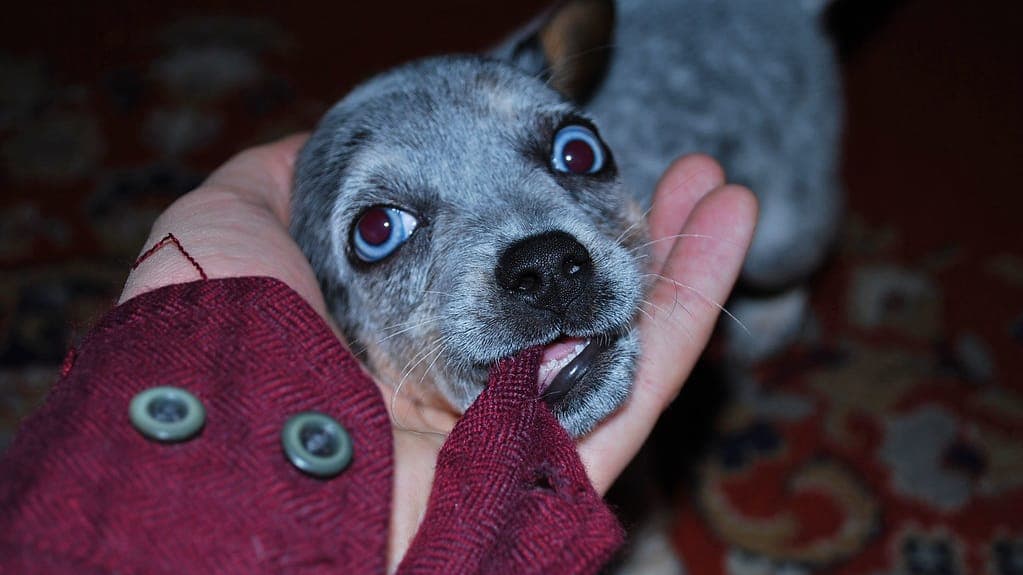
Puppies explore the world with their mouths in the same way human babies use their hands. Biting and mouthing are also how puppies play with each other. Watch littermates and you will see constant wrestling, chewing on ears and tugging at legs, all part of normal social learning.
Several factors make biting worse:
- Teething. Adult teeth push through roughly between three and seven months, and gums are sore.
- Overtiredness. Young puppies need a great deal of sleep, often 18 hours or more a day. An overtired puppy tends to get bitey, not sleepy.
- Overexcitement. Rough play, chasing feet and wriggling hands ramp up arousal fast.
- Boredom or frustration. A puppy with nothing to do, or who wants something they cannot have, may bite to start a game.
- Accidental rewards. If biting reliably makes people squeal, flap and play, it becomes a very effective game.
Learning to read your puppy's signals makes all of this easier. Our guide to puppy body language explains how to tell playful, tired and stressed puppies apart.
At what age do puppies stop biting?
There is no switch-off date, but most puppies follow a broadly similar arc. Mouthing is usually at its most intense in the first weeks at home, gets a second boost from teething, and then fades as adult teeth settle in. With consistent guidance, many puppies bite far less by around six to seven months. Without it, the habit can carry on well beyond the teething stage.
| Approximate age | What is usually going on | What helps most |
|---|---|---|
| 8 to 12 weeks | Peak play biting, still learning bite inhibition, needs lots of sleep | Gentle feedback on pressure, enforced naps, toys everywhere |
| 3 to 4 months | Baby incisors fall out, adult incisors arrive, gums sore | Cold or frozen chews, soft toys, shorter play sessions |
| 4 to 6 months | Adult canines and molars come through, strong urge to chew | Varied chew textures, puppy-proofing, redirecting firmly but kindly |
| 6 to 7 months | Adult teeth mostly in place, mouthing usually much reduced | Keep rewarding gentle play and calm greetings |
| 6 to 18 months | Adolescence, occasional flare-ups when excited or frustrated | Revisit the basics, manage arousal, keep up enrichment |
These ages vary between individuals and breeds. Retrievers and other gundogs often stay "mouthy" in a soft, carrying way for life, and herding breeds may keep the urge to nip at movement. What should change is the pressure: an adolescent who still bites hard enough to hurt, or whose biting is increasing, needs a fresh plan rather than more waiting.
Puppy nipping vs puppy biting
Puppy nipping usually means quick, light grabs at hands, ankles or clothes, often while walking or when you move around the house. Biting usually refers to harder, sustained mouthing during play or handling. They have the same roots and respond to the same plan, but nipping at moving feet and trousers often benefits from extra management, such as giving your puppy a toy to carry or using a pen during busy times.
Ankle nipping is especially common in herding breeds, whose instinct to chase and nip at movement can be strong. Give them legitimate outlets, like chasing a flirt pole toy or playing tug, rather than trying to suppress the urge entirely.
Puppy biting ankles and feet on walks
Walks pack a lot into a few minutes for a young puppy: new smells, traffic, a leash that stops them going where they want, and your feet swinging past at nose height. Grabbing at shoes and trouser legs is often a sign of frustration or overstimulation, and it tends to get worse toward the end of a walk that has gone on too long.
- Shorten the walk. Young puppies tire quickly. Several short outings, with plenty of time for sniffing, beat one long march.
- Stop moving the moment teeth land. Feet that keep walking are fun to chase. Stand still, wait for your puppy to let go, then carry on.
- Drop food low. Scatter a few treats on the ground beside your leg, which turns the urge to grab into sniffing and searching.
- Bring a tug toy. A short toy clipped to your pocket gives you a ready-made target to redirect onto.
- Head home before the meltdown. If nipping returns after a redirect or two, your puppy is telling you she has had enough for now.
If the leash itself is the target, a calm "trade" for a treat and a second, less exciting leash can help. Repeated frantic biting on every walk is worth discussing with a trainer, as it often points to too much stimulation for your puppy's age.
Nipping in adult dogs
An adult dog who nips is a different situation from a teething puppy. A nip that makes contact is technically a bite, even when no skin is broken, so it deserves to be taken seriously. Common reasons include:
- Herding instinct. Collies, shepherds, heelers and corgis may nip at running children, joggers or bicycles. This is a motor pattern, not malice, but it still needs management and safe outlets.
- High arousal or frustration. Some dogs grab hands or sleeves during exciting greetings, tug games or when held back on leash.
- Fear or discomfort. A quick nip at a hand reaching over the head, or at someone walking behind, is often a dog saying "back off" after quieter signals were missed.
- Pain. An adult who starts nipping when touched, lifted or groomed should see a vet first. Our guide to sudden behavior changes in dogs explains which health problems can drive new irritability.
- A puppy habit that never resolved. Some adolescents simply never got enough guidance on mouth manners.
Look at what happens just before the nip and at the rest of the body. Stiffness, a hard stare or a lifted lip point toward conflict rather than play. If nipping is frequent, targets children, comes with growling or causes injury, work with a qualified professional, such as a certified behavior consultant or a veterinary behaviorist.
Puppy bite inhibition: the lesson that matters most
Bite inhibition is a dog's learned control over how hard they bite. Puppies begin learning it in the litter: when a puppy bites a sibling too hard, the other puppy yelps and stops playing, and the biter learns that gentler play keeps the fun going. Puppies taken from the litter very early can miss some of that feedback.
Bite inhibition matters because almost any dog might bite if frightened or hurt enough. A dog with a well-learned soft mouth is far less likely to cause serious injury in that moment. This is why many experts suggest teaching gentleness first, rather than banning all mouth contact overnight.
You can continue the lesson at home:
- Play gently with your puppy using your hands or a soft toy. Keep arousal low.
- When teeth press hard, end play immediately. Go still, quietly remove your hand, and pause for a few seconds.
- Resume when your puppy is calm. If the next mouthing is gentler, keep playing.
- Gradually raise the bar. Over a few weeks, end play for lighter and lighter pressure, until any teeth on skin pause the game.
- Move all play onto toys. Once bite inhibition is good, teach your puppy that hands are for stroking and toys are for biting.
Myth: "Yelping like a littermate always works." Some puppies pause when you yelp. Many others find it exciting and bite harder. If yelping winds your puppy up, switch to calmly going still and withdrawing.
How to stop puppy biting: day-to-day plan
Bite inhibition is the foundation; these everyday habits do the rest.
Redirect to something better
Keep toys within reach in every room. When your puppy starts mouthing, offer a tug toy, a soft plush or a chew. Long toys, such as rope tugs, keep your hands safely away from teeth. Praise and play when your puppy grabs the toy instead.
Calmly end the game when teeth hit skin
If your puppy keeps biting you after a redirect, step away for 30 to 60 seconds, ideally behind a baby gate or pen. This is not a punishment; it simply takes away the thing your puppy wants, which is you, at the moment biting happens. Return calmly and try again.
Protect naps
Many evening "crocodile" sessions are really overtiredness. Build a routine of play, a toilet break, then a nap in a crate or pen with a chew. If your puppy is biting frantically and ignoring toys, try a nap before anything else.
Give chewing outlets
Teething puppies need to chew. Offer a variety of textures and frozen stuffed toys, and rotate them. Our guide to destructive chewing covers safe chew choices and puppy-proofing.
Manage hot spots
Notice when biting happens most: greetings, getting dressed, children running, or the evening. Plan ahead with a pen, a stuffed toy or a sniffing game during those times. If your puppy also jumps up and grabs clothes, our guide to stopping jumping on people will help.
Pro tip: Keep a short list of "calm" activities for bitey moments, such as scatter feeding in the grass, a lick mat or a frozen food toy. Sniffing and licking lower arousal; chasing and wrestling raise it.
Puppy biting methods to avoid
Avoid any technique based on pain, intimidation or "showing the puppy who's boss". These include holding the mouth shut, tapping or flicking the nose, pushing fingers into the throat, scruffing, pinning the puppy down or alpha rolling. They can make puppies fearful of hands, damage trust and, in some cases, increase defensive biting later. Our article on the alpha dog myth explains why these old methods persist and why they are outdated.
Rough wrestling games with hands are also best avoided during this stage, because they teach your puppy that skin is a toy.
Puppy biting and growling: when to worry
Growling and biting during play is normal for most puppies. Play growls tend to come with a loose, wiggly body, play bows, relaxed open mouths and regular pauses. Puppies also switch roles in healthy play, sometimes on top, sometimes underneath. Our guide to why dogs growl explains the difference between play growls and warning growls.
| Likely play | Needs a closer look |
|---|---|
| Loose, bouncy body and play bows | Stiff body, sudden freezing |
| Soft face, relaxed open mouth | Hard stare, tight or closed mouth, lip lifted |
| Easily redirected to a toy | Bites harder when you try to redirect |
| Takes breaks and comes back for more | Growls or bites when handled, picked up or woken |
| Happens during games | Happens around food, toys, chews or resting spots |
If your puppy shows the signs in the right-hand column, especially around food or toys, talk to your vet to rule out pain and then to a qualified behavior professional. Early help with resource guarding or handling sensitivity is far easier than tackling it in an adult dog.
Safety note: Always supervise puppies with children. Puppies often target small, fast-moving people, and children may respond in ways that excite the puppy further. Our guide to dogs and kids explains how to set up safe routines.
Biting and socialization
Positive, well-managed experiences with gentle people, other calm dogs and new places during the socialization window help puppies develop social skills, including a softer mouth. Well-run puppy classes give your puppy the chance to play with peers under supervision. Our guide to puppy socialization explains how to do this safely, even before vaccinations are complete, in line with veterinary guidance.
What to do next
Start today by placing toys in every room, setting up a pen or gated area for breaks, and writing out a simple daily schedule that includes plenty of naps. Practice the bite inhibition steps during calm play sessions, and redirect consistently every time teeth meet skin.
Most puppies improve noticeably within a few weeks and outgrow the worst of it by six or seven months. If biting is getting harder rather than softer, or comes with stiffening, guarding or handling sensitivity, reach out early to a qualified professional who uses humane, reward-based methods.
Frequently asked questions
When do puppies stop biting?
Most puppies bite and mouth much less once their adult teeth have come through, typically around six to seven months of age. Mouthy breeds such as retrievers may keep carrying and gently mouthing things for longer. Biting stops sooner and more completely when you consistently redirect to toys, protect your puppy's sleep and never reward hard bites with continued play.
Why does my puppy bite me so much?
Puppies explore with their mouths, play by biting, and relieve teething discomfort by chewing. Biting usually spikes when a puppy is overtired, overexcited, bored or frustrated, and often peaks in the evening. Hands, feet and clothes that move are especially tempting. More naps, more appropriate chew items and calm routines around known flashpoints can reduce biting quickly.
Is it normal for a puppy to bite and growl?
Yes, growling during play is very common. Play growls usually come with a loose, bouncy body, play bows and a relaxed face, and the puppy readily takes breaks. Be more concerned if your puppy goes stiff, freezes, stares hard, or growls and bites when handled, disturbed while resting, or approached near food or toys. In those cases, speak to your vet and a qualified behavior professional.
Should I yelp when my puppy bites?
Yelping works for some puppies by briefly pausing the play, but for many it adds excitement and makes them bite harder. A more reliable approach is to calmly go still, remove your hand, and redirect your puppy to a toy. If biting continues, end the game for a minute by stepping away or behind a gate. Consistency matters more than the exact signal.
What is puppy bite inhibition?
Bite inhibition is a dog's learned ability to control the force of their bite. Puppies start learning it with littermates and their mother, who react when play gets too rough. You can continue the lesson by ending play when teeth press too hard and continuing when your puppy is gentle. A dog with good bite inhibition is much less likely to cause serious injury if they ever bite.
Sources & further reading
- American Veterinary Society of Animal Behavior. (2008). Position statement on puppy socialization. AVSAB.
- Dunbar, I. (2004). Before & After Getting Your Puppy. New World Library.
- Scott, J. P., & Fuller, J. L. (1965). Genetics and the Social Behavior of the Dog. University of Chicago Press.
- Landsberg, G., Hunthausen, W., & Ackerman, L. (2013). Behavior Problems of the Dog and Cat (3rd ed.). Saunders Elsevier.
This guide is for education only and does not replace an in-person assessment. If your dog's behavior changes suddenly, or you are worried about bites or aggression, speak to your veterinarian or a qualified behavior professional. See our disclaimer.