Signals & emotions
Signs of Stress in Dogs: How to Spot an Anxious, Overwhelmed Dog
From whale eye and stress panting to pacing and trembling, learn the body language that says your dog is struggling, and what to do about it.

Key takeaways
- Common signs of stress in dogs include lip licking, yawning, whale eye, ears pulled back, a lowered tail, panting, pacing, trembling and avoidance.
- Owners usually spot obvious signs such as trembling or whining but often miss subtle early ones like lip licks, head turns and a closed, tense mouth.
- Stress panting is fast and shallow with a tense, stretched mouth, and it happens without heat or exercise to explain it.
- Stressors add up through trigger stacking, so a dog can cope with one challenge but react to the third or fourth in a row.
- To calm a stressed dog, remove or reduce the trigger, add distance, offer calm activities like sniffing or licking, and seek vet or behavior help for ongoing stress.
Jump to a section
- Stress, fear and anxiety: what is the difference?
- Stressed dog body language, head to tail
- Dog anxiety signs that are easy to miss
- Vocal signs of stress
- Dog panting from stress vs heat or exercise
- Dog shaking and stressed: when trembling means fear, cold or pain
- Physical and toileting signs of stress
- Freezing and stiffness
- The 4 Fs: fight, flight, freeze, fiddle (fool around)
- Trigger stacking: why stress builds up
- Why stress signals matter
- Signs of chronic stress
- How to calm a stressed dog
- When stress signals need a professional
- What to do next
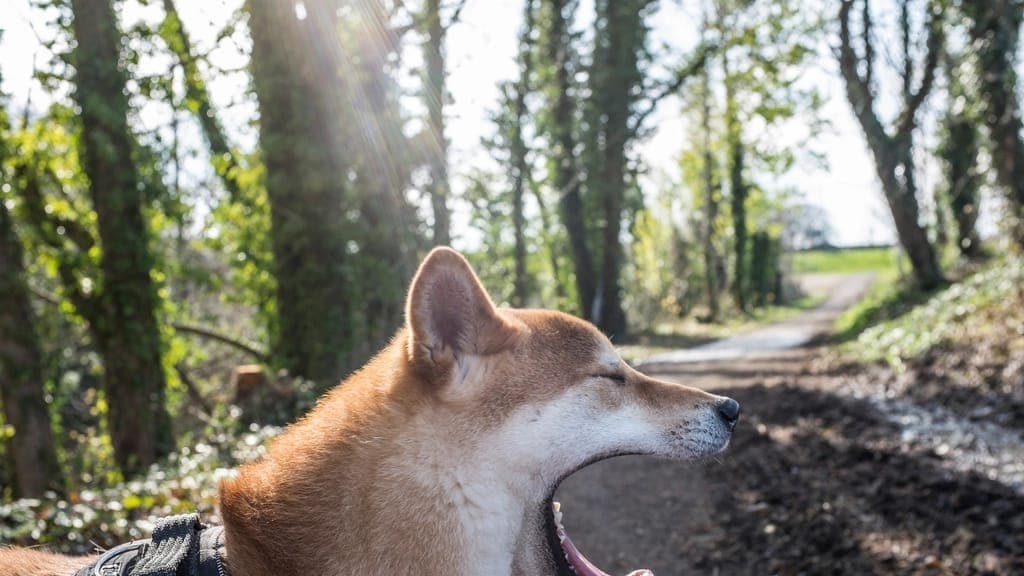
The most common signs of stress in dogs are lip licking, yawning, turning away, ears pulled back, a lowered or tucked tail, whale eye, panting without heat or exercise, pacing, trembling, and hiding or trying to leave. Early signs are small and quick; later signs are bigger and harder to miss.
The challenge is that many of these behaviors also have everyday explanations. Dogs pant when hot, yawn when tired and shake when wet. Reading stress correctly means looking at clusters of signals and the situation around them, the same whole-dog approach taught in our complete guide to dog body language. This guide shows you what to look for, why stress builds up, and how to help.
Stress, fear and anxiety: what is the difference?
These words overlap, but the distinctions are useful when you are deciding how to help.
- Stress is the body's response to a challenge, whether physical or emotional. Some short-term stress is normal and even healthy. It becomes a problem when it is intense, frequent or prolonged.
- Fear is a response to a specific threat that is present right now, such as a loud truck, a looming stranger or a slippery vet table. Our guide to scared dog body language covers it in detail.
- Anxiety is the anticipation of a threat that has not happened yet. A dog who pants and paces as soon as you pick up your keys may be anxious about being left alone.
All three involve the same stress physiology: the sympathetic nervous system activates and stress hormones such as cortisol rise. That is why their body language looks so similar.
Stressed dog body language, head to tail
Use this table as a quick reference. One sign on its own may mean nothing; several together, in a situation that could be stressful, usually mean your dog is struggling.
| Body area | Signs of stress |
|---|---|
| Eyes | Whale eye (whites showing), dilated pupils, rapid blinking, hard stare or avoiding eye contact |
| Ears | Pulled back or pinned flat, or rapidly flicking back and forth |
| Mouth | Closed and tight, or panting with corners (commissures) pulled far back; lip licking; yawning; drooling |
| Tongue | Wide, flattened "spatulate" tongue while panting |
| Body | Lowered or crouched, weight shifted back, stiff or frozen, trembling |
| Tail | Low, tucked between the legs, or held stiffly; slow, low wag |
| Paws and coat | Sweaty paw prints, sudden heavy shedding, dandruff appearing in a tense moment, raised paw |
| Movement | Pacing, restlessness, inability to settle, hiding, trying to leave, clinging to you |
| Other | Whining, refusing food or treats, sudden sniffing or scratching, needing to urinate or defecate |
For more detail on individual body parts, see our guides to ear positions and to yawning and lip licking.
Dog anxiety signs that are easy to miss
Research on how owners perceive stress has found that people generally recognize obvious signs, such as trembling and whining, but often overlook subtle ones like lip licking, yawning and looking away. Those subtle signs are exactly the ones that give you time to help.
Watch for these quiet anxiety signs:
- Food refusal. A dog who normally loves treats but will not take one is often too stressed to eat. This is a useful, objective test.
- Displacement behaviors. Sudden scratching, sniffing, shaking off or grooming in a tense moment.
- Calming signals. Head turns, body turns, slow movements and curving, described in our guide to calming signals.
- Mouth changes. A relaxed open mouth that suddenly closes tight is one of the fastest stress indicators.
- Hypervigilance. Scanning the environment, startling easily, struggling to look away from a trigger.
- Clinginess or withdrawal. Some dogs stick to their person; others take themselves off to hide.
Pro tip: Carry high-value treats on walks and offer one when your dog seems uneasy. If she takes it gently, she is probably coping. If she snatches it hard or will not take it at all, she is likely over threshold, and it is time to add distance.
Vocal signs of stress
Sounds usually arrive after the quiet body signals have gone unanswered, so a stressed dog who starts vocalizing is telling you the pressure has been building for a while. Each sound has its own stress signature:
- Whining: repetitive and high-pitched, often while pacing or staring at a door, a window or you. It is common in the car, the vet waiting room and the minutes before you leave. Our guide to why dogs whine separates stress whining from pain and attention-seeking.
- Barking: stress barks tend to be higher, faster and harder to interrupt than a single alert bark, and they may continue long after the trigger has gone. The types of dog barks guide covers pitch and rhythm in more detail.
- Growling: in a stressed dog, a growl usually comes from a still or backing-away body and means "I am at my limit." Stop, note the trigger and never punish it, as explained in our guide to growling.
- Howling and yelping: howling that starts when a dog is left alone points toward separation-related distress, while a sudden yelp with no obvious cause can mean pain and is worth a vet check.
Silence is not always calm. Some dogs, especially fearful ones, go quiet and still when overwhelmed, so read the body even when there is nothing to hear.
Dog panting from stress vs heat or exercise
Panting is how dogs cool down, so it is normal after exercise and in warm weather. Stress panting looks different and happens without those explanations.
Typical stress panting:
- Fast and shallow, sometimes with a clicking or rasping sound
- Mouth corners pulled back hard, creating a tense, stretched "grin"
- A wide, flattened tongue with a curled or spoon-shaped tip
- Comes on suddenly in a stressful situation, such as a car ride, the vet or a thunderstorm
- Often paired with pacing, whining, or whale eye
Typical cooling or happy panting:
- Rhythmic and relaxed, with a loose, soft mouth
- Happens during or after activity, or in heat
- Settles as the dog rests and cools
Vet check: Heavy panting at rest, panting with a pale or blue tongue, a distended belly, collapse, or panting in a dog who is restless and cannot settle can signal pain, heatstroke, heart or respiratory disease, or bloat. These are emergencies. Contact a vet immediately.
Dog shaking and stressed: when trembling means fear, cold or pain
Trembling is one of the more obvious stress signs, often seen during fireworks, thunderstorms, vet visits or car rides. Our guide to fireworks and noise anxiety covers noise-triggered trembling in depth.
But shaking is not always emotional. Other common causes include:
- Cold: small, short-coated and thin dogs feel the cold quickly.
- Excitement: some dogs quiver with anticipation before a walk or game.
- Pain: trembling, especially with a hunched posture, reluctance to move or panting, can signal pain.
- Illness or toxins: nausea, fever, poisoning and neurological conditions can all cause shaking.
- Age: some older dogs develop tremors in the hind legs.
If trembling appears suddenly with no clear emotional trigger, or comes with vomiting, weakness, wobbliness or lethargy, see a vet promptly. Our guide to sudden behavior changes lists other red flags.
Physical and toileting signs of stress
The stress response shifts blood flow and energy away from digestion and toward readiness to act, so the gut, bladder, skin and coat often react within minutes. These signs are easy to dismiss as bad luck or bad manners:
- Vomiting or diarrhea: car journeys, boarding, moving house and a new pet commonly upset the stomach. Loose stool with mucus after a kennel stay is a typical pattern.
- Sudden urination or defecation: a house-trained dog who has an accident during a thunderclap, a nail trim or a scary greeting has lost control through fear, not chosen to misbehave. Cleaning up quietly, without scolding, matters.
- Stress shedding: some dogs drop handfuls of hair on the vet table or the groomer's bench. Owners sometimes call this "blowing coat," although that term more often describes normal seasonal shedding.
- Appetite loss: skipping a meal on the first night in a new home or after a frightening event is common. Refusing food for more than a day is not.
- Sweaty paw prints: dogs sweat through their paw pads, so damp marks on a smooth floor or exam table on a cool day are a giveaway.
Vet check: Every sign in this list can also be caused by illness. Repeated vomiting, diarrhea that lasts more than a day or contains blood, a dog who will not eat for more than 24 hours, or new house soiling should be assessed by a vet before you put it down to stress. Puppies, seniors and small dogs can become unwell faster, so call sooner for them.
Freezing and stiffness
A dog who stops moving is easy to overlook, because stillness looks like good behavior. In a stressful setting, though, stillness is often the opposite of calm. Look for muscle tension rather than just lack of movement: a closed, tight mouth, a fixed or sideways gaze, a tail held rigid or clamped, and breathing that seems to pause.
Two forms are worth separating:
- The brief freeze: a split-second halt when something is approached, touched or taken. This is a decision point, and it can precede a snap. Our guide to dog posture covers how to tell a warning freeze from a playful pause.
- Prolonged stiffness or shutdown: a dog who stands or lies rigidly through nail trims, bathing or vet handling, and who seems "so good" because she does not struggle. This is often a dog who has given up trying to escape, not one who is relaxed.
Afterward, stiff dogs often shake off, sniff intensely or seek out water. If your dog regularly goes rigid for handling, teach cooperative care at home with short, voluntary sessions, and ask your vet about fear-free handling and breaks during exams.
The 4 Fs: fight, flight, freeze, fiddle (fool around)
Stressed dogs tend to fall back on one of four strategies, often summarized as the four Fs. The theory behind them is explained in our guide to scared dog body language; this section is about spotting your own dog's preferred strategy in everyday life and responding to it.
| Response | Everyday stress example | How to help |
|---|---|---|
| Flight | Pulls toward home on a noisy street, hides under the table when guests arrive | Let her leave; give her a retreat no one disturbs |
| Freeze | Stands rigid while being groomed, stops dead at the clinic door | Pause, reduce the handling, and rebuild with short, rewarded steps |
| Fiddle (fool around) | Grabs the leash, does zoomies or rolls over at the vet, jumps on a nervous visitor | Recognize it as coping, not naughtiness; lower the pressure instead of correcting |
| Fight | Barks and lunges at the dog next door, snaps when cornered by a child | Increase distance now, prevent repeats, and get professional help |
Most dogs have a favorite response, and it can shift. A dog whose flight attempts are repeatedly blocked by a leash, a crate or someone's arms may learn that fight works better. Keeping an exit route open is one of the simplest ways to keep stress from turning into aggression.
Trigger stacking: why stress builds up
Stress is cumulative. Each stressful event raises your dog's arousal a little, and it takes time, sometimes hours or even days for big events, for her body to come back down. When stressors arrive close together, they stack.
Imagine your dog's morning: a delivery driver at the door, then a loud truck on the walk, then a strange dog barking behind a fence. Each one on its own she handles. Then a child runs up to pet her, and she snaps. The child was not the cause; the child was the last straw.
Understanding trigger stacking helps you plan. After a stressful event, give your dog a quieter day. Avoid scheduling the vet, the groomer and visitors on the same afternoon. For newly adopted dogs, the first weeks are often one long stack, which is why rescue dog decompression matters so much.
Why stress signals matter
Stress signals are worth responding to even when your dog seems to be coping, for three practical reasons.
They are the bottom of the bite-risk scale. Behaviorists often draw escalation as a ladder of aggression: lip licks, yawns and head turns on the lowest rungs, then freezing and staring, then growling, snapping and biting. A dog whose low-rung signals reliably make the pressure go away has little reason to climb. A dog whose signals are ignored or punished learns to skip rungs. The full sequence is laid out in our guide to aggressive dog body language.
They protect health. Repeated stress responses are linked to digestive upsets, poor sleep, skin and coat problems and lower resilience to illness. Catching stress early often means a dog spends fewer hours each week in that state.
They show when learning is possible. A dog who is licking her lips and scanning the room cannot absorb a new cue, which is why training a stressed dog so often stalls. Stress signals tell you to make the task easier, add distance or end the session, so the next one starts from calm.
Signs of chronic stress
Acute stress comes and goes with a trigger. Chronic stress is a longer-term state, and it can look different. In classic research on dogs kept in stressful housing, Beerda and colleagues (1997) found that chronically stressed dogs showed a lower overall posture, more repetitive behaviors, more self-grooming and paw lifting, and more vocalizing.
At home, chronic stress may show up as:
- Disturbed sleep, or sleeping far more than usual
- Changes in appetite or digestion, including diarrhea
- Excessive licking of paws or other body parts
- Repetitive behaviors such as tail chasing, spinning or pacing
- Increased reactivity, irritability, or a shorter fuse with other pets
- Destructive behavior or house soiling, especially when left alone
If your dog shows these signs when alone, read our guide to separation anxiety, since it is one of the most common causes of chronic stress in pet dogs.
How to calm a stressed dog
When your dog is stressed right now, work through these steps:
- Identify and reduce the trigger. Turn down the noise, ask the visitor to sit and ignore her, or move away from the other dog.
- Add distance. Distance is the most powerful tool you have. Move until she can take a treat and look away from the trigger.
- Give her a safe space. A quiet room, a covered crate she likes, or a bed behind the couch where nobody bothers her.
- Offer calming activities. Sniffing, licking and chewing tend to help dogs settle. Try scatter-feeding treats in grass, a lick mat or a safe chew.
- Keep your own body calm. Speak softly, move slowly and avoid looming over her. Comfort her if she seeks you out; it will not reinforce fear.
- Do not force interaction. Let her approach people or things on her own terms.
- Allow recovery time. Plan a quiet, predictable day after a stressful event.
Over the longer term, build a predictable routine, provide daily enrichment and appropriate exercise, and work on specific triggers with desensitization and counter-conditioning, always at a level where your dog stays relaxed.
Myth: "If you comfort a scared or stressed dog, you reward the fear." Emotions are not reinforced the way behaviors are. Calm reassurance, if your dog wants it, helps her feel safe and does not teach her to be more afraid.
When stress signals need a professional
Some stress is part of every dog's life. Get help if your dog is stressed most days, struggles to recover after stressful events, shows stress in many different situations, or has begun to growl, snap or bite.
Start with your vet. Pain, gastrointestinal problems, thyroid disease and other medical issues commonly underlie stress behavior, and some dogs benefit from prescription anti-anxiety medication alongside training. For behavior support, look for a veterinary behaviorist or a certified behavior consultant; our guide to choosing a trainer or behaviorist explains the differences in qualifications.
What to do next
For the next few days, watch your dog with fresh eyes and keep a short log: what happened, which signs you saw, and how long she took to recover. You will quickly see which situations stack up for her and which ones she handles well.
Then make one change at a time, such as a quieter walking route, a safe space or a daily sniff walk, and watch how the signs shift. Small, steady reductions in stress add up to a calmer, more confident dog.
Frequently asked questions
What are the first signs of stress in a dog?
The earliest signs are usually small and quick: a lip or nose lick with no food around, a yawn when not tired, turning the head away, a sudden sniff of the ground, slowing down, or a mouth that closes and tightens. These are easy to miss, but they appear well before panting, trembling or growling, giving you time to reduce pressure.
How do I know if my dog has anxiety or is just stressed?
Stress is a response to something happening now, and it fades when the trigger goes away. Anxiety is anticipation of a threat, often appearing before the trigger, such as pacing when you pick up your keys. If your dog seems stressed most days, in many situations, or struggles to recover, talk to your vet about an anxiety disorder.
Can stress make a dog sick?
Ongoing stress can affect a dog's health. Stressed dogs may develop diarrhea, lose their appetite, sleep poorly, over-groom or lick their paws, and chronic stress can affect the immune system. Illness and pain can also cause stress behavior, so the relationship works both ways. A vet exam is the right first step for any dog with persistent stress signs.
Why is my dog panting and pacing at night?
Panting and pacing at night can come from anxiety, noises outside, needing to toilet, being too warm, pain, nausea or, in older dogs, canine cognitive dysfunction. Because several of these are medical, book a vet visit if it happens more than occasionally, especially if it is new. Note the time, duration and anything that seems to trigger it to share with your vet.
Does comforting a stressed dog reinforce the fear?
No. Fear and stress are emotional states, not behaviors you can reward into existence. Calmly comforting your dog, if she wants contact, can help her feel safer. Avoid frantic fussing or forcing contact on a dog who would rather hide, and focus on making the environment safer by removing or reducing whatever is stressing her.
Why does a stressed dog pace?
Pacing burns off nervous energy when a dog feels unsettled but has no clear way to solve the problem, for example while visitors move around, during a storm or in a vet waiting room. Repeated loops along the same route, often with panting or whining, are typical. Offer a quiet space and a lick mat or chew to help her settle. Pacing that is new or constant needs a vet check.
Sources & further reading
- Beerda, B., Schilder, M. B. H., van Hooff, J. A. R. A. M., & de Vries, H. W. (1997). Manifestations of chronic and acute stress in dogs. Applied Animal Behaviour Science, 52(3-4), 307-319.
- Beerda, B., Schilder, M. B. H., van Hooff, J. A. R. A. M., de Vries, H. W., & Mol, J. A. (1998). Behavioural, saliva cortisol and heart rate responses to different types of stimuli in dogs. Applied Animal Behaviour Science, 58(3-4), 365-381.
- Mariti, C., Gazzano, A., Moore, J. L., Baragli, P., Chelli, L., & Sighieri, C. (2012). Perception of dogs' stress by their owners. Journal of Veterinary Behavior, 7(4), 213-219.
- Overall, K. L. (2013). Manual of Clinical Behavioral Medicine for Dogs and Cats. Elsevier Mosby.
- Rugaas, T. (2006). On Talking Terms With Dogs: Calming Signals (2nd ed.). Dogwise Publishing.
This guide is for education only and does not replace an in-person assessment. If your dog's behavior changes suddenly, or you are worried about bites or aggression, speak to your veterinarian or a qualified behavior professional. See our disclaimer.