Signals & emotions
Happy Dog Body Language: How to Tell Your Dog Is Content
Soft eyes, a loose mouth, a wiggly body and a sweeping wag: learn the signs of a genuinely happy dog, plus the lookalikes that fool many owners.
Key takeaways
- Happy dog body language is loose and fluid: soft or squinty eyes, a relaxed open mouth, ears in their natural position, and weight evenly balanced.
- A wagging tail is not proof of happiness on its own; a happy wag is usually loose and wide at mid-height, often moving the hips too.
- Everyday signs of a content dog include good appetite, restful sleep, curiosity, play, and seeking out your company.
- A simple petting consent test shows whether your dog is enjoying an interaction: pause and see if she asks for more.
- A sudden drop in a normally happy dog's playfulness, appetite or energy can signal pain, illness or low mood and deserves a vet check.
Jump to a section
- Relaxed dog body language: the baseline
- Signs a dog is happy, head to tail
- Happy behaviors you can see every day
- Things that look happy but may not be
- How to tell if your dog is happy with you: the consent test
- Is my dog happy? A quick self-check quiz
- When a usually happy dog changes
- Building more happy moments
- Putting it together
Happy dog body language is loose and fluid: soft or squinty eyes, a relaxed, slightly open mouth, ears in their natural position, a tail wagging loosely at mid-height, and a body that wiggles rather than stiffens. A content dog also eats well, sleeps deeply, plays, explores and seeks out your company.
Those signs sound simple, but several popular "happy" signals, including the wagging tail and the doggy "smile," can mean something quite different in the wrong context. Reading happiness reliably means looking at the whole dog, the same skill at the heart of our complete guide to dog body language. Here is what genuine contentment looks like, and how to tell it from its lookalikes.
Relaxed dog body language: the baseline
Before you can spot happiness, you need to know what your own dog looks like at rest. Every dog has a neutral baseline: her normal ear carriage, tail height and facial expression when nothing in particular is happening. Breed matters here. A Greyhound's natural tail is low, a Husky's curls over the back, and a Basset's ears never go anywhere.
Relaxed dog body language usually includes:
- Soft eyes: the eyelids are relaxed, the gaze is gentle, and she may squint or blink slowly. Little or no white is visible.
- A loose mouth: closed and soft, or slightly open with the tongue resting over the lower teeth. The corners of the mouth are relaxed, not pulled back.
- Natural ears: neither pricked hard forward nor pinned back.
- Neutral tail: at or slightly below the level of the back for most breeds, hanging loosely or wagging gently.
- Balanced weight: standing or sitting evenly, not leaning forward or back.
- Soft muscles: no visible tension around the face, neck or shoulders.
Spend a few minutes watching your dog when she is calm at home. That picture is your reference point.
Signs a dog is happy, head to tail
| Body area | What happy looks like | Lookalike that means something else |
|---|---|---|
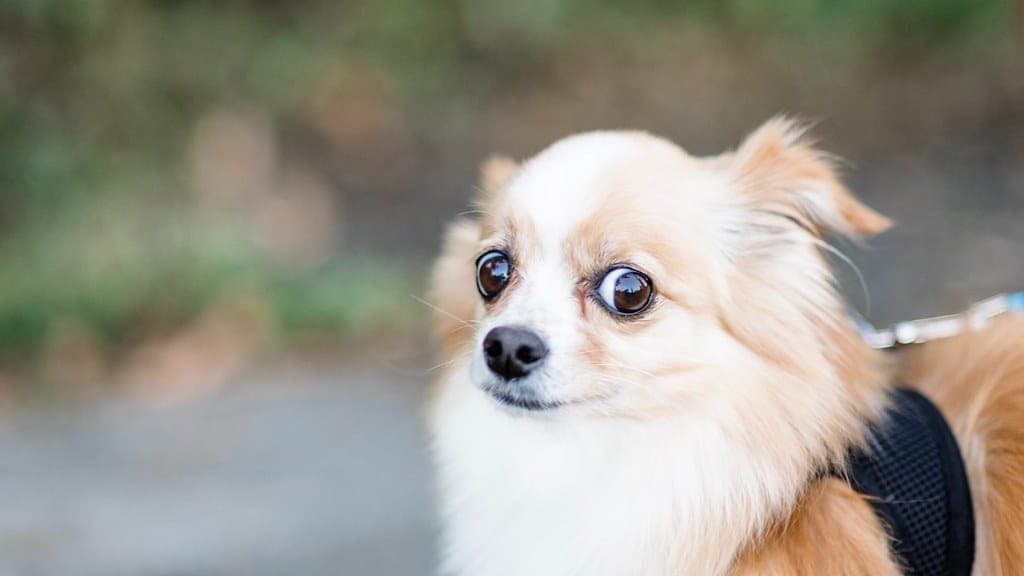
| Eyes | Soft, squinty or almond-shaped; slow blinks | Whale eye, hard stare, wide eyes with dilated pupils |
| Eyebrows | Smooth forehead, relaxed brow | Furrowed brow, tension above the eyes |
| Mouth | Relaxed and open, soft corners, tongue lolling | Corners pulled far back with fast panting; tightly closed mouth |
| Ears | Natural position, may be slightly back in a soft "greeting" | Pinned flat against the head, or pricked hard and still |
| Tail | Loose, wide wag at mid-height; "helicopter" circles | High and stiff with a fast flick; low and slow; tucked |
| Body | Loose, curvy, wiggly; play bows; rolling onto a hip | Stiff, frozen, crouched, weight shifted back |
| Movement | Bouncy, relaxed, curving approaches | Straight-line approach with tension; avoidance |
For the details of each signal, see our guides to tail wagging and tail positions and dog facial expressions.
Pro tip: The wiggle is your best friend. A dog whose whole back end sways with each wag, in a curvy, C-shaped body, is almost always feeling friendly. Stiffness, not tail position, is the first thing to check when you are unsure.
Happy behaviors you can see every day
Beyond moment-to-moment body language, a content dog shows a pattern of everyday behaviors:
Play
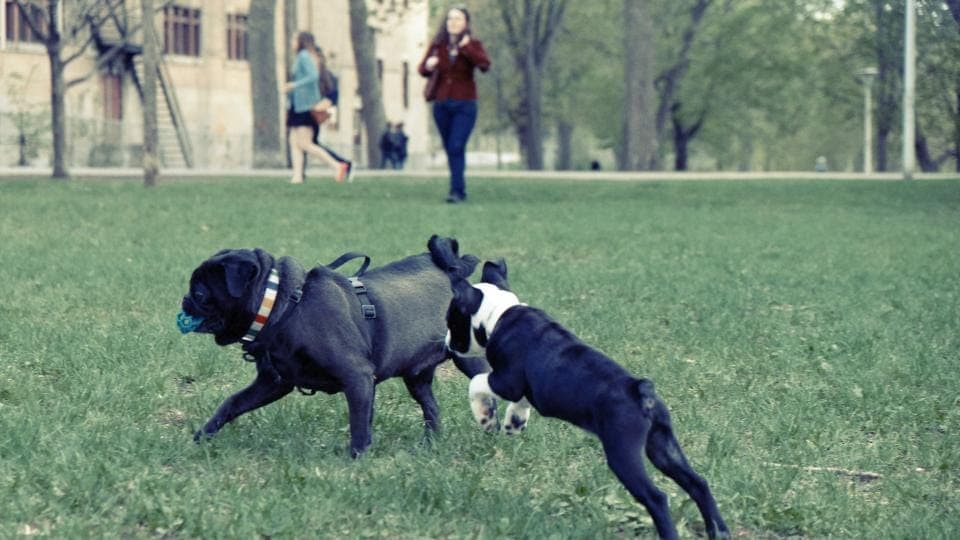
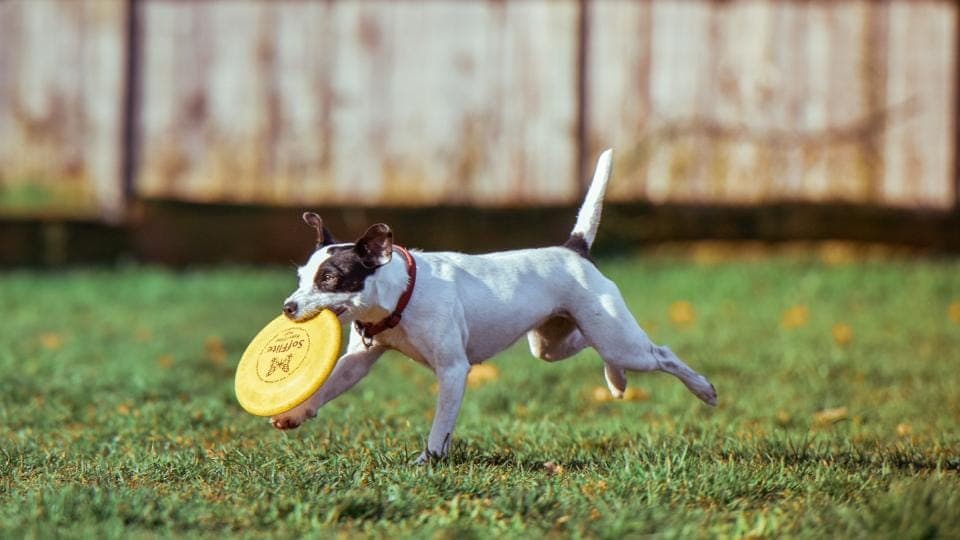
Play is one of the clearest windows into a dog's emotional state. Happy dogs invite play with a play bow, bouncy movements, a relaxed open-mouthed "play face" and exaggerated, inefficient running. Bursts of frantic running, known as the zoomies, are another sign of a dog letting off happy energy.
Restful sleep
Dogs who feel safe sleep deeply and in vulnerable positions: stretched out on the side, or belly up with legs in the air. Our guide to dog sleeping positions explains what each one says about comfort and security.
Appetite and curiosity
A dog who eats with interest, explores new smells on walks and approaches novel things with a relaxed body is showing confidence and wellbeing.
Seeking you out
Leaning on you, following you around, bringing toys and relaxing near you are all signs of a good bond. Our guide to the signs your dog loves you explores the science of canine attachment in more depth.
Things that look happy but may not be
Several common "happy dog" signs can mislead you if you read them alone.
Myth: "A wagging tail means a happy dog." A wag signals arousal and willingness to interact, not necessarily friendliness. Research by Quaranta and colleagues (2007) found that dogs tended to wag more to the right when seeing their owner and more to the left when seeing an unfamiliar, assertive dog, a reminder that wags carry emotional nuance. A stiff, high, fast wag can come right before a snap.
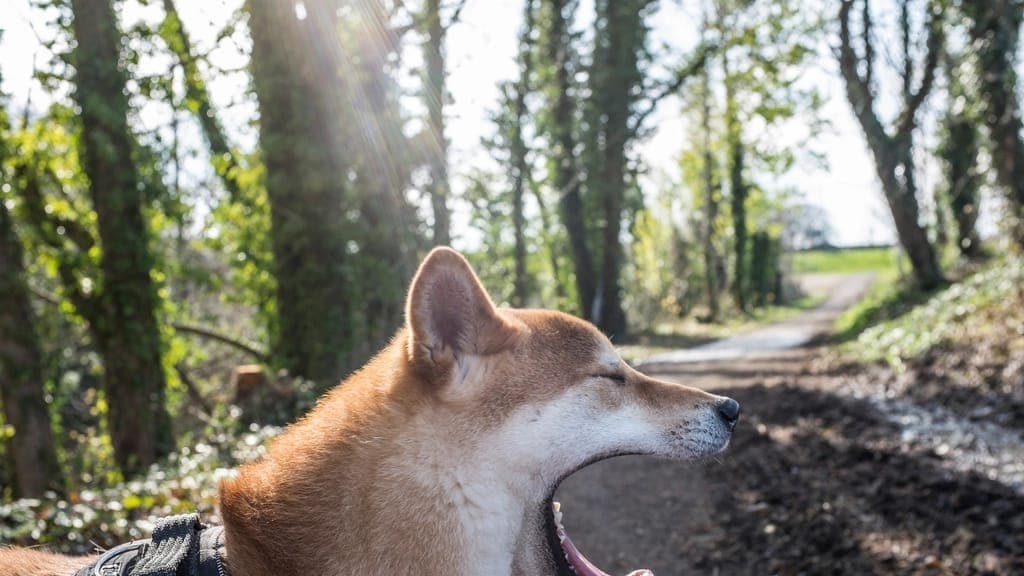
The "smile." A relaxed open mouth is a genuine sign of contentment. But the stress face, with corners pulled far back, a wide tongue and fast panting, can look like a grin in photos. So can the "submissive grin," in which some dogs pull back their lips to show their front teeth while wiggling and squinting. The submissive grin is an appeasement gesture rather than a threat, and it is usually seen in greetings.
The belly-up roll. A dog rolling onto her back can mean "rub my belly," but it can also be an appeasement gesture from a dog who feels uncomfortable. A relaxed dog on her back has a loose body and a soft face; a worried one is stiff, may hold a hind leg tight, and often shows whale eye or lip licking.
Puppy dog eyes. Dogs have a facial muscle that raises the inner eyebrow, making the eyes look larger. Kaminski and colleagues (2019) found this muscle is well developed in dogs but largely absent in wolves, suggesting it evolved alongside humans. It is a powerful communication tool, but on its own it does not tell you whether your dog is happy, hopeful or uncertain.
How to tell if your dog is happy with you: the consent test
A quick way to check whether your dog is enjoying an interaction is to let her tell you:
- Pet her gently on the chest or the side of the neck for three to five seconds.
- Stop and take your hand away.
- Watch what she does. If she leans in, nudges you, or stays close with a soft body, she is enjoying it.
- If she moves away, shakes off, licks her lips or turns her head, she has had enough for now.
Repeat this regularly and you will learn exactly which kinds of touch your dog loves. It is especially useful for guests and children; our guide on how to greet a dog covers it step by step.
Is my dog happy? A quick self-check quiz
Answer yes or no for a typical week:
- Does she eat with interest at most meals?
- Does she sleep deeply and wake up readily?
- Does she play, with you, with toys or with other dogs?
- Does she greet you with a loose, wiggly body?
- Is she curious on walks, sniffing and exploring?
- Can she relax alone for reasonable periods?
- Does she recover within minutes from small frights, such as a dropped pan?
- Does she seek out affection on her own terms?
Mostly yes? Your dog is very likely content. Several no answers, especially recent changes, are worth looking into. For a fun way to sharpen your eye, try our dog body language quiz.
When a usually happy dog changes
A drop in happiness signals is often the first sign that something is wrong. Dogs hide pain well, and reduced play, reluctance to jump or use stairs, sleeping more, a dull expression or loss of appetite may be the only clues.
Vet check: If your normally cheerful dog becomes withdrawn, stops playing, eats less or seems flat for more than a day or two, book a vet visit. Pain, dental disease, arthritis, thyroid problems and many other conditions can show up first as a change in mood.
If health issues are ruled out and she still seems low, especially after a loss or a big life change, our guide to dog depression explains how to help.
Building more happy moments
You can actively increase the time your dog spends feeling content:
- Sniff walks: let her set the pace and explore with her nose.
- Enrichment: food puzzles, scatter feeding, lick mats and safe chews.
- Positive reinforcement training: short, fun sessions build confidence and connection.
- Predictable routines: regular meals, walks and rest times reduce stress.
- Choice: let her opt in or out of petting, greetings and games.
- Rest: most adult dogs need many hours of sleep a day in a quiet spot.
Putting it together
Happiness in dogs looks soft, loose and fluid: gentle eyes, a relaxed mouth, a wiggly body and a balanced stance, backed up by a good appetite, deep sleep, play and curiosity. Check the whole dog, not just the tail or the "smile."
This week, take a few minutes each day to notice your dog when she is relaxed and happy. The better you know that picture, the faster you will spot the moments when something changes.
Frequently asked questions
How can I tell if my dog is happy living with me?
Look at everyday patterns: a good appetite, deep and restful sleep, curiosity on walks, interest in play, and a loose, wiggly body when she greets you. A happy dog seeks your company but can also relax on her own. If she shows these signs most days and recovers quickly from minor stresses, she is very likely content.
Do dogs smile when they are happy?
Many dogs show a relaxed, open mouth with soft corners and a slightly hanging tongue when they are content, which people often read as a smile. That is a genuine sign of relaxation. But a stretched mouth with corners pulled far back and fast panting is a stress face, and a submissive grin is an appeasement gesture, so always check the rest of the body.
Can a dog be happy without wagging its tail?
Yes. Many content dogs keep their tails still or gently swaying at their natural height, especially when resting or settled beside you. Look instead for soft, squinty eyes, a relaxed open mouth, loose muscles, ears in their neutral position and easy, wiggly movement. A quiet tail on an otherwise loose body is often a sign of calm happiness, not a lack of it.
What are signs a dog is relaxed?
A relaxed dog has soft eyes that may squint or blink, a loose or slightly open mouth, ears in their natural position, a neutral tail and an evenly balanced body. When lying down, she may roll onto a hip or her side, stretch out, sigh or rest her head on the floor. Muscles look soft rather than tense.
Why does my dog sigh?
A sigh with half-closed eyes, often as a dog settles down to rest, is usually a sign of contentment and relaxation. A sigh with wide, open eyes while staring at you or the door can mean mild disappointment, such as when a walk or game does not happen. As with any signal, the surrounding body language tells you which one you are seeing.
Sources & further reading
- Quaranta, A., Siniscalchi, M., & Vallortigara, G. (2007). Asymmetric tail-wagging responses by dogs to different emotive stimuli. Current Biology, 17(6), R199-R201.
- Kaminski, J., Waller, B. M., Diogo, R., Hartstone-Rose, A., & Burrows, A. M. (2019). Evolution of facial muscle anatomy in dogs. Proceedings of the National Academy of Sciences, 116(29), 14677-14681.
- Bekoff, M. (1995). Play signals as punctuation: The structure of social play in canids. Behaviour, 132(5-6), 419-429.
- Horowitz, A. (2009). Inside of a Dog: What Dogs See, Smell, and Know. Scribner.
- Aloff, B. (2005). Canine Body Language: A Photographic Guide. Dogwise Publishing.
This guide is for education only and does not replace an in-person assessment. If your dog's behavior changes suddenly, or you are worried about bites or aggression, speak to your veterinarian or a qualified behavior professional. See our disclaimer.