Signals & emotions
Dog Showing Belly Meaning: Why Dogs Roll Over (And Whether to Rub It)
A belly-up dog can be relaxed, playful or worried. Learn to read the whole body before you reach for that belly rub.
Key takeaways
- A dog showing her belly can be relaxed, inviting play, or trying to calm a situation she finds uncomfortable.
- A loose, wiggly body with soft eyes signals comfort, while a stiff body, tucked tail and whale eye signal worry.
- Rolling over when approached is often an appeasement behavior that means 'please go gently', not 'rub me'.
- Use a short pet-and-pause consent test to find out whether your dog actually wants a belly rub.
- Never force a dog onto his back; the 'alpha roll' is based on outdated dominance ideas and increases fear and bite risk.
Jump to a section
- Why do dogs roll on their back?
- Relaxed belly vs. playful belly vs. anxious belly
- Dog rolls over when approached: what it means
- Submissive rolling: what is really going on?
- Does my dog want a belly rub? Try the consent test
- Belly-up during play with other dogs
- When rolling over might be a health clue
- Kids, visitors and belly-up dogs
- Putting it together
A dog showing her belly usually means one of three things: she is relaxed and comfortable, she is inviting play, or she is trying to calm a situation that makes her uneasy. Only some of those moments come with a request for a belly rub, and the rest of her body tells you which one you are looking at.
That is why the belly-up position confuses so many owners. The same rollover can be a sign of deep comfort on the couch and a sign of worry when a stranger leans over a dog at the park. Reading it well means reading the whole dog in context, which is the core skill behind all dog body language.
Why do dogs roll on their back?
Dogs flip onto their backs for several very different reasons. The posture itself looks similar each time, so the motivation has to be read from the face, tail, muscle tone and what just happened.
Comfort and cooling
A dog sprawled on her back with legs flopped open, eyes half closed and a slack mouth is simply comfortable. The belly has thinner fur, so lying belly-up on a cool floor can also help a warm dog shed heat. Many dogs pick this position for naps, a habit you will also see in many dog sleeping positions.
An invitation to play
Dogs often roll onto their backs mid-game. Research on play between dogs found that rolling over is mostly a play tactic, used to dodge, bite at a partner's face or keep a game going, rather than a sign of submission (Norman et al., 2015). Watch for bouncy movements, an open "play face", and alternating roles, often punctuated by a play bow.
Appeasement and conflict avoidance
Some dogs roll over to say "I am no threat, please go easy." This belly-up is usually quick and stiff, paired with ears pinned back, a tucked tail, lip licking or a turned-away head. These are calming signals, and they are a request for space, not an invitation.
Scratching and scent-rolling
A wriggling back-scratch on grass feels good, and dogs also rub their shoulders and necks on strong smells. That shoulder-first roll is a different behavior with its own explanation, covered in why dogs roll in poop and smelly things.
Learned attention-seeking
If rolling over has reliably produced belly rubs, treats or laughter, many dogs repeat it on cue. This is simple learning through positive reinforcement, and it is harmless as long as the dog stays relaxed.
Relaxed belly vs. playful belly vs. anxious belly
Use this table to compare the three most common belly-up states side by side. No single signal is decisive, so look for clusters.
| Body part | Relaxed and inviting | Playful | Anxious or appeasing |
|---|---|---|---|
| Body | Loose, floppy, curved spine | Wiggly, quick to pop back up | Stiff or rigid, may tremble |
| Legs | Splayed and relaxed | Pawing or kicking in play | Held tight to the body, front paw lifted |
| Tail | Loose, may sweep the floor | Wagging broadly | Tucked between hind legs or very still |
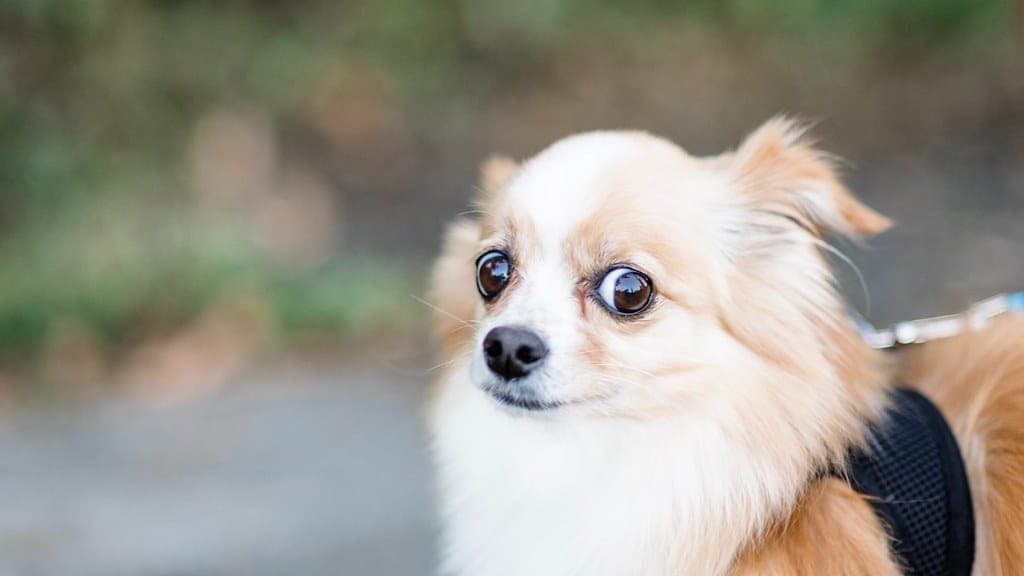
| Eyes | Soft, squinty, normal blink | Bright, engaged, looking at you | Whale eye, averted gaze, wide pupils |
| Mouth | Open, relaxed, tongue may loll | Open "play face" | Closed tight, lip licking, commissure pulled back |
| Ears | Neutral or relaxed back | Mobile and floppy | Pinned flat against the head |
| Duration | Stays put for a while | Rolls in and out of the posture | Brief, often followed by freezing or leaving |
If you see two or three signals from the right-hand column, treat the rollover as a request for space. The dog eye signals guide explains how to spot whale eye, one of the clearest tells.
Dog rolls over when approached: what it means
Picture this: a visitor walks toward your dog, bends down and reaches out. Your dog drops, flips onto her back, licks her lips and looks away. Many people read that as "she loves me, she wants a rub." More often it means "you are a bit much, please slow down."
Rolling over in response to an approaching person, especially one who is looming, unfamiliar or moving fast, is commonly an appeasement gesture. It is the dog's attempt to turn down the social pressure without running or warning. Dogs who are generally shy may do this with most new people, and the behavior often overlaps with scared dog body language.
What to do instead of reaching for the belly:
- Stop moving toward the dog and turn your body slightly sideways.
- Avoid leaning over her or staring directly at her face.
- Crouch at a distance and let her choose whether to approach.
- If she comes over loose and wiggly, offer a brief chest scratch rather than a belly rub.
- If she stays on her back, frozen, simply give her space and try again later.
These steps match how to greet a dog safely, and they build the trust that eventually makes real belly rubs possible.
Safety note: A dog who is anxious and belly-up has fewer options left. If someone keeps reaching in, some dogs escalate to a growl, a snap or a bite from that position. Never let a child or visitor "rub the belly" of a dog who looks stiff or worried.
Submissive rolling: what is really going on?
Owners often call this a "submissive roll", and the term is understandable, but it carries some outdated baggage. Older dominance-based thinking claimed that dogs roll over to acknowledge a "higher rank". Modern behavior science sees the behavior more simply: the dog is uneasy and is using a polite, conflict-avoiding gesture.
Some dogs who roll over this way also leak a little urine, called submissive or appeasement urination. It is not a training failure or defiance, and scolding makes it worse because it adds to the dog's worry. Keep greetings calm and low-key, greet outdoors where possible, and talk to your vet if it persists to rule out a urinary problem.
Myth: "Pinning a dog on his back teaches him who is boss." The so-called alpha roll comes from a misreading of wolf behavior. Forcing a dog into a belly-up position frightens him, damages trust and raises the risk of defensive biting. The alpha dog myth explains why this idea has been abandoned by veterinary behavior organizations.
Does my dog want a belly rub? Try the consent test
The only reliable way to know is to ask the dog, and you ask with a pause. This simple pet-and-pause routine works for belly rubs and for petting in general:
- Wait for your dog to come to you, rather than going to her.
- Rub her belly or chest gently for about three seconds.
- Stop and take your hand away completely.
- Watch what she does next.
- Continue only if she clearly asks for more.
Signs she is saying yes
- She stays on her back with a loose, wiggly body.
- She paws at your hand or nudges you when you stop.
- She shifts closer or rolls to present the belly again.
- Her eyes are soft and her mouth is relaxed and open.
Signs she is saying no thanks
- She rolls back onto her side or stands up and moves away.
- She closes her mouth, freezes or holds her breath.
- She licks her lips, yawns or turns her head away.
- Her back leg stops kicking and goes stiff, or she curls up.
That "scratch reflex" leg kick, by the way, is a spinal reflex. It does not reliably mean your dog is enjoying it, so judge by the rest of her body, not the leg.
Pro tip: Keep each round short. Many dogs who enjoy five seconds of belly rub start to feel crowded at thirty. Short and frequent beats long and relentless.
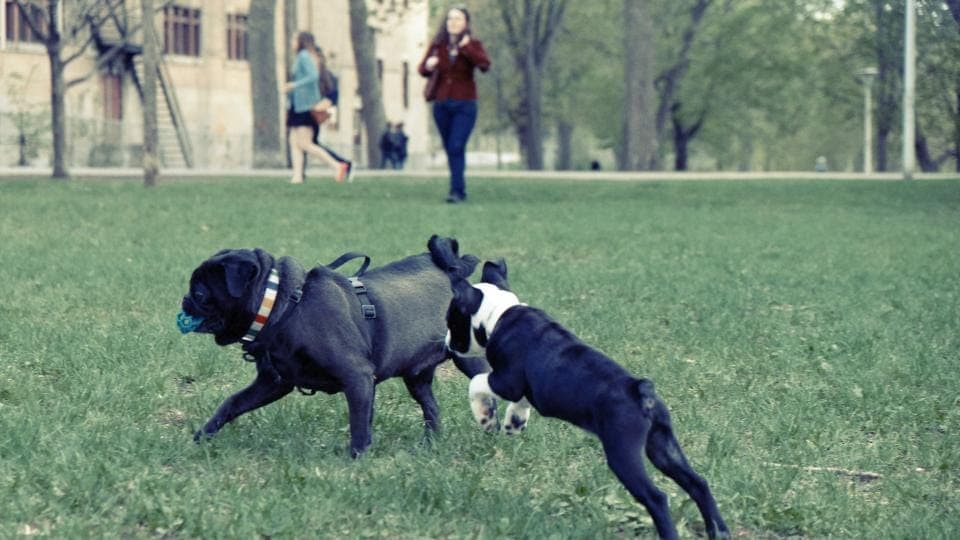
Belly-up during play with other dogs
When two dogs wrestle, one may spend a lot of time on its back. That is usually fine. Healthy play features role reversal, where dogs take turns being on top and underneath, and self-handicapping, where a bigger or stronger dog lowers itself to keep the game fair (Bekoff, 1995).
Watch more closely if one dog is always pinned, never gets up to re-engage, or tries to hide or leave after rolling over. Those are signs the game has stopped being mutual. Our guide to telling whether dogs are playing or fighting walks through the warning signs and how to interrupt kindly with a short break.
When rolling over might be a health clue
Most belly-up behavior is purely social or comfort-related. A few patterns are worth a closer look, because changes in comfortable postures can reflect physical discomfort.
Vet check: Ask your vet to examine your dog if she rolls and rubs her back constantly, chews at her skin or has red, bald or scabby patches, which can point to fleas, allergies or skin infection. Also mention it if a dog who used to sprawl on her back suddenly stops, or yelps when touched on the belly, as back, hip or abdominal pain can change how dogs lie and how they tolerate handling.
Kids, visitors and belly-up dogs
Children are naturally drawn to a dog lying on its back, and they rarely recognize the difference between a relaxed belly and an anxious one. A child reaching for the belly of a worried dog is exactly the kind of situation that leads to preventable bites.
Teach a simple family rule: dogs are petted only when they come over, only on the chest or side, and only for a few seconds at a time. Supervise all interactions, and give your dog a quiet place to retreat. The dogs and kids bite prevention guide has age-appropriate rules and a supervision checklist.
Putting it together
Next time your dog flips over, pause before your hand goes in. Ask yourself three questions: Is her body loose or stiff? Are her eyes soft or showing white? Did she roll over on her own or because someone approached? The answers tell you whether you are looking at comfort, play or worry.
Respect the "no" signals, offer belly rubs only when they are invited, and never force a dog onto her back. For a broader foundation in reading ears, eyes, tail and posture together, keep practising on everyday moments: the more often you check the whole dog, the faster the reading becomes second nature.
Frequently asked questions
Why does my dog show me her belly?
Most often because she feels safe and relaxed with you, or because she is inviting play or attention. Some dogs also roll over to defuse tension when they feel unsure. Look at the rest of her body: soft eyes, a loose mouth and wiggly movement suggest comfort, while a tucked tail, lip licking or a frozen posture suggest she is anxious.
Does a dog showing its belly mean it trusts you?
Often, yes. The belly is a vulnerable area, and a dog who sprawls on her back near you while loose and sleepy is usually comfortable in your presence. However, a quick rollover with a stiff body or averted eyes is not a trust signal. It is a request to slow down, so trust is only part of the story.
Why does my dog roll over when I go to pet him?
He may be asking for a belly rub, but he may also be using an appeasement gesture to avoid a hand coming over his head. If he stays loose, wiggles and leans into your touch, he probably enjoys it. If he freezes, licks his lips or shows the whites of his eyes, pet his chest briefly instead or give him space.
Why does my dog roll on her back and wiggle?
A back-wiggle on grass or carpet is usually a scratch, a stretch, or a burst of happy energy, and dogs often do it after baths or on interesting-smelling ground. It is normal and often playful. If the rolling becomes frequent or frantic and comes with redness, hair loss or chewing, ask your vet to check for itchy skin, fleas or allergies.
Is it bad to rub my dog's belly?
Not at all, as long as your dog wants it. Many dogs love belly rubs from familiar people. Keep sessions short, stop every few seconds to check whether your dog asks for more, and respect a 'no' such as stiffening, moving away or closing his mouth. Children should only pet a dog's chest or side, never reach for the belly of an unfamiliar dog.
Sources & further reading
- Norman, K., Pellis, S., Barrett, L., & Henzi, S. P. (2015). Down but not out: Supine postures as facilitators of play in domestic dogs. Behavioural Processes, 110, 88-95.
- Rugaas, T. (2006). On Talking Terms With Dogs: Calming Signals (2nd ed.). Dogwise Publishing.
- Bekoff, M. (1995). Play signals as punctuation: The structure of social play in canids. Behaviour, 132(5-6), 419-429.
- American Veterinary Society of Animal Behavior. (2008). Position Statement on the Use of Dominance Theory in Behavior Modification of Animals.
- Handelman, B. (2008). Canine Behavior: A Photo Illustrated Handbook. Dogwise Publishing.
This guide is for education only and does not replace an in-person assessment. If your dog's behavior changes suddenly, or you are worried about bites or aggression, speak to your veterinarian or a qualified behavior professional. See our disclaimer.