Quirky behaviors
Why Do Dogs Kick After Pooping? Ground Scratching Explained
That enthusiastic back-leg kick after a poop isn't burying anything. It's scent marking. Here's what ground scratching means and when to manage it.
Key takeaways
- Dogs kick after pooping as a form of scent marking called ground scratching, not to bury their waste.
- Kicking likely spreads scent from sweat glands in the paw pads and leaves a visible scuff, making it a combined smell and sight signal.
- Both males and females ground scratch, though it is often seen more in males and in confident, socially engaged dogs.
- Ground scratching is not a dominance display and does not mean your dog is trying to be the boss.
- You rarely need to stop it, but you can manage it near people, gardens or debris with a rewarded move on cue.
Jump to a section
- What ground scratching actually looks like
- Why do dogs kick after pooping? Scent marking from the paws
- A visual signal too
- Is kicking after pooping a dominance display?
- Who kicks the most?
- Dog kicking grass: reading the context
- When kicking might mean something else
- Should I stop my dog kicking grass?
- What to do next
Dogs kick after pooping to scent mark, a behavior known as ground scratching. The back-leg kicks likely spread scent from sweat glands in the paw pads and leave visible scuffs in the grass or dirt, adding a personal signature and a visual signpost to the spot. It's normal, instinctive communication rather than an attempt to bury waste.
Owners often worry the kick is a sign of dominance, anxiety or bad manners. In reality, ground scratching is one of many ways dogs talk to each other through smell, and reading it in context tells you a lot about how your dog feels in that moment. It's part of the scent-marking toolkit covered in our guide to dog behavior.
What ground scratching actually looks like
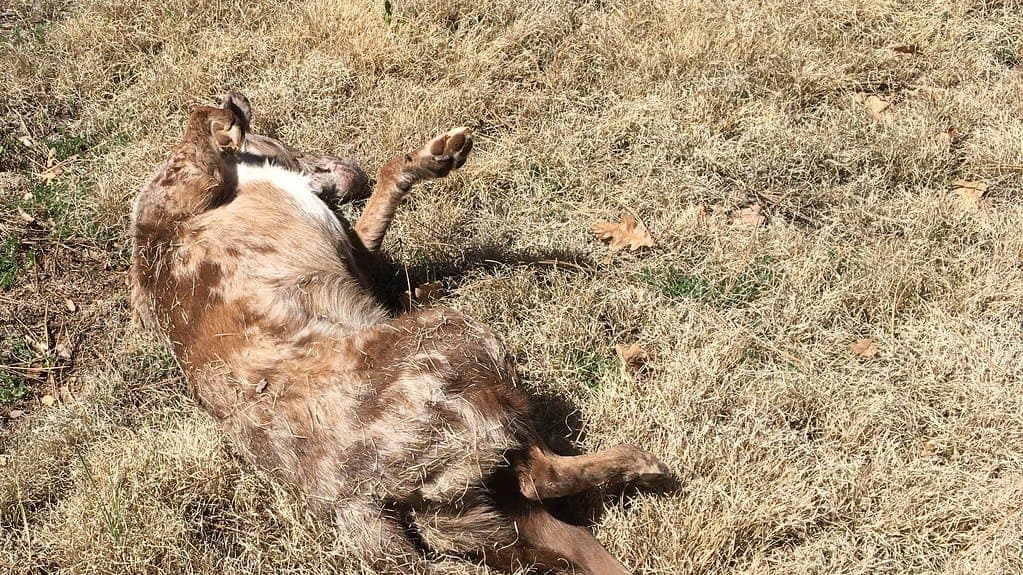
After pooping (or peeing), your dog steps forward, plants the front legs and drives the back feet backward in strong strokes. Sometimes all four feet join in. Grass, dirt and leaves fly. The display usually lasts only a few seconds.
Notice what doesn't happen: your dog doesn't turn around to cover the poop. Kicks usually go away from the deposit and often miss it completely. That's an important clue that the goal isn't hiding, as it is for cats.
Why do dogs kick after pooping? Scent marking from the paws
Dogs have sweat glands in their paw pads. This is one of the few places on a dog's body where sweat glands of this type are found, which is why you may see damp paw prints on a vet's table when a dog is nervous.
When a dog scrapes the ground, these glands, along with general skin scent from between the toes, are thought to deposit an individual odor into the soil. Combined with the much stronger scent of feces or urine, the result is a layered message that says, in effect, "this specific dog was here, recently."
How well dogs read these marks is hinted at by Marc Bekoff's (2001) observations of his own dog. Bekoff moved patches of urine-soaked snow along a trail and recorded how his dog responded. The dog spent less time investigating his own urine than that of other dogs, suggesting dogs can tell their own scent marks from others'.
Pro tip: If your dog sniffs a lamppost for a long time, then pees, then ground scratches, you're watching a full conversation: reading the latest messages, leaving a reply, and underlining it.
A visual signal too
In 1979, Marc Bekoff described ground scratching in male dogs as a composite signal, meaning it combines more than one channel of communication. The scratch marks are visible to other dogs approaching the spot, and the motion itself is a conspicuous display to any dog watching at the time.
That's why ground scratching tends to be more vigorous in places with lots of canine traffic, such as park entrances and popular trees, and sometimes when another dog is in view.
Overmarking and the "reply"
Ground scratching often appears as part of a longer sequence. A dog sniffs a spot where another dog has toileted, then urinates or defecates on or near it, and finishes with a few hard kicks. This layering of a fresh mark over an older one is called overmarking.
Overmarking is common at shared spots and is thought to help dogs keep their own message current. It isn't aggression, and it doesn't mean your dog dislikes the other dog. It's closer to adding a comment to a busy noticeboard.
You'll often see two dogs walking together take turns marking the same post, sometimes several times. As long as both dogs are loose and relaxed, this is ordinary social behavior. If marking comes with stiff posturing or staring between the dogs, watch the body language rather than the marking itself, and give them more space.
Is kicking after pooping a dominance display?
No. The belief that every confident behavior is an attempt to dominate is based on outdated ideas about wolf packs that have been revised by researchers. Veterinary behavior organizations, including the AVSAB, have cautioned against using dominance theory to explain most dog behavior. Our article on the alpha dog myth explains why.
Ground scratching is communication. It may express confidence or social interest, and some dogs scratch more around other dogs, but it isn't a challenge to you or an attempt to control the household.
Myth: "My dog kicks grass because he thinks he's the pack leader." Kicking is a scent and visual signal to other dogs. It has nothing to do with a struggle for rank over people, and correcting it won't make your dog more "respectful."
Who kicks the most?
Ground scratching appears in dogs of every breed and size, and in both sexes. Patterns people commonly notice include:
- Males, especially intact males, often ground scratch more frequently, which fits its role in scent marking.
- Females also do it, and some females scratch as vigorously as any male.
- Confident, socially engaged dogs tend to scratch more than shy dogs.
- Context matters: many dogs scratch more on walks than in their own yard, and more at busy marking spots.
If your dog never ground scratches, that's normal too.
Dog kicking grass: reading the context
The kick itself is rarely concerning, but what surrounds it can tell you a lot. Look at the whole-body posture, not just the feet.
| Context | Likely meaning | Body signals to check |
|---|---|---|
| After pooping or peeing on a walk | Routine scent marking | Loose body, relaxed tail, moves on easily |
| At a busy marking spot, after long sniffing | Replying to other dogs' marks | Focused sniffing, then pee and scratch |
| Another dog is watching nearby | Visual display plus scent | Upright stance, may stare or posture |
| With stiff legs, raised hackles, hard stare | Arousal or tension toward another dog | Freezing, high rigid tail, closed mouth |
| During play or zoomies | Excitement and energy release | Bouncy movement, play bows, open mouth |
If kicking comes with stiffness or raised hackles toward another dog, the important signal is the tension, not the scratching. Give space and calmly move your dog on.
Dog scratching ground after pooping but not after peeing
Some dogs only scratch after defecating, others only after urinating, and some after both. There's no evidence that one pattern is more meaningful than another. It mostly reflects individual habit and the setting.
When kicking might mean something else
Occasionally, scratching or pawing at the ground isn't scent marking at all.
- Digging. Sustained pawing with the front feet, often with the nose involved, is digging rather than ground scratching. See our guide to why dogs dig for the reasons behind it.
- Bed-making. Scratching at bedding or the floor before lying down is a nesting behavior, often paired with circling before lying down.
- Discomfort. Repeated kicking, shaking or licking a foot, or scooting the rear, can mean something is stuck in a paw, the skin is itchy, or the anal sacs need attention.
Vet check: If your dog suddenly starts kicking, licking or shaking one paw, limping, or dragging the rear along the ground after toileting, check for grass seeds, cuts, burrs or swelling, and see your vet if the problem persists or your dog seems in pain.
Should I stop my dog kicking grass?
In most cases, there's no reason to. Ground scratching is a natural, satisfying behavior, and dogs benefit from being able to perform normal canine behaviors. There are a few times when gentle management makes sense.
When to manage it
- Lawn or garden damage. Some dogs leave bare patches.
- People nearby. Dirt and grass flying at other walkers or children.
- Unsafe surfaces. Gravel, broken glass, sharp mulch or hot pavement can injure paw pads.
- Dog park etiquette. Kicking debris at other dogs or owners can create friction; our guide to dog park etiquette covers other courtesies too.
How to redirect kicking kindly
- Pick up the poop first, so your dog isn't kicking it around.
- Teach a "let's go" cue. At home and on easy walks, say your cue cheerfully, take a step away, and reward your dog for following.
- Use it right after toileting. As soon as your dog finishes, cue "let's go," and reward when they walk on with you.
- Choose the spot. Walk your dog to a patch of grass or soil away from people and sharp surfaces before they toilet.
- Keep it positive. Don't yank the leash or scold. Your dog isn't misbehaving, and a correction can make toileting on leash stressful.
Pro tip: If your yard is suffering, create a designated toilet area with mulch or soil that your dog can kick freely, and reward them for using it.
What to do next
Kicking after pooping is a normal and fascinating part of how dogs communicate with scent. It isn't burying, it isn't dominance and it rarely needs fixing. Read it with the rest of your dog's body, manage it where it's inconvenient, and enjoy watching your dog leave a message for the neighborhood.
To understand the rest of the scent conversation, read about why dogs sniff each other's butts, and find more everyday quirks explained in our dog behavior guide.
Frequently asked questions
Why do dogs kick after pooping?
Dogs kick after pooping to scent mark. The behavior, called ground scratching, likely spreads scent from sweat glands in the paw pads and leaves visible scrapes in the grass or dirt. It adds a personal signature and a visual flag to the marking site, telling other dogs who was there. It is a normal, instinctive canine behavior.
Why do dogs scratch the ground after pooping instead of burying it?
Unlike cats, dogs are not trying to cover their waste. If they were, they would face the poop and push dirt over it. Instead, dogs usually kick backward and away, often scattering grass without hitting the poop at all. That pattern fits advertising their presence through scent and visual marks rather than hiding it.
Should I stop my dog kicking grass?
Usually no. Ground scratching is a harmless, natural behavior that many dogs find satisfying. Manage it when it damages a lawn, sprays dirt at people, or happens on surfaces that could hurt the paws, like gravel or glass. Teach a cheerful let's go cue and reward your dog for walking on with you after toileting.
Is a dog kicking grass a sign of dominance?
No. Ground scratching is scent and visual communication, not an attempt to dominate other dogs or people. The idea that dogs are constantly trying to rise in rank over their owners is outdated. Dogs who kick a lot are often simply confident, socially interested and keen to leave a mark where other dogs will notice.
Why does my dog kick after peeing too?
Ground scratching can follow urination as well as defecation, because both are ways of leaving scent marks. Some dogs, especially intact males and confident females, kick after nearly every pee on walks, particularly at popular spots like lampposts and park entrances where many other dogs have left their own marks.
Sources & further reading
- Bekoff, M. (1979). Ground scratching by male domestic dogs: a composite signal. Journal of Mammalogy, 60(4), 847-848.
- Bekoff, M. (2001). Observations of scent-marking and discriminating self from others by a domestic dog (Canis familiaris): tales of displaced yellow snow. Behavioural Processes, 55(2), 75-79.
- Horowitz, A. (2009). Inside of a Dog: What Dogs See, Smell, and Know. Scribner.
- American Veterinary Society of Animal Behavior. (2008). Position Statement on the Use of Dominance Theory in Behavior Modification of Animals. AVSAB.
This guide is for education only and does not replace an in-person assessment. If your dog's behavior changes suddenly, or you are worried about bites or aggression, speak to your veterinarian or a qualified behavior professional. See our disclaimer.